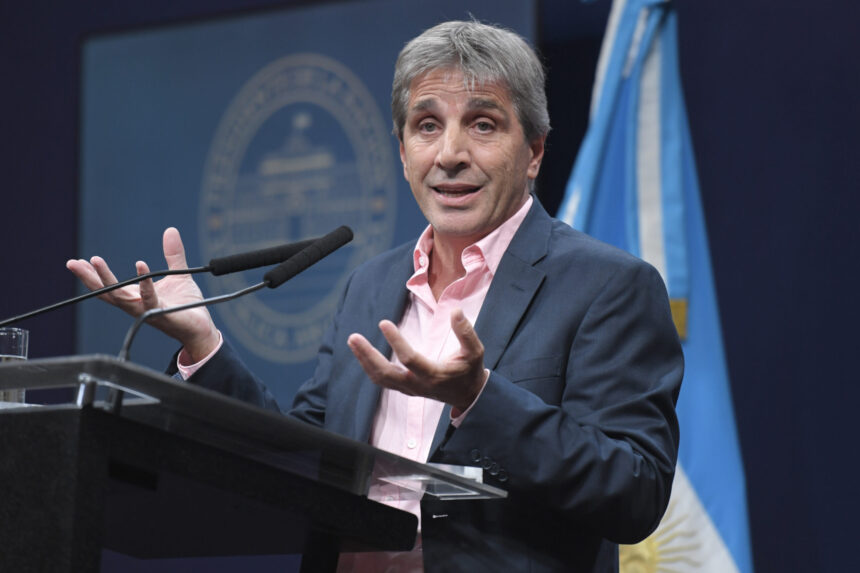
Economy Minister Luis Caputo expressed confidence that President Javier Milei will be reelected in the 2027 presidential race in Argentina after the economy rebounds strongly in the coming months.
During an interview with Cadena 3 radio station on Monday, the official said that there is “zero risk” of Kirchnerism returning to power, even if the libertarian does not win.
“It is so obvious that Milei will win by a landslide. People will realize this before that happens, and there will be fierce economic growth,” Caputo predicted, trusting that the current economic problems will “be solved much earlier” than the election.
The minister projected that the strongest recovery would begin in May or June. He said the disinflation process remains underway and will be key to the rebound.
“By the end of June, work will be underway on virtually all 9,000 kilometers of highway corridors. That will give a strong boost to the construction sector,” he assured.
The minister considered that “there are no chances” of the economy being as “volatile” this year as it was during the 2025 legislative election campaign, when inflation went up amid uncertainty of who would win.
“Milei will win in the first round, and comfortably so,” he stressed in comments that seemed to be aimed at possible investors in the country.
You may also be interested in: Argentina ranks among 10 hardest countries in the world to do business in
Kirchnerism
Minister Caputo also said that “there are no chances” of Kirchnerism returning to power, despite certain polls that suggest that possibility.
“Kirchnerism is not an option even if we lose, because everyone knows that that would be hell,” Caputo said. “Most people don’t want to return to hell. There is no way.”
The remark appeared aimed at Buenos Aires Province Governor Axel Kicillof, who is widely seen as the most likely Peronist candidate in the 2027 presidential election.
Kicillof served as economy minister during the presidency of former leader Cristina Fernández de Kirchner (2007–2015), though he is now at odds with her. Kirchner is currently under house arrest after being sentenced on corruption charges.
According to Caputo, Kicillof will not be an electoral threat, even if he allies with others outside of hardline Kirchnerism.
“This will be the first time we will be growing for four years in a row. Argentines are not stupid. They can measure the president’s popularity and say it has gone down, but even if you give people a ballot box tomorrow, they will still not vote for Axel Kicillof, because he is hell.”
Caputo added that once “communism and socialism stop being an option,” Argentina “will start behaving like a normal country, where the left, center or right can win, but you still go down the same path, and rules remain the same.”
Macri
Caputo distinguished the economic growth that “is coming” from the one experienced during the first years of the government of center-right president Mauricio Macri (2015-2019), of which he was also part.
He said now there is “an euphoria for investing in the real economy” instead of in finance, as occurred during the Macri years, when he was finance minister.
“Many people make the mistake of linking this government to Macri’s, simply because it is not Peronist. In terms of economic policy, this administration is not only different from Macri’s, it is the opposite,” he said.
The minister affirmed that while Macri “inherited deficit levels very similar to what President Milei inherited,” the former kept the levels high, while the libertarian leader has had zero deficit since he took office in December 2023, a policy at the heart of Milei’s economic plan.
While Macri’s party, PRO, had been a loyal ally of Milei since the start of his administration, it recently distanced itself from him amid a corruption scandal involving Chief of Staff Manuel Adorni.
Caputo’s comments come at a time when inflation seems to be slowing down after months going uphill. The figure dipped to 2.6% in April, almost one percentage point below March, marking the first time in eleven months that the inflation rate has slowed, according to statistics agency INDEC.
At the same time, the government points to growth in sectors such as mining, fishing, agriculture and finance. Critics, however, note that those industries generate relatively few jobs, at a time when employment, wages and mass consumption are falling sharply.
You may also be interested in: Argentina posts primary fiscal surplus of 0.5% of GDP in the first four months of 2026