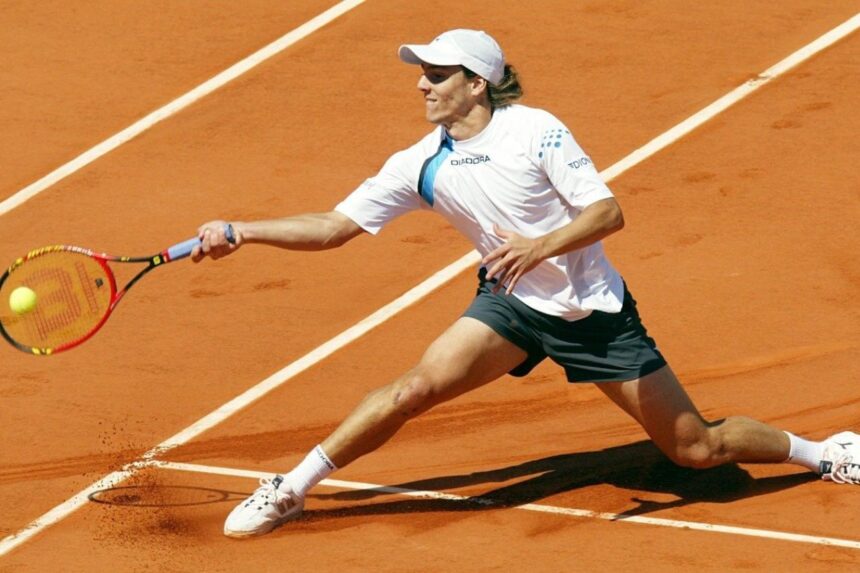
Tennis players having breakdowns in the middle of a match isn’t exactly new. From John McEnroe’s iconic “you cannot be serious” to Serena Williams’ clashes with linesmen and umpires at the US Open, few stars have ever been able to keep their composure at all times.
However, in Argentine tennis one particular meltdown has reached near-mythical status: Gaston’ Gaudio’s shouting “qué mal que la estoy pasando,” roughly “what an awful time I’m having.”
Part of a tirade that went throughout a hard-fought, five-set win for Gaudio against Russia’s Igor Korolev, at Roland Garros 2006, the phrase became so linked to him that, years later, he repeated it at a star-studded ad for telecommunications company Claro, in which he was linked to a marriage to a famous model on live television.
The rant turns 20 this June, with the 2026 tournament getting underway on May 24th. But while the meltdown is certainly one of Gaudio’s most infamous moments, it’s certainly not his most important one as a tennis player.
A precocious talent
Born in Temperley, in the southern Buenos Aires Metropolitan Area, on December 9, 1978, Gaudio grew up in the bosom of an upper-middle-class family. The youngest of three brothers, he began playing tennis at age 6.
Former coach Roberto Carruthers recalled in 2004 how Gaudio used to sneak away from school to go to the club and play, but even back then, his talent was apparent.
A fervent fan of Argentine football giant Independiente, he split his time between tennis and football until his father had a heart attack that put his life at risk when Gaudio was 14. The situation forced him to consider focusing on tennis as a way to become a professional and make a living.
Having missed out on a new player development plan, the Argentine Tennis Association (AAT, for its Spanish initials), Gaudio — like many others in the generation that went on to become the Legión Argentina — had to take loans to fund his progress through the ranks.
He quickly became one of the standouts, finishing the 1996 junior tennis season as Argentina’s second-best-ranked player behind Mariano Puerta, and turned pro that very year.
A love-hate relationship with tennis
Fast and strong, and with one of the most beautiful and effective one-handed backhands of his era, Gaudio complemented his game with plenty of finesse and panache for skill shots to go with it.
“His problem was never tennis,” Carruthers told Clarín in 2004. “It is his head that always lets him down.”
Gaudio had all the tools to become a top player, but struggled to deal with mistakes and demanded too much of himself. In a 2006 interview with ESPN, he admitted “sometimes tennis was the sport he hated the most.”
Cemented as a top-50 player in the Association of Tennis Professionals (ATP) singles rankings by 2000, Gaudio’s career’s biggest rivalry began to develop around this time: his clash with Guillermo Coria.
It all started at the 2001 Viña del Mar tournament final, when Gaudio took issue with Coria’s Marcelo Salas-inspired celebrations after beating him. He had his revenge seven days later, waving an Independiente flag after beating Coria in the Buenos Aires Open quarterfinals.
The boiling point came in 2003, when they clashed in the ATP Hamburg Masters semifinal.
Gaudio felt Coria was mocking him after he limped to the net following a 6-0 win in the final set. He didn’t wait for retaliation, shouting: “What’s your problem? If you look at me like that, I’ll f*cking batter you, idiot.”
It set up the perfect scene for Gaudio’s greatest hour: Roland Garros 2004
Roland Garros champion
Coming to the French Open, he was far from the favorite. Even among the Argentines, Coria was coming off a Montecarlo Masters win, while David Nalbandian had just lost the Rome Masters final.
However, Gaudio beat Australia’s former World No.1 Lleyton Hewitt to reach the semifinals, and then took out another of the favorites in Nalbandian, setting up a final against Coria.
The face-off quickly looked like it would be a nightmare for Gaudio, as Coria raced to an early 6-0, 6-3 lead. But when the stakes rose, and the trophy came into view, things changed.
The crowd started a stadium wave at 4-3 in the third set; Gaudio took the interruption in stride and came alive, and Coria seemed to crack. He started to cramp up and dropped the next two sets, 6-4 and 6-1, and the match headed to a final set tied at 2-2.
Coria made one last stand in the fifth set and even had two match points at 6-5 up, but missed both. When opportunity came knocking at his door, Gaudio took it and won against all odds to become only the second ever men’s Argentine tennis player to win a Grand Slam after Guillermo Vilas.
Life after Roland Garros
It was the only final Gaudio won all year. Having shot up to 10th in the ATP rankings, he lost the deciders at Bastad, Stuttgart and Kitzbühel. He’d have his most successful season the following year, with five titles — including the Buenos Aires Open — and a run to the ATP Tennis Masters Cup semifinals.
It was just two years removed from his greatest hour when, struggling for results and motivation, he uttered perhaps his most famous phrase. By the end of 2006, he had dropped out of the top ten, and he retired in 2010 after attempting several comebacks.
In 2018, he was named captain of the Argentine Davis Cup team, but left in 2021 after mixed results and was replaced by his longtime rival, Coria.
Since 2018, he’s been in a relationship with model Helena Ayerza, with whom he fathered a child.
Gaston Gaudio’s legacy is one of opportunities taken when they presented themselves.
One of the most talented players in a generation that put Argentine tennis back on the front pages, his love-hate relationship with the sport limited his chances. However, where the likes of David Nalbandian, Guillermo Coria, Juan Ignacio Chela or Juan Mónaco could not take the final step, he did.
Unbeatable on a good day and a joy to watch for tennis fans, Gaudio may have had “an awful” time on the courts at times, but he wrote one of Argentine tennis’s brightest pages.