“The Malvinas Islands are Argentine.”
The message, hastily painted on a piece of cloth from a hotel sheet, was secretly brought into the stadium where Argentina was facing England for the semifinals of the men’s football World Cup on July 15 by an Argentine fan and dropped onto the field for the national team’s players to pick up and celebrate with after their win.
It revived a centuries-old debate.
Who do the Malvinas — or Falklands, as the United Kingdom refers to them — belong to?
🗣️ “FUE UN MOMENTO ÚNICO. ES PARTE DE NUESTRA HISTORIA”
🇦🇷 Lisandro Martínez se refirió a la bandera con la leyenda “Las Malvinas son argentinas” que desplegó la Selección Argentina tras vencer a Inglaterra en la Copa del Mundo 2026:
“Fue un momento único. La verdad que bueno,… pic.twitter.com/GSbvTHFOjk
— dataref (@dataref_ar) July 26, 2026
Photos and videos of Argentina’s footballers holding the banner went viral on social media and appeared on the front pages of news outlets around the world after the match. The International Federation of Association Football (FIFA) had banned political banners and messages inside the stadium.
Argentina defeated England 2-1, adding a new chapter to the football rivalry between the two countries that dates back to 1986, when the South American team, lead by Diego Maradona, eliminated the British in one of the most famous World Cup matches in history.
But, as in Mexico 1986, it was more than just a football game. Politics surrounded the entire encounter, creating tension on and off the pitch.
After Argentina’s latest triumph, local media and fans used the victory to highlight the country’s claim over Malvinas, while UK outlets and even the government refused to discuss the matter.
“The World Cup might not be ours, but the Falkland Islands definitely are,” the UK government spokesperson said.
The debate, however, is far from over.
This is what you need to know about the Malvinas conflict.
Editorial disclaimer: Although the UK refers to the territory as the “Falkland Islands,” Argentina strongly contests this name. The Buenos Aires Herald uses “Malvinas” to refer to the islands.
What are the Malvinas Islands?
The Malvinas are the two main islands of an archipelago that also includes the South Georgias, the South Sandwich Islands, and around 700 smaller formations. They are located in the South Atlantic Ocean, about 500 kilometers from the Patagonian coast — an area that Buenos Aires considers part of the Argentine Sea.
The islands are on the Patagonian shelf, meaning they are geographically connected to continental Argentina.
They have been under British control since 1833 and currently have a population of around 3,600 people, most of whom are of British descent.
The UK considers them an overseas territory called the Falkland Islands, but they are self-governed.
Argentina, however, has demanded sovereignty over the islands since the arrival of the British settlers in 1833.

Who populated the Malvinas Islands originally?
While some archaeological discoveries indicate there may have been temporary Indigenous presence before European colonization, the islands had no permanent Indigenous population or settlements before the arrival of Europeans.
Over the past four centuries, there have been Spanish, French, British, and Argentine settlements, with some lasting longer than others, followed by competing claims over the territory.
Who discovered the Malvinas?
Following the Spanish colonization of what is now Argentina, in 1516, a group of Spanish explorers first sighted the Malvinas during an expedition in 1520 and registered them as part of the territory of the Spanish Empire.
The government of the Falkland Islands says on its website, however, that the first reported sighting was made by British Captain John Davis in 1592 and that British Captain John Strong was “the first person to have been recorded as landing in the Islands.”
Strong “spent several days in the Islands” and named them Falkland Sound after Viscount Falkland, one of the owners of the ship he was traveling on.
Who was the first to settle in the Malvinas?
Spain’s domain over South America, including the maritime territories and islands, was “undoubtedly preserved” in several treaties signed with other empires throughout the 16th and 17th centuries, according to a document on the history of the islands published on the Argentine Foreign Ministry’s website.
In the mid-18th century, France and Great Britain began taking interest in the islands due to their strategic location. France established a settlement there in 1764 and called them Îles Malouines, a name that would later transform into “Malvinas.”
In 1765, a British expedition arrived on one of the islands of the archipelago and planted a British flag, with settlers arriving later on.
After finding out, Spain protested both settlements. France agreed to leave the islands and recognized the Spanish sovereignty over them, following diplomatic negotiations. The British left their settlement in 1774 after an armed battle and negotiations between the crowns.
In 1767, the Spanish king formalized his domain over the islands, making them the administrative responsibility of Buenos Aires and sending a governor to rule over the Malvinas.

On May 25, 1810, Buenos Aires declared its independence from Spain. The new government of the Provincias Unidas del Río de la Plata included the Malvinas as part of its territories — now independent from the Spanish crown — as recorded in several documents of the time.
This showed “institutional continuity” between the colonial and the independent governments, lawyer Guillermo Carmona, former Malvinas, Antarctica, and South Atlantic secretary of the Argentine state (2021-2023), told the Herald.
In 1820 the new government sent David Jewett, a colonel of the Argentine Navy, to the islands, and he raised the Argentine flag in the Malvinas for the first time.
This was followed by several attempts to establish permanent settlements by tradesmen Luis Vernet and Jorge Pacheco. Vernet finally succeeded in 1829, becoming the first political and military commander of the islands under Argentine rule.
Vernet settled there with his family and dozens of settlers, including gauchos who were in charge of working the land and raising cattle. The first recorded child to be born there was Vernet’s daughter Matilde “Malvina” Vernet y Sáez.
“An Argentine community began developing there, in what was a reflection of the continental Argentine society of the time,” Carmona described. “There was a government, there was a population, there were social relations, there were relations with the continental territory,” he added.

When did the sovereignty dispute begin?
Following an attack from American sea lion hunters in 1831, which disrupted order and left considerable damage in the Puerto Soledad settlement, on January 3, 1833, the British Royal Navy arrived at Puerto Soledad, then capital of the Malvinas, and demanded the Argentine authorities surrender and hand over control of the territory.
“During that attack, most of the people who were living there were detained, put on a ship, and sent to Buenos Aires,” Carmona said, describing this event as an “invasion.”
The Falkland Islands government describes on its website that a visit from the Argentine military carried out in 1832, following the U.S. attacks, attempted to “establish sovereignty” over them, “disregarding the British claim of 67 years prior.”
They added that, after the 1833 eviction carried out by the Royal Navy, “the civilian population, who had sought permission from Britain to live there, were invited to stay,” and in 1834, “a small, permanent British administration was established.”
The settlement would grow to the 3,600 inhabitants it has now.
Carmona explained that some of the members of the Argentine population in Malvinas who stayed resisted the British occupation, including gaucho Antonio Rivero, who finally was taken prisoner and tried in London.
There, however, the judiciary determined that “it had no jurisdiction to make a ruling over Malvinas.” Rivero was released and sent to Montevideo. “This is a very clear precedent of British institutions recognizing they had no jurisdiction in Malvinas,” Carmona stated.
Argentina never regained control over the islands after that, despite numerous diplomatic complaints filed during the past two centuries, first with British authorities and, after 1960, with international forums.
The conflict would peak in 1982 when the military dictatorship ruling Argentina declared a war and sent Argentine forces — many of them young, untrained soldiers — in an attempt to regain control over the Malvinas. 649 Argentines, 255 British and three islanders died during the Malvinas War.

What did the United Nations say?
In 1965, the United Nations formally acknowledged Argentina’s sovereignty claim over the Malvinas, South Georgia, and South Sandwich Islands and their surrounding maritime areas and recognized an ongoing dispute with the UK over them.
The UN qualified the dispute as a colonization issue. Since then, the international body has consistently urged the two countries to arrive at a peaceful solution, in line with the organization’s goal to end decolonization around the world.
For the past four decades, the Special Committee on Decolonization has renewed its call every year for a peaceful resolution to the Malvinas issue.
“The war led to a huge setback in terms of the diplomatic developments that had been reached (until 1982),” Carmona said.
While the UK and the islanders have defended the Malvinas’ population right to self-determination, the UN established in 1965 that this right is not applicable to them because the population arrived after the territory was colonized and is therefore a “special and particular” case of colonization.
In 2013, a referendum was carried out in the islands in which virtually all inhabitants voted to remain an overseas British territory.
In contrast, a recent survey conducted in the UK by the More in Common organization showed that only one in 10 young British people thinks it’s “very important” to keep sovereignty over the islands.
Yesterday, in powerful statements, democratically elected members of @FIAssembly, Dot Gould MLA and Michael Goss MLA, put self-determination and the people of the Falkland Islands, front and centre, as they addressed the @UN Special Committee on Decolonization. #Falklands 🇫🇰🇬🇧🇺🇳 pic.twitter.com/noEmTyHE5Z
— FIG Representative to the UK and Europe (@FalklandsRepUK) June 26, 2026
The Malvinas banner displayed by the Argentine players after the match against England brought attention back to the issue and restarted a debate that some may have thought was settled. On social media, some British content creators joked that they cared more about winning a World Cup than keeping the islands.
“What the Argentine players did visibilized the issue of a colonial situation existing in the 21st century. I believe this has made the United Kingdom uncomfortable, and I think it’s helping to put pressure on them to comply with international law, but it doesn’t replace diplomatic action,” Carmona said.

What is President Milei’s position?
In recent years, Argentine President Javier Milei has vowed to “recover” the country’s sovereignty over the Malvinas Islands via diplomacy and has even argued that his economic policies would help the deed.
Milei questioned the display of the Malvinas banner during the World Cup, saying sports “should not be mixed” with politics. However, he said that what players do on the field is “not part of diplomacy.”
Following the game, he posted on X that “while some dedicate themselves to ranting like mono-neuronal teens,” his government is “getting closer to recovering the Malvinas Islands through the diplomatic path.”
Now, he said, it is necessary to “sit down” with the UK to talk. “Part of the English considers that they should return the Malvinas to us because they are ours,” he added.
Editorial disclaimer: Although the UK refers to the territory as the “Falkland Islands,” Argentina strongly contests this name. The Buenos Aires Herald uses “Malvinas” to refer to the islands.
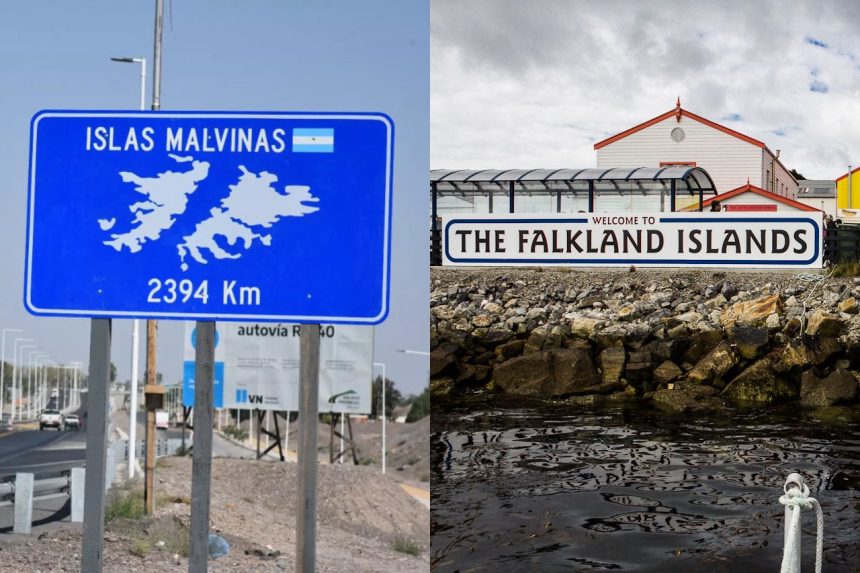
Cover image credits: Left: social media. Right: Alex Petrenko on Wikimedia Commons.