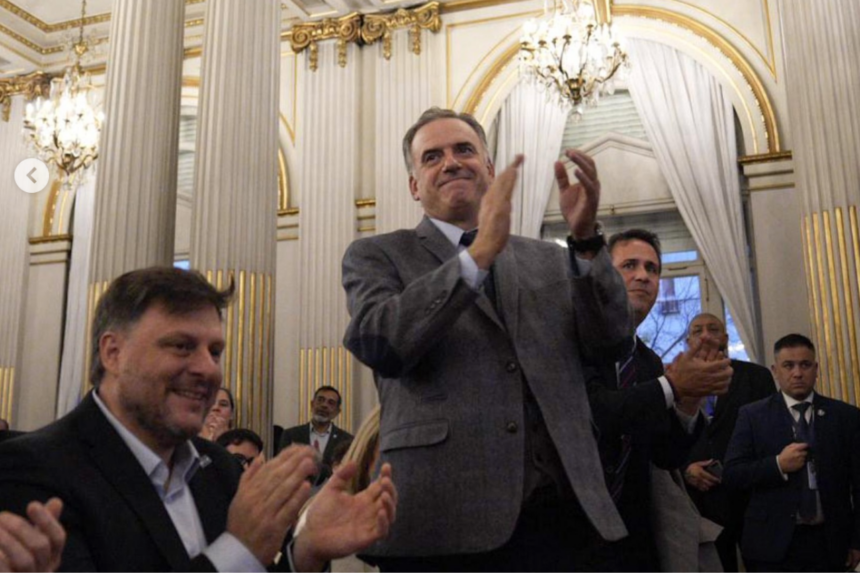
Uruguayan President Yamandú Orsi was present in the Buenos Aires City Legislature on Thursday for a tribute to four Uruguayan political activists who were kidnapped and murdered 50 years ago in Argentina as part of Operation Condor.
Those who were honored were former lawmakers Zelmar Michelini and Héctor Gutiérrez Ruiz, and Tupamaros militants Rosario Barredo and William Whitelaw.
Michelini, also a founder of the governing Frente Grande (Broad Front) coalition, and Gutiérrez Ruiz, a member of the National Party and former lower house president, were living in exile in Buenos Aires due to Uruguay’s civic-military dictatorship.
They were kidnapped on May 18, 1976, along with Barredo and Whitelaw, who were also escaping the dictatorship.
The four of them were illegally detained in a clandestine detention center in the Argentine capital.
Their bodies were found riddled with bullets inside an abandoned car two days later, and subsequent judicial investigations determined that the crimes were committed as part of Operation Condor, the coordinated campaign carried out by Southern Cone dictatorships to persecute, kidnap, and eliminate political opponents.
The case became a symbol of state terrorism in the Río de la Plata region.
“I want to acknowledge and thank the solidarity of the Argentine people, who for so many years took care of our people,” Orsi told the press after the event, given he did not give a formal speech.
“In this case, there were four murders, but let’s not forget that many people were saved thanks to the Argentine people who took them in and helped them,” the Uruguayan president said.
The event
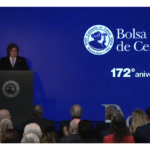
The ceremony honoring Michelini, Gutiérrez Ruiz, Barredo and Whitelaw, was carried out on Thursday evening at the Buenos Aires City Legislature, with the singing of both national anthems followed by a minute of silence for the victims of Operation Condor and the presentation of commemorative plaques
In a speech, Buenos Aires lawmaker Leandro Santoro stated that the four Uruguayan activists represented what the dictatorships wanted to eliminate: “They went after activists from different political backgrounds who had a vocation for democracy, for fighting authoritarianism, seeking human dignity and defending human rights.”
Uruguayan Ambassador to Argentina Diego Cánepa Baccino said that exercising memory “is not just complying with a protocol.” Instead, a society must know where it comes from to move forward, he affirmed, adding that the deaths of the four activists had “a huge impact” in Uruguay at the time.
Among the cross-party delegation accompanying Orsi were not only representatives of the Executive Branch such as Vice President Carolina Cosse and the Presidential Secretary Jorge Díaz, but also opposition figures such as former President Julio María Sanguinetti, symbolizing the rejection by the entire Uruguayan political spectrum of one of the emblematic episodes of state terrorism during the 1970s.
“For those of us on the side of democracy, in these cases there is no government or opposition,” Orsi said, consulted about the presence of the opposition members.
Santoro highlighted the presence of Orsi and Sanguinetti, saying that “that is the best homage, building a consolidated democracy where people can meet and talk despite the differences.”
Also in attendance were the families of those being honored, as well as Argentine human rights activists such as Nobel Peace Prize laureate Adolfo Pérez Esquivel and Argentine politicians from several parties.
Also among the audience were young people whose identities were restored thanks to the work of the Grandmothers of Plaza de Mayo, including Mariana Zaffaroni and Carlos D’Elía, children of disappeared Uruguayan activists.