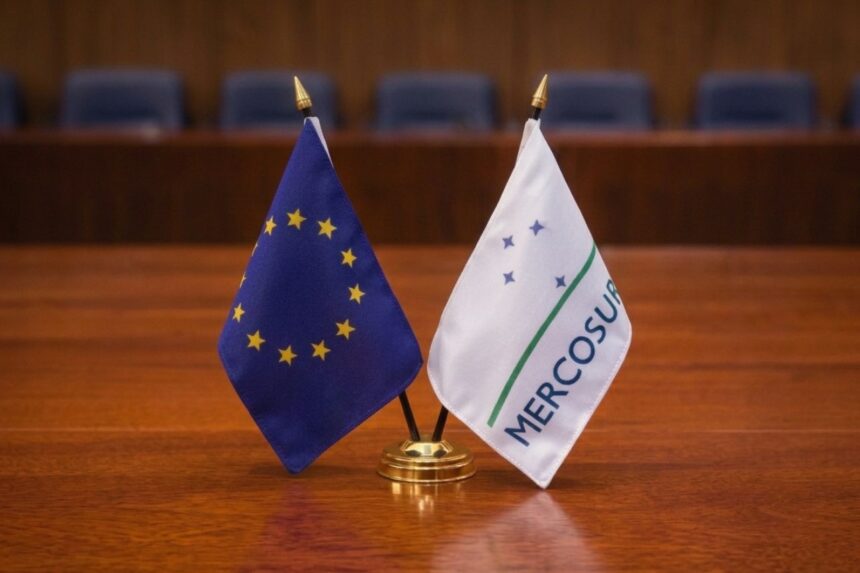
The free trade agreement between the European Union (EU) and Mercosur is one of the largest and most ambitious in the world, according to diplomats from the EU, Spain and Catalonia. But for it to be fully implemented, the economies of both blocs will have to adapt to competition and new trade rules.
Although its signing — after more than 20 years of negotiations — marks a historic milestone and promises a sharp rise in Argentine exports and investment over the coming decades, that outcome can’t be reached without some “sacrifices.”
The warning came from Spain’s ambassador to Argentina, Joaquín María de Arístegui Laborde, at the Catalonia-Southern Cone Economic Forum held at the Argentine Chamber of Commerce.
Arístegui warned that “nothing is magic or free — it’s going to demand sacrifice.” He stressed that the free trade agreement “is a bet on shared prosperity” between the two blocs, but that it will inevitably require “legal and commercial changes,” among other adjustments.
“Do you really think that when Spain joined the EU it didn’t sacrifice anything?”, the Spanish diplomat said, noting that since joining the European bloc, the Spanish economy is now the one that “has contributed the most growth and the most jobs” to the EU in recent years.
Along similar lines, the Catalan government’s delegate for the Southern Cone, Josep Vives i Portell, recalled that in the run-up to Spain’s entry into the EU “there was a lot of skepticism,” but pointed to its positive impact, especially in major Spanish cities like Madrid, Barcelona and Bilbao.
“This is going to be very complicated, but it’s going to be exciting,” Vives said, adding that “when we look at this thicket of regulations” — a reference to the 4,000 pages that make up the agreement — “we shouldn’t be scared; on the contrary, it should spur us on.”
The impact on the Argentine industry
At another point in his remarks, Arístegui acknowledged that “we’ll have to see what impact it has on the province’s industry” — referring to Buenos Aires Province.
He added that “the success of this agreement will depend on ordinary citizens noticing it, not just honey producers,” a reference to the first shipment of Argentine honey under the agreement.
Buenos Aires Province is Argentina’s industrial heartland — 50% of its manufacturing is produced there — and also the region hit hardest by trade liberalization and falling consumption under Javier Milei’s government.
Eric Hoeg, the EU’s ambassador to Argentina, said the two blocs’ economies are complementary, noting that together they create “the largest free trade area in the world, with 700 million people, accounting for 35% of global trade.”
“The EU has a competitive edge in machinery, vehicles, pharmaceuticals and chemicals. Mercosur exports food, energy, raw materials and certain industrial goods, and it also has a lot of potential in services,” he said.
According to Hoeg, “the province plays a fundamental role” in the future, since “companies are going to have new opportunities” thanks to the opening of a high-purchasing-power market with tariff predictability.
“For small and medium-sized companies in Mendoza, Córdoba, Santa Cruz or Greater Buenos Aires, that means being able to plan an export,” he said. He added that this predictability “is perhaps the most valuable asset of the agreement, and the one that determines investment 10, 20, 30 years out.”
Winners, losers and reinvention
Mining stood out as one of the most talked-about sectors among the speakers. Hoeg, for instance, said “the European energy transition needs lithium and copper,” of which Argentina “has world-class reserves.”
“The European investor isn’t looking to extract and leave, but to join the local value chain, transfer technology and respect the highest environmental standards,” he added.
José Antonio Ardavín, head of the Latin America and Caribbean Division at the OECD, reached a similar conclusion.
“Latin America and the Caribbean holds a strategic position in this global supply of critical materials: the region accounts for 40% of lithium reserves and 32% of copper reserves,” he said.
Not every sector of the economy shares the same fate, however. Romain Zivy, director of the office of the Economic Commission for Latin America and the Caribbean (ECLAC) in Argentina, explained that alongside mining, the energy and agribusiness sectors would be the big winners in Mercosur.
On the other side would be manufacturing, along with dairy and wine production — the latter two hurt by the trade barriers the EU imposed to protect its own output.
“The agreement is an opportunity for the bloc to narrow competitiveness gaps, not just in production,” Zivy said, stressing the need to “foster the development of local suppliers built on the activities with comparative advantages that benefit from the agreement.”
In the same vein, Ardavín noted that the region has experience exporting commodities, “but the challenge is much more than exporting.”
“It means looking at how we can move forward to turn that mineral wealth into productive capacity, innovation and even processing and sustainable industrial development,” he said.
The automotive industry
Zivy, from ECLAC, stressed that trade among Mercosur members has fallen from 28% in the 1990s to 12% today.
“It runs counter to the trends in other blocs around the world, and it strikes us as a warning sign,” he cautioned.
On that point, he noted that 25% of intra-bloc trade is in the automotive sector, considered “the main driver of integration” in the region. But it now “faces the challenge of the growing demand for Chinese electric cars.”
Ardavín added that “Mercosur — and Argentina and Brazil in particular — has a very solid auto industry, with a tradition of exporting.”
For that reason, he raised the possibility “that the industry could be retooled to focus on this type of [electric] vehicle,” while also drawing on the region’s critical-mineral deposits.
“Given the circumstances we’re living in, with the geopolitics we’re experiencing, integration and the building of value chains in the region become essential,” he concluded.