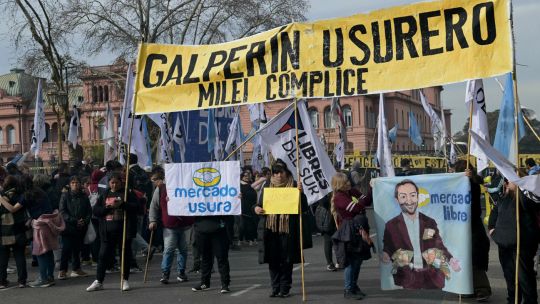
Thousands of people took to the streets in Buenos Aires on Thursday to demand relief measures as household indebtedness reached its highest level in 20 years under President Javier Milei.
More than 5.8 million Argentines – around 12.5 percent of the population – are behind on loan payments, an unprecedented level since the country’s major 2001 crisis, according to Central Bank data.
“I’m just another Argentine with debts. I work independently and, honestly, day by day, it is becoming increasingly difficult to cope,” said 47-year-old lawyer Mariano Almeyda, during the protest.
The demonstrators directed their demands at President Milei and his austerity policies and deregulation of interest rates.
“The government needs to move away from the blinkered view it is taking and start looking more closely at the reality of what we are suffering,” Almeyda argued.
The protest was backed by the country’s main trade union confederations, the CGT and CTA, as well as left-wing parties.
Demonstrators occupied part of Plaza de Mayo, next to the Economy Ministry, which was cordoned off with barriers and surrounded by a heavy police presence.
Among the trade union flags were banners carrying messages against digital wallets, such as Mercado Pago, that operate as lenders.
The protesters are calling for state intervention to restructure or manage excessive household debt and regulate exorbitant interest rates charged outside the formal financial system, which borrowers turn to because they lack access to bank credit.
In a recent interview, Milei said debt was “a matter between private parties” in which the state should not intervene.
“Today we marched on the Economy Ministry against a model that is forcing Argentine families to take on debt to buy food, pay the rent and keep basic services running,” the CGT said in a post on X after the march.
– TIMES/AFP