The trade agreements Argentina signed with the United States and the European Union — the latter as part of Mercosur — in 2026 are starting to deliver what they promised: a rise in exports to those markets.
In the U.S. case, Argentina and Washington signed the Agreement on Reciprocal Trade and Investment (ARTI) on February 5, 2026.
Unlike the deal with the European Union, ARTI is not a free trade agreement. It does, however, remove reciprocal tariffs on 1,675 Argentine products, mostly from agro-industrial and manufacturing sectors.
“While that agreement has not formally entered into force, it also included an increase in the U.S. import quota for Argentine beef,” the think tank Fundación Mediterránea said in a report.
The beef numbers bear that out. In the first six months of 2026, Argentine sales of frozen beef to the U.S. jumped 175%, worth an extra US$193 million. Chilled beef exports rose 122%, or US$48 million.
The Mercosur-European Union free trade agreement was signed on January 17, 2026, with tariff cuts taking effect on May 1. That leaves a much shorter track record to judge by.
“The effects of this agreement are very recent, and only May and June data are available,” the free-market think tank said.
Even so, it noted that several products are growing far faster than Argentine exports to the European Union as a whole:
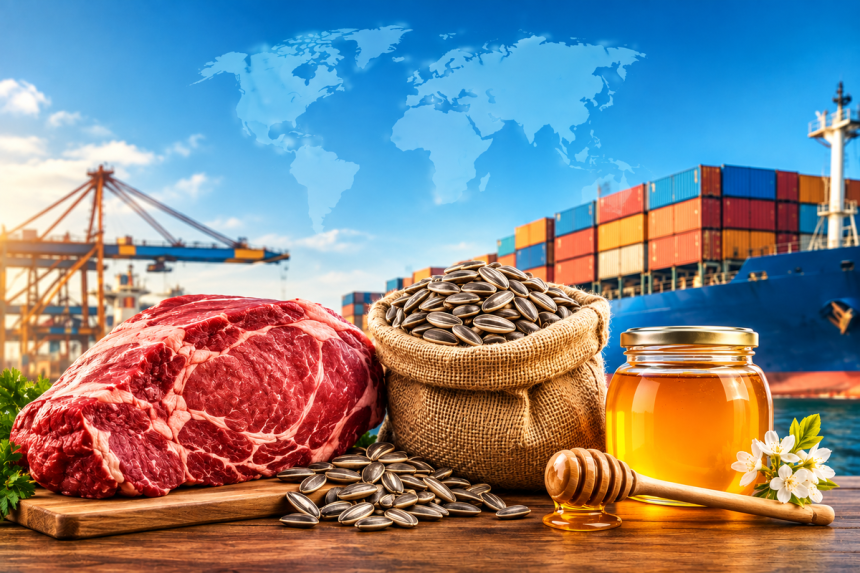
• Sunflower seeds (+611%)
• Shelled eggs (+277%)
• Sunflower oil (+242%)
• Sawn timber (+138%)
• Dried pulses (+114%)
Mollusks (+82%), honey (+75%), sour citrus fruit and fruit juices (both +68%) and frozen fish (+55%) also posted sharp gains.
Because those sectors are spread across the country, Fundación Mediterránea argued, opening up to foreign markets should lift activity in every region, not just the farm belt.
July figures confirm the trend
Exports grew again in July, official data released Thursday showed, rising 14% year-on-year to US$8.9 billion — a record for the month. That left a trade surplus of US$2.1 billion, the highest for any July since statistics bureau INDEC began keeping records. Exports are up 22.9% in the year to date.
Both markets are pulling their weight, but the U.S. is pulling harder. Sales there soared 23.4% year-on-year in July and are up 38.4% over the first seven months, totaling US$5.9 billion. Exports to the EU reached US$5.1 billion over the same period, up 19.1% — though July alone brought a gain of just 1.5%.
That gap is already reshaping Argentina’s export mix. The U.S. accounted for 8% of total exports in 2024, 9.5% in 2025 and 10% so far this year. The European Union has gone the other way, slipping from 10.3% in 2024 to 9.7% last year and 8.9% today.