Energy, competitiveness and trade: keys to driving Argentina’s growth
 Juan Marcos PollioUpdated 1 hour Ago3 Mins read
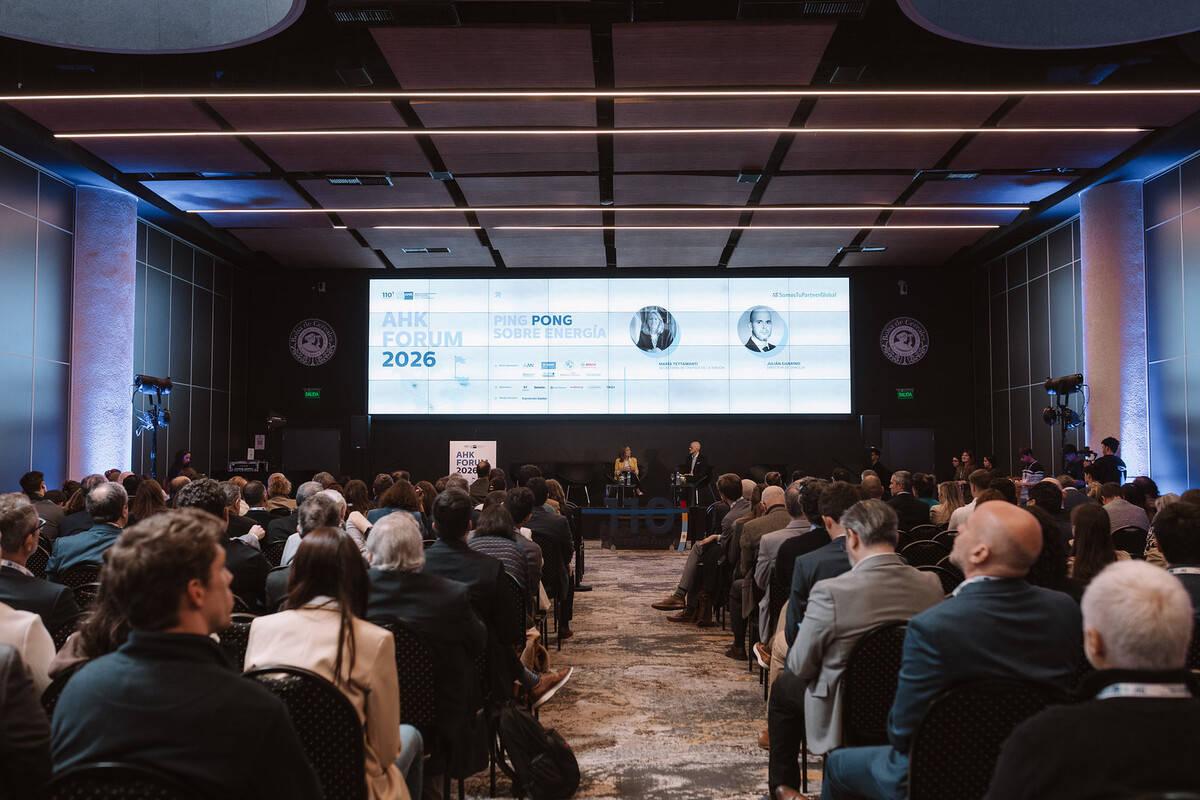

Argentina’s economic outlook was mixed at the end of 2026, as an export boom in commodities coincided with rising unemployment, a slowdown in disinflation and slowing economic activity.
Against this backdrop, the German-Argentine Chamber of Industry and Commerce (AHK, by its German acronym) organized a gathering titled “Debating the Foundations of Argentina’s Future” at the Buenos Aires Grain Exchange.
The event brought together CEOs and general managers from some of the country’s leading companies, as well as public-sector officials and prominent members of Argentina’s business community.
“We discussed future opportunities and how to turn them into tangible development,” the AHK said in a statement about the event, which the Herald attended.
Industrialization driven by the market One of the first speakers was Energy Secretary María Tettamanti, who stressed that “to take advantage” of the natural gas reserves in the Vaca Muerta formation, “they have to be exported.”
This is expected to happen on a large scale once the two liquefied natural gas (LNG) projects approved under President Javier Milei’s Large Investment Incentive Regime (RIGI) are completed.
She argued that industrialization in an economy is the result of clear rules of the game and predictability.
“One of the mistakes made in Argentina is that the governments that talk the most about industrialization and adding value before exporting are the ones that created rules that, far from encouraging industrialization, worked against it,” she said.
“Without macroeconomic stability and clear rules of the game, what industry would want to set up shop here?” she asked.
For that reason, she said, the Milei administration would not intervene in this sector of the economy.
“We believe the market should determine whether a raw material is exported in its current state or whether domestic industry wants to process it,” she said.
Energy beyond hydrocarbons During another panel, Juan Pedro Agüero, general manager of New Energy Argentina, said the country “has everything to gain and grow over the long term.” In addition to its unconventional hydrocarbon reserves, Argentina has abundant, world-class wind resources, as well as significant potential for solar energy and green hydrogen, he said.
Similarly, Federico Garín Odriozola, CEO of Solar DQD, identified lithium batteries as one of the key technological developments driving growth in Argentina’s renewable energy sector, since they “make it possible to stabilize renewable power generation.”
“What we are seeing with batteries is remarkable. In three years, we have gone from barely talking about them to having them installed and suddenly up and running,” he emphasized.
Agüero also said that mining companies, LNG terminals and even data center operations could generate substantial new demand in the short term.
Boosting competitiveness During a panel devoted to the challenges and opportunities involved in strengthening Argentina’s competitiveness, Eduardo Gorchs, president of AHK Argentina and Siemens’ managing director for South America, said the country had a track record of making major technological leaps in certain industries.
“Sometimes it’s because we fall too far behind for a while and then make the leap,” he joked. He added that “if we can combine the capabilities we have in the country with the technology already available, anything is possible.”
Meanwhile, Matías Martin, managing director and CFO of BASF Argentina, said the debate over competitiveness “is not unique to Argentina,” since “everyone around the world is looking at how to become more competitive.”
“I think our biggest challenge today is to move from promise to power. Argentine talent will be key to meeting that challenge, and competitiveness will become even more important,” he added.
Carolina Barton, managing director of Aluplast, acknowledged that the company had considered establishing a production plant in South America, with the aim of turning Argentina into a regional hub. However, those plans had to be put on hold.
“In recent years, we have had economic models that swung sharply from one extreme to the other, requiring a great deal of effort to adapt to one and then the next. As a result, these decisions were postponed,” she said.
The European Union opportunity At another point during the event, Marcelo Elizondo, chairman of the International Chamber of Commerce in Argentina, said the country was “at a turning point” because its economy was undergoing “a transformation on four major fronts.”
The first was the “restoration of macroeconomic order,” while the second was the “establishment of a market economy.” The third involved implementing “more reasonable deregulation,” and the fourth was “reintegration into the international economy.”
“There are many areas in which the economy is not delivering good results, but the international arena is one where it is,” he emphasized.
This shift toward greater international integration is helping Argentina increase its share of global trade. “In 2023, Argentina hit rock bottom: its share of total global exports had never been so low, at 0.29%. This year, we will most likely reach 0.37%,” he said.
In this regard, he stressed the importance of the agreement between Mercosur and the European Union (EU) in consolidating that trend. “It’s not just about tariff reductions. The agreement brings a change in the economic model and a shift in the institutional architecture.”
He noted that Argentina’s Constitution gives international treaties precedence over domestic laws, meaning that “if, in the future, someone tries to obstruct something established in an international treaty through a decree or a law, they cannot do so.”