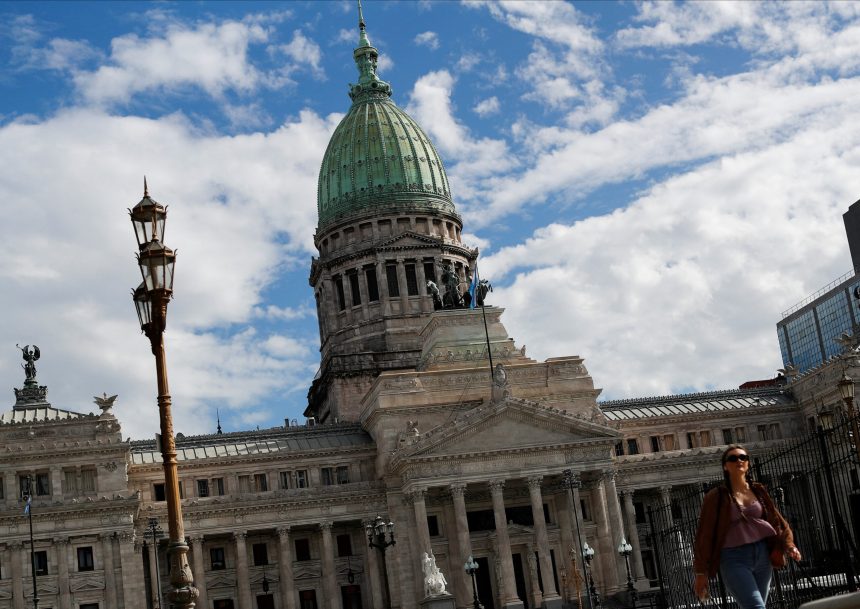
The Lower House is set to debate on Wednesday two bills filed by President Javier Milei aimed at reforming the Central Bank’s charter and offering more incentives for people to bring their stashed dollars into the formal economy.
The two bills are key parts of Milei’s legislative agenda for 2026. If they pass, they still need Senate approval to become law.
Ruling party La Libertad Avanza (LLA) agreed to also add several proposals from smaller provincial blocs to the agenda in order to secure more support for the session, such as lowering the value-added tax on cassava at the request of Misiones lawmakers.
The decision to also debate the opposition’s proposals follows a mixed win in early August, when the government’s Private Property Rights reform bill passed the Senate in general terms, but LLA had to drop what it considered its most important provisions due to a significant lack of opposition support.
The reform originally sought to modify the Land Law, which protects rural and natural areas, to allow foreigners to purchase up to 25% of Argentina’s territory. It also allowed land burned by wildfires to be sold and used for other purposes. Neither of those proposals were approved.
What remains of the Private Property Rights reform proposal still has to be debated in the Lower House, although no date has been scheduled.
Wednesday’s session will give the government another opportunity to flex its negotiating skills after the widespread rejection of the Land Law reform.
Other bills to be addressed in the session include the free trade agreement between South American trade bloc Mercosur and Singapur, as well as the ratification of the Patents Cooperation Treaty (PCT), an international agreement that allows applicants to seek patent protection for inventions in the 158 countries that are party to it.
The Argentine Senate approved the country’s ratification of the treaty in 1998, but it was never debated in the Lower House.
In February, Argentina and the United States signed a commercial agreement that included a commitment to “modernize” the Argentine patent system and ratify the PCT. Argentina is the only G20 country not to be party to the agreement.
While the U.S. had asked Argentina to ratify the PCT in full, lawmakers agreed in committee to exclude a provision of the treaty that establishes an international preliminary examination for patent applicants. While the examination is optional and non-binding, it would delay national-phase entry for patents by 30 months, something critics say would harm domestic industries, particularly pharmaceutical and medical companies.
Central Bank’s charter reform
During the 2023 presidential campaign, Milei had promised to eliminate Argentina’s Central Bank (BCRA, by its Spanish initials). Instead of doing that, he now proposes to reform the institution’s charter to redefine its role.
During a televised message earlier this month to explain his decision, the president said he wanted the Central Bank’s “sole responsibility” to be preserving the value of the Argentine currency.
This would mean stripping it of its other current objectives: financial and monetary stability, full employment, social equity, and economic development.
The main change he wants to introduce with this reform is to ban the Central Bank from financing government spending in order to prevent future inflationary spikes.
Milei also aims to establish protections for BCRA’s leadership so that they cannot be removed for “arbitrary” political reasons, bolstering institutional governance, and restrict the distribution of dividends derived from the Central Bank’s earnings.
The initiative is part of a broader reform program that also aims to implement a U.S.-style government shutdown mechanism if Congress fails to restore balance to the public accounts.
Fiscal Innocence II
The government also filed a bill aimed at reforming a law approved by Congress in December known as Fiscal Innocence, which raised the threshold for tax evasion with the goal of encouraging Argentines to use and bring their stashed dollars into the formal economy. In return, there is less supervision from authorities.
However, the original law did not work out as planned, and enrollment in the simplified tax regime created under the provision was limited.
Economy Minister Luis Caputo has said there are still “more than four times as many dollars outside the financial system” than in it.
The reform, dubbed Fiscal Innocence II, seeks to address the risk of taxpayers losing the regime’s benefits if national tax agency ARCA identifies discrepancies in their tax filings.