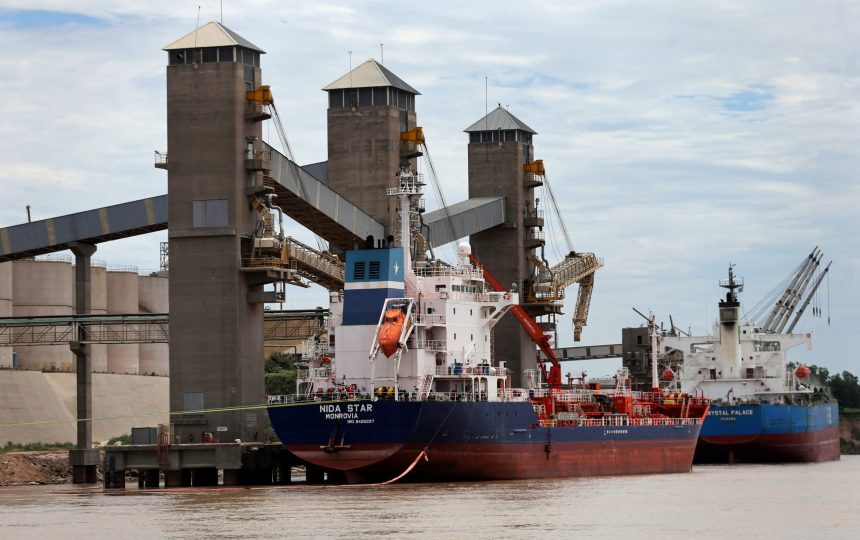
Argentina’s foreign trade is currently in day two of a standstill following President Javier Milei’s decision to deregulate port piloting services, triggering a labor conflict with sector workers that is affecting more than 150 vessels.
The strike hit the country’s main ports — La Plata, Dock Sud, Buenos Aires, Zárate-Campana, Quequén, Bahía Blanca, Rosario, and others along the Paraná River. Operations are being rerouted to Montevideo and southern Brazil.
Uncertainty and concern over the protest, which is causing million-dollar losses, are spreading among business leaders. Some are even quietly criticizing the government for its handling of the reform.
“It’s terrible that this is happening,” businessman and importer Martín Zocchio told the Herald, adding that ships that have trouble entering and operating at a specific destination will eventually “unload at an alternative port.”
Zocchio said that moving a container from Montevideo to Buenos Aires costs between US$700 and US$1,000, with destination charges included.
The measure is also hitting fuel distribution. The Argentine Energy Chamber (CADE) reported 12 tankers stalled, creating a risk of gasoline, diesel, and fuel oil shortages.
“Among the suspended operations was that of the White Marlin, a vessel needed for work on the Vaca Muerta Oil Sur (VMOS) pipeline, which is more than 75% complete,” the bank Mariva warned in one of its latest reports.
“With the ships coming in to load, maybe there’s a bit more leeway and they have to wait, but that also creates an operating cost that someone ends up paying,” Zocchio lamented.
Frustration in the agro-export sector
Gustavo Idígoras, president of the Chamber of the Oil Industry and the Cereal Exporters Center (CIARA-CEC), warned of how severely the situation is affecting Rosario, Santa Fe province — the epicenter of agricultural exports.
“Right now we’re past 45 ships stalled, and if this isn’t resolved today, we’ll be adding another 30 or so, and so on. Every ship delay is like a taxi running the meter, charging between US$50,000 and US$100,000 a day,” he told the Herald.
While Idígoras said he was in favor of cutting port costs, he criticized the way the government’s measure was implemented. He also questioned the lack of communication with pilots in order to discuss the changes.
“We back any deregulation program that lowers export costs, but the way it was done clearly set off an internal explosion in this sector,” he went on to say, urging the government to step in as soon as possible to break the deadlock.
“The Coast Guard, as the competent authority, should call everybody in to find a road map that allows the decree to be implemented and gets everyone back to work.”
Economic and reputational impact
Idígoras voiced his concern about how the conflict affects the country’s image in international trade.
Argentina could end up on a “list of dirty countries,” he explained. This would label it an “unreliable nation when it comes to honoring its export contracts,” something that would benefit direct competitors like Brazil.
The Chamber of Private Commercial Ports (CPPC) also voiced concern about the situation, saying that it represents a “direct and immediate brake on the national economy” that threatens damage to the country’s international reputation.
“Operational unpredictability and the risk of ships being diverted to other ports in the region damage Argentina’s image as a reliable supplier, jeopardizing trade agreements built over years,” the organization argued in an official statement.
Furthermore, the number of delayed ships interrupts the normal flow of exports and imports, “immediately halting the inflow of foreign currency that is essential to the country’s macroeconomic stability.”
That situation also causes a “breakdown of supply chains,” since the port stoppage “creates a domino effect that paralyzes overland transport — trucks and trains — overwhelms storage capacity at the terminals and cuts off strategic industrial and energy inputs for local production.”
The CPPC also warned that the inability to meet agreed deadlines “subjects exporters to severe contractual penalties and drives up logistics costs disproportionately through cost overruns.”