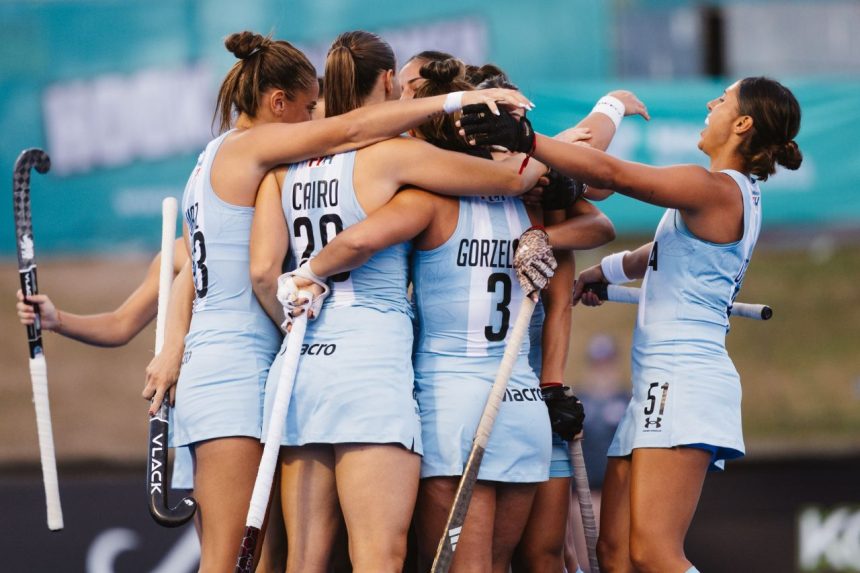
On September 24, 2000, the Argentine women’s field hockey team, competing at the Sydney 2000 Olympics, needed to win to survive in the tournament. In front of them was the Netherlands, one of women’s field hockey powerhouses.
They decided to give it their all and, to represent that commitment, put the image of a lioness, hand-drawn by forward Inés Arrondo, on their shirt. The match ended in a 3-1 win for Argentina, earning them not only their first-ever Olympic final but also their own place among Argentine sports legends.
It was the birth of Las Leonas.
That silver in Sydney was not a fleeting moment of magic, but the kickstart of over 25 years of glory and unmatched competitive spirit.
With the field hockey World Cup set to launch on August 15, we took a dive into how far the team has come since and what to expect this coming tournament.
The first titles
Success at Sydney did not come out of nowhere, as field hockey expert reporter Gastón Saiz told the Herald.
“Argentina always had talent at the club level, but it lacked organization,” Saiz said.
According to him, coach Sergio Vigil’s arrival on the national team was “revolutionary” not only in his methods but also in his use of psychology to reach out to the players in a special way.
The initial breakthrough didn’t halt after Sydney.
Two years later, Argentina beat the Netherlands in a tense final at the 2002 World Cup to lift their first-ever World Cup trophy.
By the late 2000s, Luciana Aymar became the anchor of the team. Widely regarded as the greatest field hockey player in history, Aymar’s dribbling and vision earned her the FIH Female Player of the Year award an unprecedented eight times (2001, 2004, 2005, 2007, 2008, 2009, 2010, and 2013).
Under the helm of head coach Carlos Chapa Retegui, Las Leonas lifted their second World Cup title in Rosario in 2010.
Playing in front of a roaring home crowd, Argentina swept through the tournament undefeated, capping off their campaign with a 3-1 victory over the Dutch in the final.
Hockey reaches mass popularity
The Leonas have since become one of the most decorated teams in Argentine sports, and their success has brought significant development to hockey.
“It made it a lot more popular,” said Saiz. “It became the number one sport for women in the country; it brought a lot more publicity, and that in turn brought a lot more development at club level.”
The success also gave many of the players who had played as amateurs in Argentina the chance to become professionals abroad. According to Saiz, it proved a way out and the opportunity to progress not just sport-wise but economically and in their lives.
However, for all their success, the Olympic gold medal remained elusive for Las Leonas.
Following Sydney 2000, the team secured back-to-back bronze medals at Athens 2004 and Beijing 2008, before returning to the final at London 2012 to claim another silver.
A new generation
Aymar’s retirement following the team’s 2014 Champions Trophy win in Mendoza, and a disappointing seventh-place finish at Rio 2016 seemed to herald the end of the golden era. However, a new generation of talent emerged to carry the mantle.
“[Dealing with Aymar’s retirement] was complicated, but it proved less traumatic than Diego Maradona’s exit from the football national team, or what Lionel Messi’s might be now,” said Saiz.
The team, while still packed with talented individuals such as Delfina Merino and Agustina Albertario, adopted a more team-oriented style of play.
“They came to have a more collective approach and not rely so much on the talent of [someone like] Luciana Aymar,” said Saiz.
At Tokyo 2020, a blend of veterans and rising stars, including defender Agustina Gorzelany and forward Julieta Jankunas, took Argentina back to the Olympic final, earning a third silver medal.
Las Leonas followed that performance by earning a silver medal at the 2022 World Cup and a bronze medal at Paris 2024. That means the team has now claimed six Olympic medals across the last seven Olympic Games.
“Even though we lack infrastructure and budgets are perhaps insufficient, the youth development system at clubs is still up and running, and there’s a deeply rooted culture surrounding Las Leonas,” said Saiz. “It’s an invaluable treasure that was created, took shape, and, fortunately, just keeps going.”
The challenge ahead
The Leonas will be competing in the 2026 Women’s World Cup, which is held in the Netherlands and Belgium, with the men’s tournament — which features Argentina’s men’s team — played alongside.
The tournament format has changed from that of previous tournaments.
In the Pool Stage, 16 teams are split into four pools of four. Each team plays three matches within their pool.
Then, the top two teams from pools A and D combine to form pool E, while those in B and C form pool F. The bottom eight teams form classification pools G and H.
Results against teams advancing from the same initial pool carry over, meaning, for example, the 1st-placed team from pool A will only play against the teams coming from pool D.
Then, the top two finishers from pools E and F advance straight to the semifinals, and remaining teams play classification matches for final rankings (5th–16th).
Argentina will be part of pool B, facing the United States on August 15 at 12:30 p.m., Germany on the 17th at 12 p.m., and against Scotland on the 19th at 6 a.m., with all games played at the Belfius Hockey Arena in Wavre, Belgium. All times are Argentine time.
“The Netherlands has been the dominant force for many seasons, with Las Leonas always in pursuit,” said Saiz. “The big challenge for Argentina is to break that dominance, as it did in 2002 and again in Rosario in 2010.”
In Argentina, all matches will be broadcast live on TV via ESPN channels and streamed online on Flow, DGO, and Telecentro Play, as well as on the Disney+ Premium digital platform.
‘We have a real team’
Head coach Fernando Ferrara, who took over from Retegui after the 2020 Tokyo Games, repeated 13 players from the team that won the bronze medal at Paris 2024.
Among those missing from this roster are veterans such as Rocío Sánchez Moccia, Agustina Albertarrio, and Pilar Campoy.
“We started with a list of 54 players,” he said ahead of the team’s departure to Belgium. “We’ve arrived at this point with a roster of 20 players with what we believe is the best team we can field to represent the country.”
Las Leonas captain María José Granatto said she believes the team had a “spectacular preparation” for the tournament.
“We did everything we could to be at our best in this World Cup. I’m leaving with that confidence, and I know the team is going to perform well,” she said.
She insisted the team is at a “great moment” on and off the field, the result of “many hours, effort, and dedication” put into training.
“Today, we have a real team,” she added. “Being able to say that fills me with pride and gives me confidence that things will go as well as possible for us there.”
Cover image: International Hockey Federation