Javier Milei didn’t just promise to fix Argentina’s economy when he entered politics. He promised to make Argentina’s traditional way of doing politics obsolete.
He gave the enemy a name: la casta. The professional politicians, the provincial power brokers, the whole intermediary class that had spent decades protecting each other while the country declined. Milei didn’t plan to get better at their game. He planned to make the game irrelevant.
Three years on, something closer to the reverse is happening. Milei has reshaped Argentine politics, no question. But Argentine politics is reshaping him right back.
With the 2027 election starting to loom, the president looks more and more like the head of an ordinary political coalition.
La Libertad Avanza (LLA) is talking to Mauricio Macri’s PRO again. The government needs governors on side. And Milei, who built his whole identity on accusing the political establishment of rigging the system in its own favor, is now pushing to rewrite the rules of the next election just as he prepares to run in it.
It’s tempting to call this hypocrisy. Tempting, yet not especially useful.
Learning to govern
Some of it looks more like growing up in the job.
Milei, a libertarian economist with no prior experience in politics, except for a two-year stint as a national deputy, arrived at the Casa Rosada in December 2023 in a strange position for a president.
He had no provinces, no territorial machine, tiny minorities in both houses of Congress, and a bloc of legislators who’d barely set foot in politics before. That was the appeal. He’d apparently proven the old machinery could be skipped entirely.
Governing turned out to be a different story. Argentina is a federal republic. Governors hold territory and political resources, Congress can’t be wished away, and a law passed with support from people you can’t stand beats a perfect law that never leaves your desk.
Figuring that out doesn’t make Milei part of the caste. It might just make him a more competent president.
The more interesting shift is that Milei now has something he lacked when he showed up: power worth holding onto. That changes the math.
What reelection requires that disruption didn’t
Take the PRO rapprochement. Milei spent his rise cannibalizing Mauricio Macri’s old center-right coalition. PRO politicians kept crossing over to LLA, and there was little incentive to rescue a party he looked capable of simply replacing.
Reelection changes that. It takes candidates, local structures, poll watchers, congressional allies, operators on the ground across a country this size. Not just an ideology.
Same story with the governors. Provincial machines Milei once treated as everything that was wrong with Argentina are now people his government has to sit down with.
None of that would be especially remarkable on its own: a dominant president consolidating power, business as usual. What makes it worth watching is that Milei is adapting to conventional politics just as his own position gets shakier.
Unpopular, yet hard to beat
The polling reaffirms that story. The August edition of the Universidad de San Andrés survey found 69% of respondents unhappy with the country’s direction and 61% disapproving of the government. Just 35% approved, rough numbers for any incumbent.
And yet, asked about voting intention, Peronism came in at 26% and La Libertad Avanza at 24%. Discontent with Milei hasn’t translated into enthusiasm for anyone else.
That gap might be the president’s biggest asset right now. Argentina seems to have a large anti-Milei electorate with nowhere obvious to go, Peronism still split among rival leaders, the old center-right hollowed out largely because Milei ate its base, and a sizable chunk of voters simply unclaimed.
Heading into 2027, he could be deeply unpopular and yet remain entirely competitive.
That’s the context that makes it worth pulling apart what’s actually going on, because not all of it belongs in the same category. Cutting a deal with Macri is coalition-building. Negotiating with governors is just governing in a federal system. Neither requires Milei to abandon the core beliefs he ran on.
Where adaptation turns into something else
Changing the electoral rules is a different kind of thing entirely.
Milei’s government sent a sweeping electoral reform bill to the Senate in April, and it sat there through the winter recess, short of the votes it needed. The package touches party financing, a Ficha Limpia (Clean Slate) clause barring candidates convicted in a second-instance ruling, changes to the paper ballot, and — its most contested piece — eliminating the PASO primaries.
Allied blocs balked, and the government spent months negotiating directly with governors and floating fallback options, including simply suspending the primaries in 2027 rather than scrapping them outright, as it did in 2025.
As of this week, the government says it has finally assembled the votes and is pushing for a Senate session before the month is out, though after several false starts this year, that claim is treated with some caution even inside the ruling coalition.
The PASO system is a genuinely odd piece of machinery: the whole electorate votes in simultaneous party primaries even when a party has no real internal race to speak of. Therefore, reforming it isn’t inherently anti-democratic.
But rules and incentives don’t live in separate boxes. The primaries the government wants to eliminate are also one of the few mechanisms a fragmented opposition has for putting rival factions inside the same electoral coalition and resolving their competing candidacies at the ballot box, which happens to be the exact problem currently working in Milei’s favor.
There’s a simple way for a government to show that a proposed change in electoral rules is not implemented solely to benefit it in upcoming polls: write the law to take effect two cycles from now, after the people passing it have nothing left to gain from it.
Nobody in Congress is proposing that version. A government seeking to eliminate those primaries as the president prepares for a reelection campaign deserves more scrutiny than a government simply grumbling that the system is clunky and expensive.
This is where Milei’s evolution becomes more interesting than the usual debate over whether he has betrayed his principles.
The outsiders learn to run the machine
Every disruptive political movement eventually runs into institutions it can’t just disrupt. At first, compromise looks like corruption, procedure looks like an obstacle, and professional politicians look unnecessary because their skills get mistaken for their privileges.
Then the outsiders actually win, and procedure decides whether their bills pass, governors hold votes they need, career politicians know things they don’t, and the party structures that looked parasitic start looking pretty handy with an election on the calendar.
The movement doesn’t necessarily abandon its ideas. It learns that replacing the old political machinery is easier than governing without political machinery at all. That’s what’s happening to La Libertad Avanza.
None of this means Milei has failed to change Argentina, he clearly has. He displaced the Macri-led center-right as Peronism’s principal national rival, effectively absorbing much of the electorate of a coalition that had governed Argentina only four years before his election.
He pulled fiscal balance out of the technocratic weeds and into the center of the national conversation. He built a national political force at breakneck speed and turned libertarian ideas that used to live on the fringe into a governing program.
Those are substantial changes, and dismissing them would obscure just how profoundly Milei has already reshaped Argentina’s political landscape.
But the transformation has run in both directions. The Milei who campaigned against the caste needed almost nothing from it. President Milei found out he needed Congress. The Milei gearing up for 2027 is finding out he may also need the governors, Macri’s political infrastructure, and maybe even a different set of electoral rules.
Where the education stops
There’s nothing scandalous about a politician wanting to win again, and no reason to condemn a president for learning how the system he runs actually works. In some ways, Argentina should probably prefer a Milei who’s learned to negotiate over one convinced that winning an election means he gets to govern alone.
The real question is where that education stops.
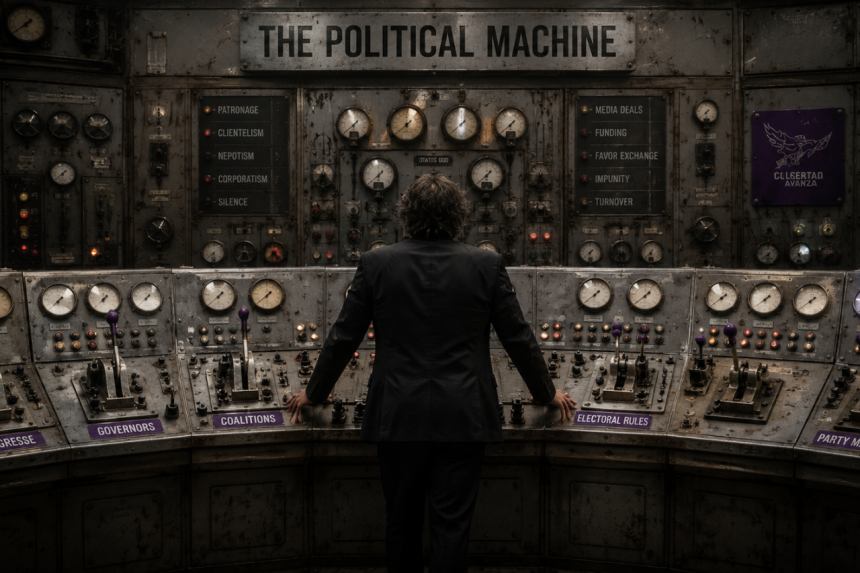
Milei entered politics convinced that Argentina’s problem was a class of politicians who had become too good at operating the country’s political machine. His solution was to replace them with outsiders who would get rid of the machine itself.
As 2027 approaches, those outsiders are becoming increasingly skilled at operating it.
Milei has changed Argentine politics more profoundly than many of his critics expected. The irony is that Argentine politics is proving just as capable of changing him.