President Javier Milei and leading experts are at odds over whether Argentina’s economy has recovered from a recent wobble, highlighting the challenges involved in gauging whether the reformer’s shock therapy policies are working as intended.
Argentina’s economy contracted sharply in February, posting its biggest monthly decline since 2023 as retail and manufacturing continued to struggle. The turbulence followed a dramatic turnaround during which Milei’s administration won over investors with a mix of aggressive fiscal adjustment, deregulation and steps to normalise the country’s monetary and exchange-rate regime.
With the dust yet to settle from the bout of early-year weakness, Milei and his administration are pointing to rebounds in sectors like cement, steel and auto production as evidence that the economy is finding its footing and his reformist agenda remains on track.
Two indicators published on Thursday supported that view. Construction activity grew 4.7 percent in March from the previous month and 12.7 percent from a year earlier, while industrial production rose 3.2 percent and five percent, respectively, according to data from statistics agency INDEC.
Economists, on the other hand, have maintained that the government is painting an optimistic picture not yet backed by data. Bolstering that view are reports showing weakness in spheres such as domestic activity and consumption – often from the private statistics firms that Milei says focus on the wrong areas of the economy or put a gloomy spin on the economic situation.
The back-and-forth underlines how economic data – always top of mind in Argentina – has become even more front and centre as pressure grows on Milei to show that his ambitious overhaul can deliver the growth he has promised. Milei has staked the future of his Presidency on the success of his programme, which has dramatically cut the country’s endemic inflation while also stoking an uneven economic recovery. Argentina will hold presidential elections in October 2027.
“Leading indicators are still sending mixed signals,” said Jimena Zuñiga, Argentina economist at Bloomberg Economics. “There has been a strong recovery in exports, imports and car production. But those signs coexist with less encouraging evidence of weakness in consumption and employment.”
A recent debate over consumption, seen as an important indicator of where growth may be headed, illustrates the contrast between economists’ views and those of Milei and his administration. Scentia, one of the country’s main reference firms, reported a 5.1-percent drop in mass consumption in March from the same month a year earlier – a trend echoed in other indicators.
Milei, by contrast, urged economists to focus on a different dataset: earnings reports of e-commerce companies such as MercadoLibre Inc and Temu, which are showing robust consumption.
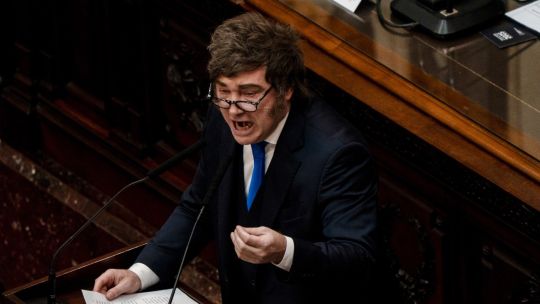
“Consumption is at a historic peak, guys,” he told an audience of business leaders and politicians at a dinner hosted by the Libertad Foundation think tank on April 28. The e-commerce data was more relevant because “the way things are sold has changed,” he said.
The mercurial leader has lashed out in the past over what he called the mismatch of data highlighted by his government versus statistics cited by business leaders, who he described as “empresaurios” – a made-up insult combining the Spanish words empresarios (businessmen) and dinosaurios (dinosaurs).
But analysts including Nicolás Gadano, chief economist at local consultancy Empiria and a former general manager of Argentina’s Central Bank, insist Milei is jumping the gun.
“The economy is growing at a slow pace, with a great deal of sectoral heterogeneity on the supply side and sluggish dynamics in both consumption and investment. There are no signs that this is changing for the better,” he said.
For now, both sides have plenty of data to support their case. A more consistent theme is likely to emerge in coming months, with investors looking to gauge whether Milei can keep a lid on inflation while also reviving the real economy before voters – and investors – run out of patience.
While national elections are still 17 months away, for Milei, “obviously, the sooner, the better,” Zuñiga said.
by Ignacio Olivera Doll, Bloomberg