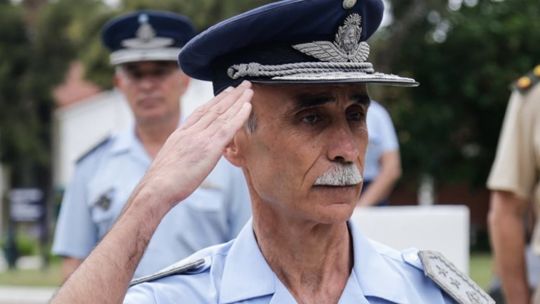
Chile will send a formal note of protest to Argentina over comments made by Brigadier General Gustavo Javier Valverde, Chief of the General Staff of the Argentine Air Force, who described the Strait of Magellan and the Drake Passage as areas of Argentine “sovereignty.”
Speaking on the streaming show La Fábrica del Podcast on Sunday, Valverde said: “The Magellan region, the south and the Drake Passage represent a matter of sovereignty and a “bi-oceanic key between the Atlantic and Pacific.”
The general added that Argentina needed to “maintain a presence” there.
Chile’s Foreign Minister Francisco Pérez Mackenna, on an official visit to Vietnam, called the remarks unacceptable, stating: “The Strait of Magellan is indisputably Chilean.”
Pérez Mackenna, a top official in President José Antonio Kast’s right-wing government, cited the Treaties of 1881 and 1984 as the legal basis for Chile’s position and issued a “stern call” for foreign officials to speak responsibly and avoid sowing confusion over the territory’s status.
Interior Minister Claudio Alvarado echoed the criticism, insisting Chilean sovereignty over the strait is beyond question under the two countries’ existing legal framework.
Opposition lawmaker Gonzalo Winter went further, arguing that Magallanes is sovereign Chilean territory that no foreign authority should question.
Alejandro Riquelme Ducci, a deputy for the Magallanes Region, said the episode was not an isolated one, pointing to earlier flashpoints in 2021 and 2026 sparked by Argentine statements.
The row touches on two related but distinct chapters of Argentine-Chilean border history. The Strait of Magellan’s status was largely settled under the Boundary Treaty of 1881, which recognised Chilean sovereignty over the waterway while guaranteeing free navigation to ships of all flags.
Further south, the Beagle Channel and its islands remained contested for another century.
Argentina and Chile went to the brink of war in 1978 over control of the Picton, Nueva and Lennox islands. That crisis, known as the Beagle conflict, was defused only through the personal mediation of Pope John Paul II, culminating in the Treaty of Peace and Friendship, signed at the Vatican in November 1984 and in force since 1985.
The treaty confirmed Chilean sovereignty over the disputed islands while granting Argentina specific navigation rights through the channel.
Argentine response
In a statement posted by Foreign Minister Pablo Quirno, Argentina’s Foreign Ministry framed the episode within the two bilateral treaties, distancing the government from Valverde’s remarks.
Both treaties, it said, “remain fully in force and are considered definitive by the Argentine Republic.”
The Foreign Ministry added that “the strategic relevance of the southernmost tip of the continent is a matter of state policy publicly maintained by the Argentine Republic,” linking the position to the Malvinas sovereignty dispute, the South Atlantic and Antarctica.
President Javier Milei’s government further sought to play down the row, instead highlighting cooperation with Chile in the South Atlantic and Antarctica.
“We reaffirm the strategic value of cooperation with Chile,” the Foreign Ministry said, noting that the two countries mutually recognise each other’s Antarctic rights, jointly manage specially protected areas and have run the Joint Antarctic Naval Patrol (PANC) for more than two decades.
“The Argentine Republic reaffirms its commitment to the bilateral relationship with Chile,” the ministry said, adding that matters of common interest should be handled through “the established institutional channels between both governments.”
– TIMES/PERFIL