Buenos Aires’ cinephiles are going back to basics: getting together to watch good films. Anywhere.
As blockbuster releases clog multiplex theaters and isolated binge-streaming becomes an increasingly unfulfilling habit, in recent years amateur film clubs have sprouted not only in regular theaters but also in improvised locations such as bars, cultural centers and even downtown offices.
“What a film club really does is build a community, and not just for cinephiles,” Paula Félix-Didier told the Herald. A programmer at MADO, an organization that runs the Recovered Cinema Week, she is also one of Argentina’s top film preservation experts and a former director of the Buenos Aires Film Museum.
A community was precisely what Andrés Firu Fichendler, a film editor and artist who co-founded the Florida film club in mid-2023, was looking for when he ventured into the La Cueva film club in Mexico City.
“I had just moved to town. I didn’t know anyone; I had no friends. And an Argentine friend who had been there before told me I should go to this great film club,” he remembers. “I ended up going every week, and that’s where I made my Mexican friends.”
Back in Buenos Aires, Firu partnered with his friend and cinematographer Lucio Castelnuovo to set up Florida Filmclub in the downtown area, where the real estate fallout of the pandemic offered cheap office spaces.
With free screenings every day, nine programmers, a bar, and no social media, Florida is now a 30-seat, semi-clandestine small cinema people can access only through a Whatsapp group.

“Working through word of mouth helped to make the community more real,” says Firu. “We’re not doing it for the Instagram story,” he adds.
“Couples have begun here; others ended. I made a bunch of new friends, which I haven’t done since I was a kid. Lots of people also found work, because we get 20-something film students as well as experienced film professionals over 50.”
Florida’s programming, he says, is diverse and “super whimsical.”
“We screen whatever we want to see. I myself program surprise films, films I haven’t seen yet and want to watch. Instead of watching them alone at home, I play them at the cinema, and people come to take a chance along with me,” he says.
A red screening room at Aquilea 57 bar in a restored mansion in Villa Urquiza, Amorina Filmclub also promotes diverse programming and social gatherings, screening “auteur cinema, weird gems and classics, with a bar and a community.”

With online ticketing and aimed at a young, social-media-driven audience, Amorina mixes independent cinema and late-night partying. Their latest program includes the 14-hour cult film La Flor, directed by Mariano Llinás, a renowned indie filmmaker and co-writer of Argentina’s latest Oscar-nom Argentina, 1985. The film’s three parts will screen on different dates, ending with a live Q&A with Llinás himself.
A history of cinephilia
Buenos Aires’ film club trend is certainly not new. The city has had a long tradition of film clubs since the late 1920s, with the Buenos Aires Film Club founded by director León Klimovsky within Amigos del Arte, a famous art-promoting association that included writers Victoria Ocampo and Leopoldo Lugones.
“The spirit behind them was always sharing films that weren’t easy to access as well as amateur films,” says Félix-Didier.
With the arrival of sound in the 1930s, silent films disappeared from theaters, and film clubs became the only chance to watch them. That is why most film collectors were also into film clubs — “they had the films,” says Félix-Didier, who also ran the Buenos Aires Film Museum until July.
The goal of making films circulate and reach different audiences also connects the film club scene with the origins of film festivals and cinematheques, both around the world and in Argentina, with the legendary French Cinematheque as an example.
The international exchange of films also gave way to institutions like the Argentine Cinematheque Foundation, a private entity that still nurtures the Sala Lugones film theater, a cinephile temple in Buenos Aires.
Film clubs also became a seedbed for local film criticism. In the 1940s, the film club Gente de Cine in Buenos Aires — and its film magazine of the same name, led by Rolando Roland Fustiñana — shaped the city’s cinephile culture, which would in turn lead to a renovation in film directing known as The 60s Generation.
Firu’s own great-grandfather had been a member of Gente de Cine, which he later found out was located a block away from his own Florida Filmclub. For Gente de Cine’s 100th anniversary, Florida organized a special screening of silent films with live musical accompaniment to commemorate the institution.

Also a regular at Gente de Cine, Salvador Sammaritano co-founded in 1952 the Núcleo Film Club, which still operates under Salvador’s son Alejandro at the Gaumont Cinema, with long-time members still attending every screening.
Núcleo was also a refuge during the military dictatorship, as the government’s official censor Miguel Paulino Tato would allow Sammartiano to screen in their full versions the films he himself had cut, under the elitist notion that such films weren’t suited for general audiences but for more refined cinephiles.
A film club pioneer and critic, Sammaritano also founded the landmark film magazine Tiempo de Cine in the 1960s and played a key role in the discovery of a lost full print of Fritz Lang’s sci-fi masterpiece Metropolis in Buenos Aires.
Film historian and collector Fernando Martín Peña claims one of the clues about the lost print was when Sammaritano told him that during a 1959 screening he had to hold a projector’s piece with his finger for two and a half hours straight — which was longer than the existing version.
A film curator of the Buenos Aires Museum of Latin American Art (MALBA), Peña himself hosts a weekly film club called Peña sin Cadenas (Peña Unleashed) in the independent theater Hasta Trilce. Showing two films every Tuesday in film format only — mostly from his own collection, Filmoteca Buenos Aires — he never lets his audience know what they will see beforehand. Every screening is a surprise.
“Two surprise films. Quality is guaranteed. Endless joy,” he repeats every week on his social media.
A communal experience
The list goes on, both in Buenos Aires and the provinces. In Córdoba, the municipal film club Hugo del Carril, created by journalist and poet Daniel Salzano in 2001, was recently the location and topic of The Night is Fading Away.
An ode to cinephilia and a poignant portrait of solidarity in times of crisis, the film by Ramiro Sonzini and Ezequiel Salinas follows a young projectionist whose quiet life is troubled when budget cuts in state funds threaten the existence of the theater. Economic hardship leads him into forming a community inside the theater with homeless people and other struggling friends.

The experience of watching a film in a cinema theater is, in the end, an essentially communal experience.
“The emergence of spaces like ours speaks to a sense of enthusiasm, and enthusiasm is contagious,” says Firu.
“At a time when everyone seems a little isolated and it’s become harder to genuinely share the things we love, the fact that places like this emerge only feels natural.”
A guide to Buenos Aires film clubs
- Peña sin cadenas (Hasta Trilce, Maza 177)
Film historian and collector Fernando Martín Peña projects two films every Tuesday, usually from his own Filmoteca Buenos Aires collection. The catch? Titles aren’t revealed beforehand, and they’re always screened in celluloid prints.
- Cineclub Nocturna (MALBA, Av. Pres. Figueroa Alcorta 3415)
Every Saturday at midnight, Nocturna screens all sorts of genre films, from Japanese horror to Alfred Hitchcock. Tickets through MALBA’s box office. - Cineclub Florida (Downtown, address through Whatsapp)
Set in a downtown office, Florida offers free daily screenings at 8 p.m., as well as a small bar and special events. Location is only available through a Whatsapp group — do a little Instagram search and we’re sure you’ll be able to find it. Beware: smoking is allowed. - Amorina Cineclub (Aquilea 57, Villa Urquiza)
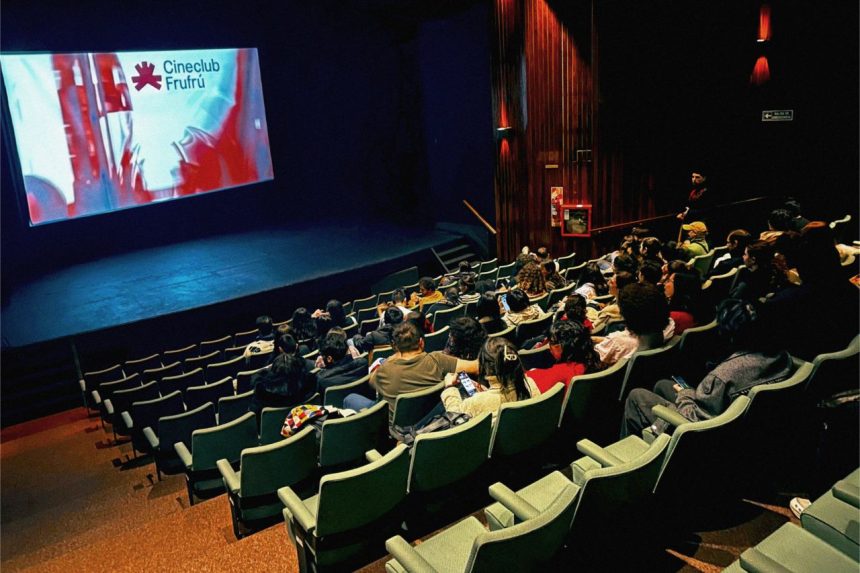
In an old mansion turned bar, Amorina has its own small theater where they screen films — and party afterwards. Expect a younger crowd and a special interest in Argentine cinema. Tickets available online. - Cineclub Frufrú (British Arts Centre, Suipacha 1333)
In the 170-seat Victoria Ocampo Theater, Frufrú‘s 2026 irregular schedule — usually on Wednesdays, two times a month — focuses on experimental, avant-garde films and Japanese animation. - Sala Lúcida (Avda Cabildo 4740)
An independent theater in Saavedra, they host film screenings as well as immersive experiences at the intersection of art, science, and technology. - Club Lucero (Nicaragua 6048, first floor)
On the first-floor screening room above its bar, Club Lucero Filmclub offers drinks and snacks and wireless headphones for a better film-viewing experience. Ticket reservation through their Instagram account - Cineclub Proyecciones Terrestres (Calle 3 1663, La Plata)
In La Plata, Proyecciones Terrestres operates with young, underground vibes in a house you access through a long corridor, offering very diverse programming and a special interest for local filmmakers.