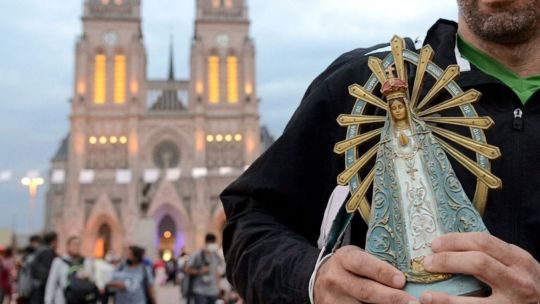
Argentina has changed its religion or, to be more exact, its forms of belief.
A new report – Barómetro de las Religiones y las Creencias en Argentina 2026 – prepared by the OCreAr (Observatorio de las Creencias en Argentina) observatory at the University of Buenos Aires (UBA), shows a profound transformation of Argentina’s religious landscape.
Today, Catholics are still the majority, but no longer the dominant identity capable of structuring the country’s cultural map on its own account.
The figure is conclusive – nowadays 57.7 percent of Argentines identify themselves as Catholic, well short of the 90 percent registered in the 1960 national census. Those without any religious denomination already number 22.4 percent and are now consolidated as the second-largest group, ahead of Protestants on 17.4 percent.
But the real finding is not just the statistics. It is important to understand what they tell us about a changing contemporary Argentine society.
For decades religion functioned as a vast structure for a sense of collective belonging. Catholicism occupied a central place in the construction of the national identity and in the symbolic organisation of social life.
Nevertheless, that link has gradually crumbled. In this new scenario, many are distancing themselves from churches although they continue, believing, praying or maintaining spiritual practices. We sociologists call this phenomenon “religious de-institutionalisation” or “believing without membership.”
Religion is not disappearing but changing. Faith persists but the forms of belonging are increasingly flexible, individual and subject to change. People are choosing, mixing, redefining and believing sui generis.
This transformation of the religious landscape also has a generational face. Among youth aged between 16 and 29, Catholicism has fallen to 44.6 percent, while those without a religious denomination have climbed to 31 percent. Among those aged over 50, in contrast, Catholicism still commands 69 percent of those surveyed.
This is not a passing fashion but a process of generational replacement which will deepen the religious diversification in the next decades – Argentina’s religious map for 2050 is already starting to be written.
There is another especially relevant aspect – religion also expresses social inequalities. The report shows that the lower-class sectors of Argentina’s society have a greater Protestant presence, while those without a religious denomination are on the rise among those with higher educational levels. In other words, forms of belief are also traversed by material conditions, community networks and cultural capital.
This helps us to understand why the growth of Protestantism cannot be reduced to theological or geopolitical explanations. Many churches function as areas of contention, socialisation and concrete aid in territories where the state hardly arrives or ineffectively. Where other institutions have retreated, religious communities occupy an important place and have done so for a long time.
Cities also have their own dynamics. The Buenos Aires Metropolitan Area (AMBA) concentrates higher levels of population without religion, while the interior conserves a stronger Catholic presence. Big cities appear to be labs for new cultural identities, areas where the traditional church memberships lose their weight faster.
The study describes something more than a religious change, portraying a cultural transformation of these times. Argentina is no longer homogenous in its beliefs nor organised around a single religious identity. Pluralism has come to stay.
Comprehending how the forms of belief are changing is not a marginal nor exclusively religious issue. It is a privileged way of understanding the cultural, social and generational transformation of contemporary Argentina.
Understanding how Argentines today believe is one form of understanding the country lying ahead of us.
* Sociologist, doctor of Social Sciences at the University of Buenos Aires (UBA), researcher at CONICET (Consejo Nacional de Investigaciones Científicas y Técnicas) national research council.
** Degree in sociology and doctorate in Social Sciences (UBA), professor of methodology for social research for undergraduate and postgraduate students.
related news
by Mariela Mosqueira* & Gabriela Irrazábal**