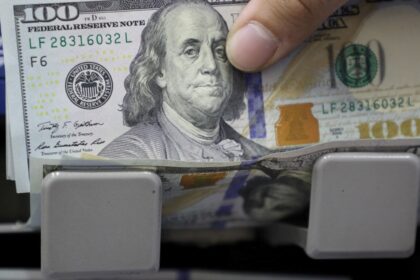
The Argentine government scrapped a restriction dating back to the 2001-02 crisis on Thursday, clearing the way for banks to lend their deposits in U.S. dollars to companies that do not earn foreign currency.
Economy Minister Luis Caputo called the decision a “partial easing” of the restriction, while the Central Bank (in Spanish, BCRA) described it as a loosening of its “prudential framework” for financing in foreign currency.
The resolution will be made official via a decree shortly.
Under the rules in force until now, banks could only lend dollars to companies that either generated foreign currency or could present a guarantee from one that did. The change enacted on Thursday means that the benefit is now open to all companies.
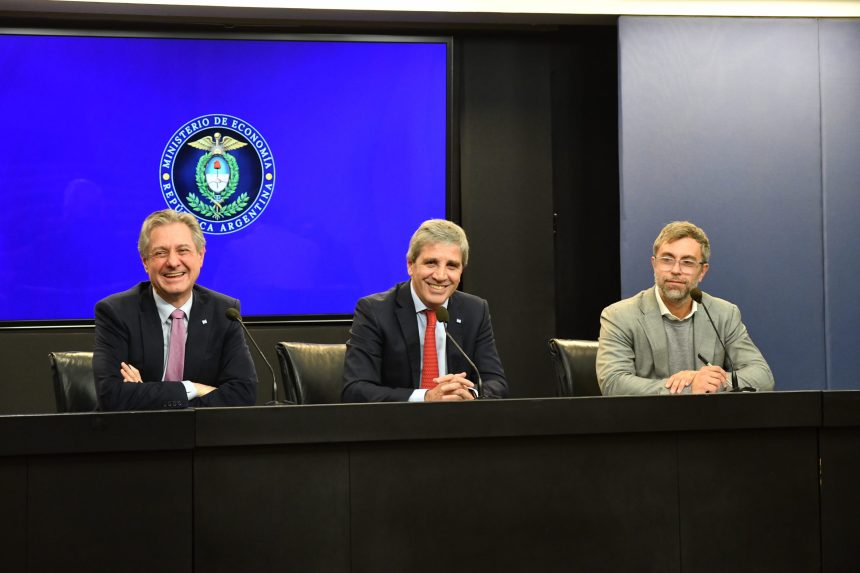
“This is specifically for companies. It does not include individuals,” Caputo told reporters at the economy ministry, flanked by Economic Policy Secretary José Luis Daza and Finance Secretary Federico Furiase.
The minister explained that economic prudency was the reason individuals were left out. An additional reason, he added, was that legal precedents regarding the validity of contracts are firmer when the two parties involved are companies.
In February, sources with knowledge of the matter had told the Herald that the amendment was under consideration, pointing to the specific regulations that were covered in Thursday’s announcement.
You may also be interested in: Government loosens dollar lending rules, raising echoes of 2001 crisis
The guardrails
In the statement, the Central Bank explained that these loans may not exceed, in aggregate, 15% of each bank’s foreign-currency deposits. It also laid out the three conditions guardrailing these operations.
- The minimum capital requirement for those loans will be “125% of what is required for funding in similar circumstances.”
- These loans will account for “1.25 times the exposure they would otherwise represent if not included in this scheme.”
- Banks must assess borrowers’ repayment capacity under “exchange-rate scenarios of varying magnitude.”
The statement went on to say that the measure would be accompanied by a “prudential scheme aimed at ensuring sustainable financial growth, safeguarding the solvency and liquidity of the financial system, and limiting risks tied to borrowers’ potential currency mismatches.”
Market estimates seen by the Herald placed the amount that could actually be lent under the new scheme at around US$5.2 billion, roughly 20% of the current stock of dollar loans.
Caputo said no exchange-rate hedge would be attached to the loans.
“That is a matter between private parties,” he explained, adding that assessing the risk of each borrower is the job of the bank’s own credit department. The Central Bank’s role, he pointed out, is to impose tougher prudential requirements than for an ordinary loan.
Borrowers will still have to convert the proceeds in the official foreign exchange market.
Caputo described the requirement as a way of avoiding what he called a multiplier effect, meaning a situation in which the dollars return to the banks as new deposits that in turn fund new dollar loans.
The minister went on to say that the rule would also add to the market an estimated additional supply of US$3 billion and US$6 billion.
Asked about the restriction and the effect of the 2001 crisis, Caputo said that the rules that caused problems before the end of convertibility remain in force.
Banks at the time, he explained, had lent to provinces at rates as high as 15%. This was funded with 30-day dollar deposits, leaving provinces unable to repay and banks with a large maturity mismatch.
“None of that changes; all of that stays in place,” he said.
You may also be interested in: Caputo unveils new fiscal innocence bill: ‘Keeping stashed dollars is bad business’
Deposits, rates, and the amnesty
Caputo linked the timing to the “fiscal innocence” bill in Congress, which cleared committee on Wednesday and is intended to bring dollars held outside the banking system into it.
The new law introduced changes to the Argentine tax system by loosening controls and raising the threshold for how much money citizens can spend without justifying where the funds came from.
The minister also pointed out that peso borrowing costs remain high, with small companies facing rates ranging from 80% to 100%. Giving companies the option to borrow in dollars, he pointed out, would likely push that number down.
Dollar deposits have risen from about US$14 billion to a record US$40 billion since the government took office. Dollar loans have gone from US$3.7 billion (26% of deposits) to US$24.7 billion (61%).
With a 25% reserve requirement, he said banks could lend US$30.5 billion today against the US$24.7 billion they have lent. This would leave some US$5.8 billion of unused capacity, which he said could grow if the amnesty works.
Economic Policy Secretary Daza explained that the announcement came from an assessment of Argentina’s capital market. While there are savings, most are in dollars and outside the financial system, meaning that they are not channeled into credit and investment.
Daza added that the International Monetary Fund had been informed of the measure and supported it.
Cover image: From left to right, Economic Policy Secretary José Luis Daza, Economy Minister Luis Caputo, and Finance Secretary Federico Furiase (Credit: Economy Ministry).