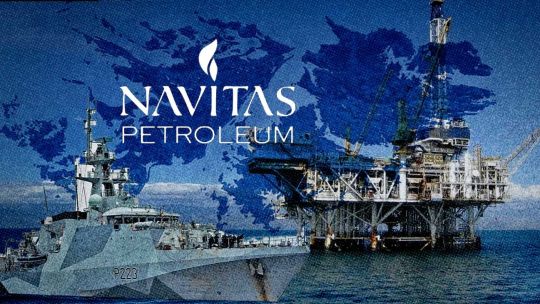
The ambitious Sea Lion mega-project to develop offshore oil in the northern basin of the Malvinas, contemplating an initial investment of US$1.8 billion, is creating diplomatic complications for Argentina with both Israel, a pet ally of President Javier Milei, and neighbours Chile.
The Israeli Company Navitas Petroleum has become embroiled in controversy over its participation in this oil exploration project off the Malvinas, the centre of a sovereignty dispute between Britain and Argentina.
According to an investigation published by the newspaper Perfil, Navitas is reported to control 65 percent of the Sea Lion enterprise but its activities in the zone have yet to receive any public condemnation from the government, unlike the stance adopted by previous administrations.
The publication recalls that companies developing the exploration and exploitation of fossil fuels in the continental platform of the Malvinas have been disqualified by the Argentine state since 2022, a sanction imposed by the Alberto Fernández administration.
True to its total alignment with the state of Israel, the libertarian administration has played this two ways, in complete contradiction. On the one hand, it has stood by the sanction contained in Resolution 240/2022 declaring “clandestine” the activities of Navitas and disqualifying the firm for 20 years for operating in the country.
Also specified in Law 26,659 and its amended versión, Law 26,915, the same norms apply to nine other companies qualifying in disputed áreas: Falkland Oil and Gas, Rockhopper Exploration, Borders and Southern Petroleum, Argos Resources, Desire Petroleum, Premier Oil, Noble Energy Falklands, Chrysaor Holdings and Harbour Energy.
But neither have there been any new administrative or judicial moves since the change of government in December, 2023 – just a Foreign Ministry communiqué rejecting the operations and listing the firms, issued last December 11 and now used as a protective shield, as government sources told Perfil.
The communiqué further detailed that “the legitimate licence holders Rockhopper Exploration Plc, of British origin, and Navitas Petroleum Development and Production Limited, of Israeli origin” have no permits from the competent national authority to develop the “Sea Lion” deposit located in the Northern Malvinas Basin off the Malvinas.
“The rejection extends to all activities linked to advancing the productive phase of the project, including the adoption of self-styled island norms, concessions to exploit the Argentine continental platform, contracting service providers and every other move or decision linked to the illegal activities of exploring and exploiting fossil fuels in Argentine continental platform near the Malvinas Islands,” added the Foreign Ministry.
This was followed by a promise which has not been kept until now.
“Due to the gravity of this situation, Argentina will deepen its action plan with the aim of adopting all additional measures, in full compliance with international law, which it considers necessary to safeguard its sovereign rights and interests,” were the words.
In Government House they answered a question from PERFIL by saying that Foreign Minister Pablo Quirno had dedicated himself to talking about this issue at international forums – specifically, the Organization of American States (OAS) and the United Nations. But on the other hand, no further action has been taken.
The controversy took on new dimensions after a visibly uncomfortable presidential spokesman Adrián Ravier recently admitted ignorance of the situation when consulted by journalists at a press conference last Tuesday. The Foreign Ministry subsequently pointed out that it would deepen analysis of the case.
“That’s all I know for now. We’d have to go into more depth with the Foreign Ministry,” said Ravier.
The Foreign Ministry later ratified the historic Argentine stance on the Malvinas issue, assuring that it would continue adopting the measures provided by international law to safeguard the country’s sovereign rights.
Navitas Petroleum was founded in 2015 and has offices in Herzliya (Israel), Houston (Texas) and London with a portfolio of 14 assets linked to developing projects to explore and produce oil and gas in different international markets. These included the centre of this controversy, Sea Lion, a deposit around 220 kilómetres north of the Malvinas discovered in 2010.
The link between Navitas and Sea Lion dates back some five years ago to the purchase of Harbour Energy’s share in the investment scheme. The British Company pulled out when it considered that this asset did not fit into its global strategy. From then on, Navitas has controlled 65 percent of the Enterprise with the remaining 35 percent in the hands of Britain’s Rockhopper Exploration.
Navitas is headed by Gideon Tadmor, a pioneer of the Israeli energy industry who helped to discover the Tamar and Leviathan oilfields in the Eastern Mediterranean, while the CEO is Amit Kornhauser, a former financial director of Navitas and Delek Energy with no Argentines listed on its board of directors or its main institutional shareholders.
Last March during a presentation to Navitas investors, Kornhauser mentioned that he had heard some statements by the Argentine president permitting him to interpret that he supported the right of the islanders to self-determination and that he did not consider the Malvinas issue to be a pending political conflict.
At the same presentation, Kornhauser maintained that the Final Investment Decision of the Sea Lion project was advancing “with no interference” from the Argentine government and with the “full support” of the British authorities and the islanders.
At the same time project director Ian Ramsey affirmed that the Israeli firm was recognised as a “competent authority” by island authorities and by British government advisors with no official reply to those statements emerging from the Foreign Ministry.
During his Independence Day visit to Israel last April, Milei did not raise this issue in his meetings with Iraeli prime minister Benjamin Netanyahu nor meet with executives of the energy sector nor specifically mention the Sea Lion project, despite having previously, on the April 2 anniversary of the Malvinas war, described the activities of the initiative as “unilateral and illegitimate,” promising “all the diplomatic action necessary.”
The investigation raises questions about the political alignment between the Milei administration and Israel and the impact which the participation of an Israeli company in an oil project in an area whose sovereignty is claimed by Argentina might have.
Meanwhile Chile’s Easter Island Naviera (EIL) has embarked on formal negotiations with the British colonial authorities on the islands, thus a new chapter of tension for Argentine diplomacy to the South Atlantic geopolitical and economic scenario.
The negotiations seek to join the scheme of maritime logistics supplying future oil exploitation in the archipelago.
As confirmed by sectorial sources, representatives of the firm held meetings with the Falkland Islands Development Corporation (FIDC) while making contact with over a dozen local companies and the Chamber of Commerce on the islands. The central aim of the shipping company, which habitually operates the sea lanes between Valparaíso and Easter Island, is to consolidate a regular maritime monthly route from Punta Arenas geared to supplies in general and to energy infrastructure.
These dealings of the Chilean firm coincide with the advance of the ambitious Sea Lion oil project in the northern basin of the islands. This enterprise, headed by the Israeli company Navitas Petroleum in partnership with Britain’s Rockhopper Exploration, plans to commence the commercial extraction of crude oil as from 2028.
Contemplating an initial outlay of US$1.8 billion, the development plan seeks to extract over 170 million barrels of oil out of estimated reserves in a primary phase with a projected expansion which could double that figure. The potential value of the deposits in the long term could top US$10 billion.
From the perspective of the Argentine state, such activities are considered an illegal exploitation of natural resources in waters and territories whose sovereignty is illegitimately occupied by the United Kingdom within a dispute recognised by the United Nations.
The interest of the Chilean shipping company is not an isolated fact but falls within a network of pre-existing commercial links between southern Chile and the archipelago. LATAM airline currently operates the main continental air connection with the military base at Mount Pleasant while various Chilean firms cater to the island fisheries, food supply and infrastructural import needs.
Both the FIDC executive director Zachary Franklin and project manager Sam Cockwell valued the advance of conversations, describing a “clear interest” in reviving a permanent maritime route between the continent and the islands.
This new development comes in a climate of growing diplomatic unrest:
-
In recent weeks the Foreign Ministry presented a formal protest to the British government over the warship HMS Medway sailing through disputed waters before crossing the Straits of Magellan. The protest was dismissed by the Foreign Office.
-
Bad blood with Chile: The participation of the Chilean Navy in protocol ceremonies during a Royal Navy stopover in Punta Arenas was emphatically rejected.
-
Congress pressure: At local parliamentary level, opposition caucuses demanded from the government a detailed report on its strategy in the face of illegal fishing and the advance of unilateral oil licences in the exclusion zone.
– PERFIL