As Argentine children race to collect stickers and complete their 2026 Men’s Football World Cup albums ahead of the tournament that starts in June, a local artist has decided to use the craze to pay homage to two of the most important human rights organizations in the country.
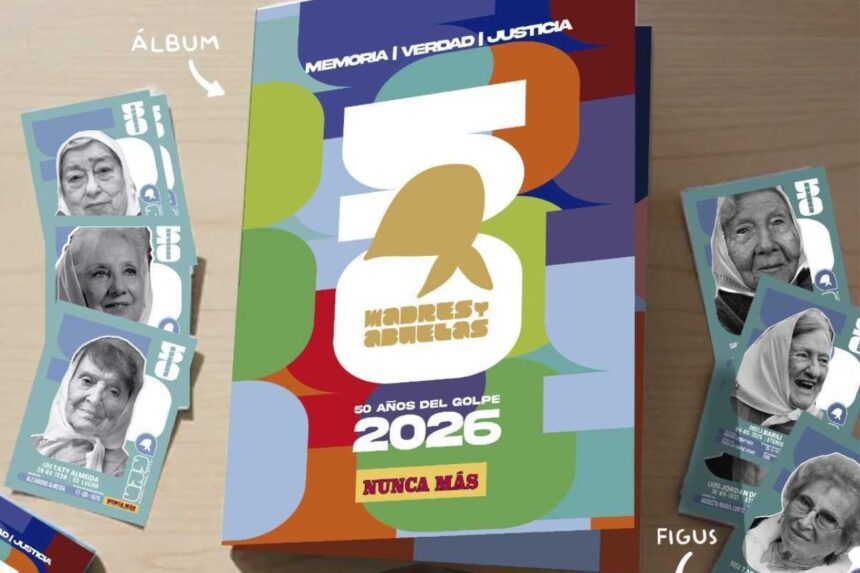
Ariel Cuadra created an album that features members of the Mothers and Grandmothers of Plaza de Mayo instead of the traditional football players.
The digital album is inspired by the popular World Cup album sold by Italian publisher Panini, but with a twist aimed at raising awareness about the work of the Mothers and Grandmothers, just two months after Argentina marked the 50th anniversary of its last military coup.
The album and stickers are available for free online in PDF format and can be downloaded here.
They can be printed, cut out and pasted into the album as an activity for families, schools, cultural centers, and other community spaces.
Each sticker features the full name of a Mother or Grandmother of Plaza de Mayo, along with personal details such as their date of birth and the names of their disappeared children.
For the Grandmothers, Cuadra also included the names of their stolen grandchildren.
Cuadra told the Herald that the goal of releasing it online for free was for “everyone to be able to access it.”
“I created it out of a need to preserve memory, and for that to happen, there had to be no financial barriers to receiving it,” he said.
World Cup fever
As the World Cup nears — it will begin on June 11 — sales of the Panini album and the stickers skyrocketed, so Cuadra wanted to take advantage of that to create something meaningful.
The album was released in collaboration with human rights organization H.I.J.O.S., which groups children of dictatorship victims, many of whom were stolen as babies and grew up to find their true identities. Some of them were also able to reunite with their grandmothers and families.
“I believe that shifting the focus from sports idols to our idols of democracy is the main aim of my project, and that it also serves as a learning tool for community groups where information about the Mothers, Grandmothers, their children and grandchildren may not be as widely available,” the artist said.
The project was launched in a context where “members of the ruling party visited perpetrators of genocide in prison, where people are encouraged to look the other way, and where forgetting and misinformation are promoted,” he said.

The album, Cuadra added, is a medium children and young people are familiar with, which may make sharing information about this easier for families and schools.
“Perhaps through it, we can generate greater engagement with these issues and collectively pass on the memory.”
“At a time in which memory is being attacked by the government led by Milei and Vice President Victoria Villarruel, we found this initiative to be a creative and accessible tool,” H.I.J.O.S. member Giselle Tepper told the Herald.
The search, she said, lives on: “We still do not know where the bodies of thousands of disappeared people are, nor the whereabouts of our brothers and sisters who were taken and still do not know their true identity.”
The stars of the album
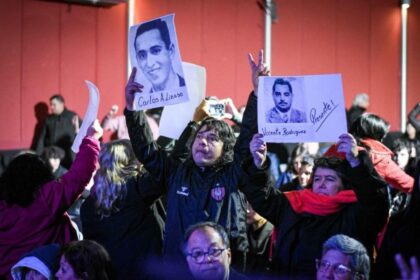
The project includes 16 stickers of members of the Mothers and Grandmothers of Plaza de Mayo, as well as the NGO Relatives of People Disappeared and Detained for Political Reasons.
There are four additional stickers that picture some of their protests in Plaza de Mayo, in front of the presidential palace, the Casa Rosada.
Among the iconic women featured in the album are Estela de Carlotto, president of the Grandmothers of Plaza de Mayo; Taty Almeida, head of the Mothers of Plaza de Mayo-Founders’ Line; and emblematic Mothers who passed away, including Nora Cortiñas, Hebe de Bonafini, and Azucena Villaflor.

In an introductory text in the album, Cuadra described them as “women who are indispensable to our democracy, many of whom have already passed away but remain eternal in the collective memory.”
“We hope this project will bring us together to learn a little more about our heroes of democracy: those who, with boundless strength, dribbled their way through the darkness so that Argentina could live in democracy and so that justice might prevail over those who still seek to keep it in the shadows,” the text says.