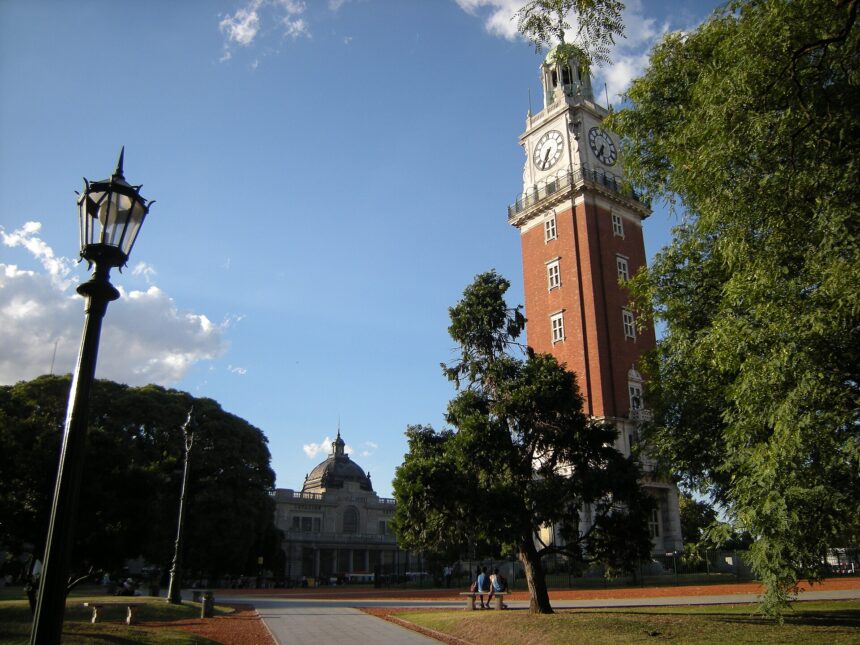
Buenos Aires City celebrated the 110th anniversary of the Torre Monumental, also known as the Torre de los Ingleses, on Sunday with a public cultural and heritage program aimed at showcasing the monuments history, architecture, and cultural legacy. The towers esplanade on the Fuerza Area Argentina square, across the street from the Retiro train station, hosted an afternoon of live music, historical reenactments, vintage Ford automobiles, and free guided visits to both the clock mechanism and the panoramic viewing gallery. Authorities presented new signage for the viewing gallery and common areas, along with a refreshed museographic layout. The city also unveiled the renovated exterior lighting system, developed in coordination with the General Directorate of Public Lighting. An institutional signing ceremony was held to commemorate the anniversary. Representing the British community who donated the clock tower as part of the 1910 celebrations for the first centenary of Argentine independence were Gavin Bruce, chairman of the ArgentineBritish Community Council, and John Hunter, chairman of the British Cemetery of Buenos Aires. The diploma was signed by General Director of Heritage, Museums, and Historic Districts (in Spanish, DGPMYCH) Pedro Aparicio; Escuela Taller Director Graciela Labato; Deputy Heritage Manager Horacio Padula; DGPMYCH Communications and Content Director Mariano Oropeza; DGPMYCH Chief of Staff Andrea Nagy; and Villa Devoto School Director of Institutional Relations and Admissions Graciela Grandi. It will also be signed by BA City Mayor Jorge Macri, Culture Minister Gabriela Ricardes, and UK Ambassador David Cairns. The diploma will be presented in the towers entrance hall. The towers history The Torre Monumental, inaugurated in 1916 and built entirely with materials imported from the United Kingdom, remains one of the citys most recognizable symbols and a testament to the longstanding cultural links between Argentina and the United Kingdom. In 1909, British residents in Argentina resolved to present a memorial to the Argentine nation for the 1910 centenary of the May Revolution. A committee of British residents was formed to plan and fund the gift. Proposals considered included a statue, a lighthouse, and a park, but the committee chose a clock tower as the most fitting memorial. The project was presented to the Argentine Congress, which accepted the British offer and directed the municipality to approve the blue prints for the tower and move forward. After initial alternatives, it was decided that the project would be located on a site in Retiro (known at the time as Plaza Britnica). The design was by Ambrose Macdonald Poynter, who came out on top in a design competition. The north cornerstone of the terrace was laid on 26 November 1910, in a public ceremony attended by Argentine and British officials. The tower was built largely from concrete, Portland stone, and red English facing brick; steel was used sparingly. Work proceeded under local contractors with technical oversight from the committee and British consulting engineers. The style follows English Renaissance motifs. It is square with an octagonal drum and cupola, surmounted by a gilded weather vane in the form of a threemasted frigate. Clock faces are four illuminated dials, each 4.4 meters in diameter. The hour bell weighs about five tons. The quarter-chiming bells total just over three tons and sound the Westminster chimes. The interior includes a waiting room, lift access to galleries, and stone carving of British and Argentine arms. The tower was formally presented on May 24, 1916, as a celebration of Empire Day, a historical holiday first celebrated in the UK in 1902 to honor Queen Victoria’s birthday. The ceremony was attended by the then Argentine President Victorino de la Plaza, British dignitaries led by Minister Reginald Tower, municipal authorities, and the Clock Tower Committee.
Torre Monumental marks 110 years with heritage celebration in Retiro


Leave a Comment