Colombia will hold elections on May 31 to choose its next president. The winner will succeed current President Gustavo Petro, who cannot seek reelection because Colombian law prohibits consecutive presidential terms.
Fourteen candidates will compete in the race, with three currently coming at the top of the polls: left-wing Iván Cepeda — the contender backed by Petro — far-right Abelardo de la Espriella; and traditional right candidate Paloma Valencia.
The next president will face major challenges, including a widening fiscal deficit, high levels of debt, worsening security conditions, and the management of the armed conflict with guerrilla groups.
The strategy for addressing the latter could vary drastically depending on who wins.
What will Colombians vote?
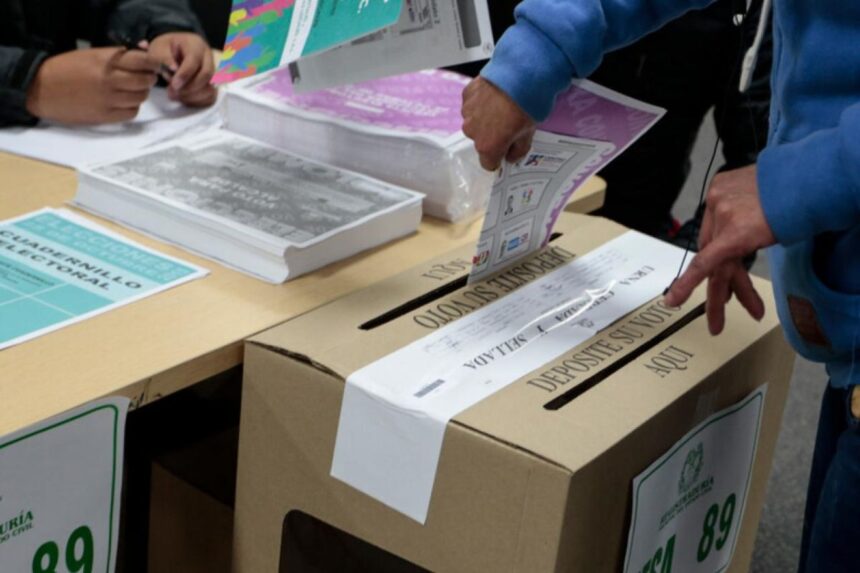
On Sunday May 31 Colombian electors will vote for president and vice president for the 2026-2030 period. The winners are set to take office on August 7.
Candidates must secure more than 50% of the vote to win outright in the first round. As no candidate appears likely to reach that threshold, according to opinion polls, a runoff election is expected on June 21.
Legislative elections were held in March to renew both the Lower House and the Senate. President Gustavo Petro’s party, Pacto Histórico (Historic Pact), finished first with 23% of the vote, followed by the centre-right Centro Democrático (Democratic Centre) party (16%), founded by former President Álvaro Uribe.
What do the polls say?
Senator Iván Cepeda, from Pacto Histórico, is leading the polls a week from the election, with between 35% and 44% of vote intention, according to surveys published in the past few days.
Center-right Senator Paloma Valencia (Centro Democrático) and far-right businessman Abelardo de la Espriella, from Defensores de la Patria (“Defenders of the Homeland”), are disputing the second place, which would secure them a spot in the runoff.
While more recent polls show De la Espriella gaining an advantage over Valencia, the result is far from certain, as a fragmented electorate could still produce a different outcome.
Who are the candidates for Colombia’s 2026 presidential election?
Cepeda represents the continuation of President Petro’s progressive agenda, with support from farmers and indigenous groups. His proposals include implementing a universal basic income for vulnerable sectors and advancing wealth redistribution policies.
The lawmaker is a philosopher and human rights activist. He is also one of the architects of Petro’s “Total Peace” strategy to resolve the conflict with armed groups that has plagued Colombia for decades.
The approach centers on dialogue and negotiations aimed at reducing violence, securing ceasefires, and dismantling guerrilla organizations.
De la Espriella, an independent outsider nicknamed El Tigre (“The Tiger”), represents the opposite end of the political spectrum. Among his proposals is a complete reversal of the “Total Peace” strategy, which he has strongly criticized.
Among other measures, he has proposed bombing armed groups and adopting a tougher stance against drug trafficking, as well as replacing illegal coca plantations — the raw material used to produce cocaine — with crops such as cocoa and African oil palm.
Drug trafficking, particularly cocaine production and exports, is widely considered one of the main sources of funding for guerrilla groups.
Valencia, of the Centro Democrático party, represents a more traditional conservative wing of the right and is backed by former President Uribe.
Among her campaign proposals are tougher measures against illegal immigration, strengthening the security forces, and increasing funding and resources for the public healthcare system.
She has also pledged to address the country’s energy supply crisis through measures such as diversifying energy sources and launching a program to replace household appliances with more energy-efficient alternatives, with the aim of lowering costs for consumers.
What challenges will the next president of Colombia face?
While President Gustavo Petro is expected to end his administration with relatively high approval ratings — around 40% — he will leave several major issues unresolved.
“He is leaving the country with severe debt levels, weakened in the face of criminal threats, and a deeply divided country due to significant political polarization — a divide President Petro has not sought to bridge,” political risk analyst Sergio Guzmán told the Herald.
“Petro has not been a balm for a wounded country; rather, he has been a spark that has set it ablaze,” added Guzmán, co-founder and director of Colombia Risk Analysis.
For Guzmán, the next president’s main challenge will be tackling the country’s high fiscal deficit and mounting debt burden. “Colombia is currently borrowing at rates of 15%. Some estimates suggest the country will need a fiscal adjustment equivalent to about three percentage points of GDP over the next four years,” he said.
Secondly, Colombia is facing deteriorating security indicators, particularly in rural and border regions. According to the expert, the next administration will need to devote significant resources to restoring security, potentially “costing lives” if military operations against armed groups intensify.
Another major issue will be the healthcare and social security system, which the analyst said is suffering from “chronic underfunding” under Petro.
“This would force the next government to take drastic measures regarding social security, allocating more resources to the sector in order to save it,” he added.
Guzmán said that, if Cepeda wins, “he would not aim to save the healthcare sector, but rather deepen the current crisis.”
A shift to the right?
While Cepeda is expected to win the first round on May 31, the race could turn around in a runoff, as right and center-wing voters are likely to split their support between the two conservative candidates.
In a second round, however, most of those votes could shift to his right-wing opponent, similar to what occurred in Chile’s 2025 election, when far-right candidate José Antonio Kast defeated left-wing rival Jeannette Jara despite Jara having finished first in the initial round.
“In the rest of Latin America, the pendulum has moved between left and right. In Colombia it moves between peace and war,” Guzmán said.
“Right now, under Petro, it is on the side of peace, and the same would happen if Iván Cepeda wins. But it seems that if other candidates win, the pendulum would go to the opposite side.”
However, Guzmán stressed that while “most Colombians are dissatisfied with the security situation,” if a candidate advocating tougher security policies wins, it does not necessarily mean their most hardline proposals will become reality.
“Any shift depends on the institutional and legal capacity to implement it,” he said. Measures such as De la Espriella’s proposal to intensify military attacks against guerrilla groups would likely require approval from Congress or the Constitutional Court.
“Governments with more extreme positions would be constrained by legal and institutional limits when trying to implement some of these programs,” he added.