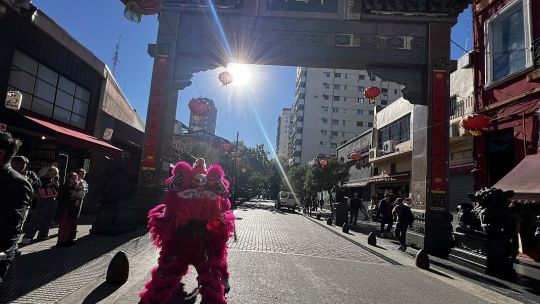
Under the imposing arch of Calle Juramento, guarded by stone lions who seem to be keeping watch over the pulse of the city begins a journey which is not only geographical but also emotional. Carlos Lin – a spokesman of reference for the Chinese community in Argentina – stops in front of the entrance to Barrio Chino in Buenos Aires.
As the crowd gathers, he explains that what everybody today sees as a shopping arcade was in reality born with a much more intimate purpose – to “kill” or rather help deal with the nostalgia of those at a world of distance from their home.
Walking down Calle Arribeños, through the centre of Barrio Chino, today is to understand a process of cultural maturity.
Carlos points to the 11-metre arch, donated by the community in 2008, the year of the Beijing Olympics as a symbol of gratitude to the country giving them shelter but also as a reminder of their roots. At the top the words “Chong Quo” can be read. Lin explains that the inscription does not mean “China” but “Middle Kingdom” – this is a name based not on ego but on the quest for balance and harmony, fundamental pillars of Chinese philosophy.
From the 1980s
The official history of Buenos Aires’ Barrio Chino starts on a clear date: 1984. Back then, the neighbourhood of Belgrano was very different.
Everything began with the idea of satisfying a need. The Song family was not seeking to create a tourist hub but to offer aid to the families meeting every Sunday at a nearby cultural centre to watch Chinese films and share the solitude of the immigrant.
Mr Song understood that in order to feel at home, they needed the flavour from over the waters – rice and the spices not to be found on this city’s supermarket shelves began to arrive, thus founding the popular Casa China market, which today occupies the space of three normal shops, side by side.
The breakthrough, mass interest, came little more than a decade ago. In 2010, a group of youngsters decided to celebrate Chinese New Year – which until then had been an indoor festivity for the community – on the street, mounting a small stage and taking a dragon around the corner. The magnetism was immediate. The Belgrano neighbours pressed up against the railings to see the dance performance and percussion, transforming a private ritual into a civic festivity which today gathers thousands nationwide.
Touring the zone today leads to the discovery that art is also on offer. Carlos presents to the crowd Índigo, an artist who 12 years ago, when the neighbourhood was still not in fashion, began to daub its dark walls.
One of his most significant murals is that of a horse, which includes the Ma Dao Cheng Gong phrase: “Immediate success arrives with the horse.”
Lin explains that in Chinese culture, the Year of the Horse is the time to reap what has been sown, a transition towards the success which today stands reflected in the renewed face of the streets.
Via Viva
The transformation of the neighbourhood has been breakneck. What began with barely 28 families meeting to watch films every Sunday has expanded to a site taking up eight blocks. Carlos highlights the contrast between the traditional part of Arribeños and the new ‘Vía Viva’ area underneath the railway tracks of the Mitre line.
This modern sector has not only brought new shops but also integrated the neighbourhood with international tourism, succeeding in having the GrayLine tourist bus modify its route to enter directly via Avenida Juramento.
The neighbourhood’s present is a dialogue between the ancient and modern. While the traditional part maintains the historic restaurants and the Buddhist temple – where a monk awaits visitors amid aromas of jasmine and cardamom – the new route underneath the railway tracks has made the neighbourhood grow exponentially in a single year, integrating shops offering design and technology in a vanguard structure.
Looking ahead to the future, the most ambitious project is the creation of a first radio station in the Chinese neighbourhood. This station will not only be local, functioning as a live bridge connected to a university in Beijing and permitting direct transmissions between two of the most distant points on the planet.
For Carlos Lin, the neighbourhood will continue being a hotspot of cultural resistance where martial arts grandmasters like Gonzalo and Germán Bermúdez, who keep alive the dance of the lion and the dragon, and old neighbours like Mr Sie, who from his window sees how this “Middle Kingdom” keeps growing in the heart of Buenos Aires, all live together.
Today it is a triangle which does not stop expanding. The spirit of those pioneers of 1984 stays alive. As Carlos Lin says, “the neighbourhood has seen us grow and today invites us to touch the sphere of wisdom in the lion’s claws and make a wish for the year to come, as well as giving thanks for what has happened in the sphere of the lioness.”