‘They are still writing’: 50 years of the ‘Night of the Pencils’ kidnappings
 Buenos Aires HeraldUpdated 2 hours Ago4 Mins read

“We’re already dead. But every New Year’s Eve, raise your glass for us.”
Claudia Falcone was 16 when she said goodbye to her friend and schoolmate Pablo Díaz. He was about to be released from Pozo de Banfield (Banfield Pit), the death camp where the pair had been illegally held by police for months. It was December 1976, and the country was ruled by a ruthless military dictatorship that would go on to disappear more than 30,000 people.
Falcone, a fine arts student, remains a desaparecida. Díaz would survive and later go on to tell the story of how they were both kidnapped and tortured in what is one of the most harrowing chapters of state terrorism in Argentina: the “night of the pencils.”
The “truth machine” State terrorism had been ravishing Argentina since late March 1976, when a military dictatorship death squad kidnapped 6 high school students in La Plata, the capital of Buenos Aires province, on the night of September 16.
Two more students were taken the following night and a third on September 21. The abduction was part of a bigger operation that had begun on September 8, when one student was kidnapped. All ten were taken to clandestine detention centers, where they were viciously tortured by Buenos Aires state police.
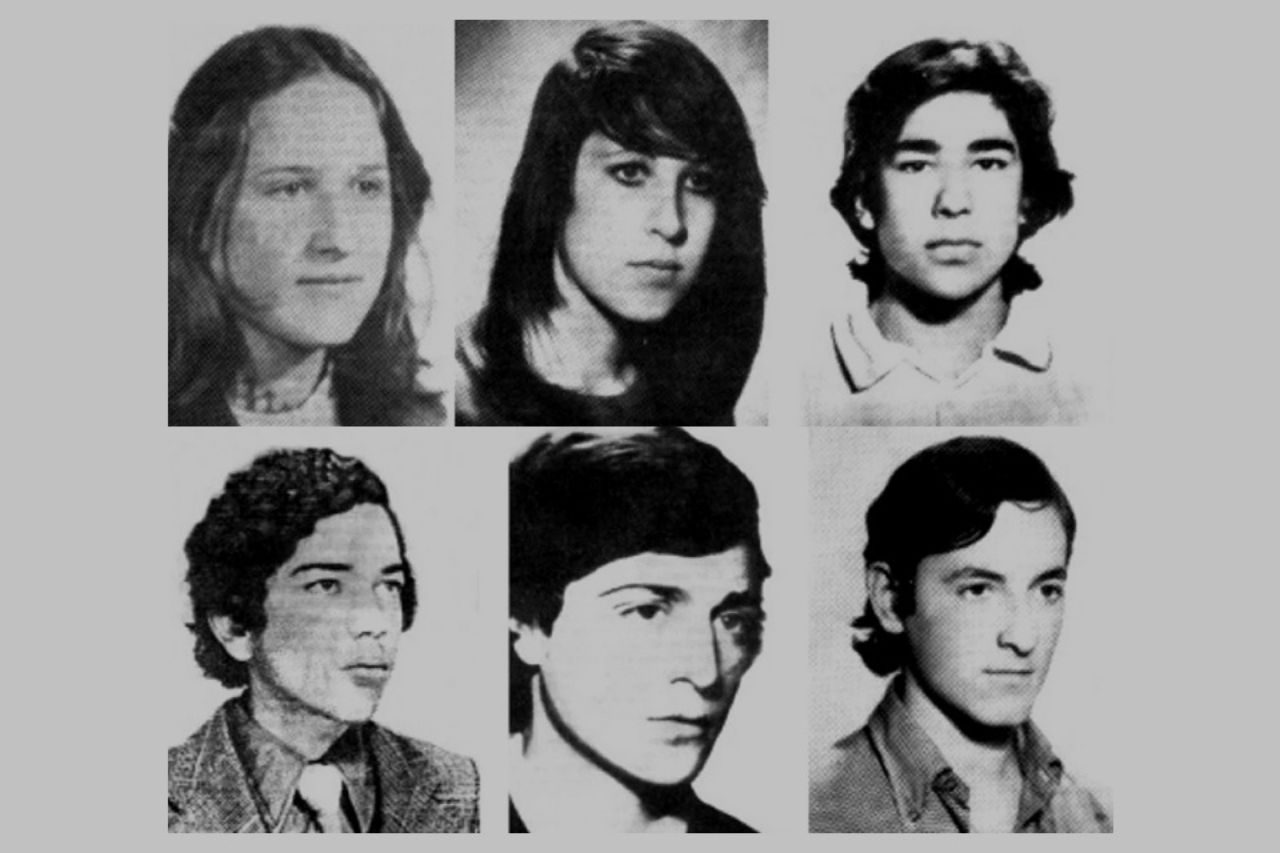
The group of 6 taken were Claudia Falcone (16), Francisco López Muntaner (16), María Clara Ciocchini (18), Horacio Ungaro (17), Daniel Racero (18), and Claudio de Acha (18). Emilce Moler and Patricia Miranda, meanwhile, were taken the following night.
Top left to right: María Clara Ciocchini (18), Horacio Ungaro (17), Claudia Falcone (16).
Bottom left to right: Claudio de Acha (18), Daniel Racero (18) and Francisco López Muntaner (16) Pablo Díaz, a close friend of Falcone who would go on to become a major witness of what they endured, was kidnapped on the 21st — an eerily symbolic date, as it commemorates Argentina’s own Students Day. Gustavo Calotti had already been taken on September 8.
While most of them had been involved in student activism, at least one (Miranda) hadn’t been involved in any kind of political activity.
In María Seoane and Héctor Ruiz Núñez’s 1986 book “Night of the Pencils,” Díaz gives a detailed account of his ordeal, pointing out how he remembered sighing with relief when his captors told him he would undergo a session with the “truth machine.”
Believing he was going through a polygraph test, he asked them to hurry so he would clear his name and walk free. But the machine was an electric prod, and the torture sessions began.
At the detention center he was being held, he was shocked all over his body, including his genitals, while he was interrogated about his activism and asked to give the names of his fellow students. He would later face a fake firing squad, blindfolded and hearing other teenagers next to him cry for their mothers, believing they were all about to die.
On December 29, 1976, he was “legalized” as a political prisoner and transferred to Unit 9 prison of La Plata. He regained his freedom in 1980. He was one of only four to make it out alive (Calotti, Miranda, and Moler also survived).
A ‘subversive seedbed’ The deliberate targeting of high school students by the military dictatorship was based on what the military perceived as a potential source of future members of guerrilla organizations.
The involvement of the middle class in political activism had been a feature of Argentina’s society in the late 1960s and early 1970s, with young people becoming more and more active players in politics.
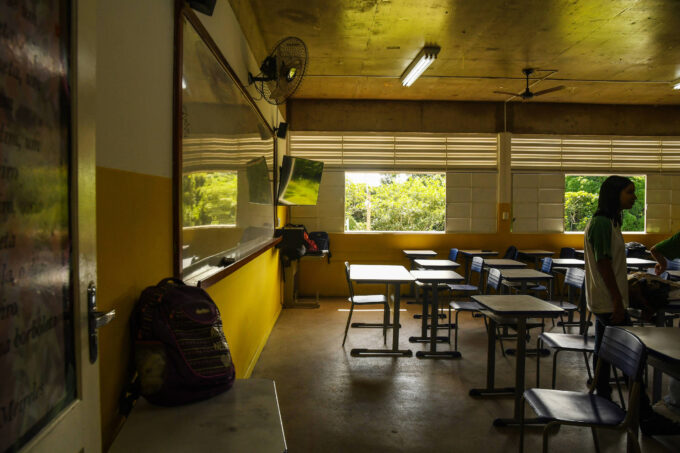
High schools and universities became intense political spaces, organizing building occupations, assemblies, leaflet campaigns, and graffiti. The demands ranged from specific, localized issues to broader calls for change.
Marches demanding the High School Student Fare (in Spanish, BES) took place against this backdrop of intense social and political unrest and growing violence. During September 1975, large numbers of young people took part in demonstrations in La Plata and other cities.
After the military coup in March, 1976, student groups — often associated with revolutionary organizations like Montoneros and the People’s Revolutionary Army — were particularly targeted by repression forces.
“It wasn’t the bus fare. They wanted to change the world” “The pencils are still writing” According to records by the Provincial Commission on Memory, at least 349 high school students were killed or disappeared during the military dictatorship. The National Commission of Disappeared Persons report “Nunca Más” stated that around 20 percent of disappeared victims were students.
For years, the narrative around the “night of the pencils” stated that their “crime” had been advocating for a student’s discounted bus fare the year before. Years later, though, undisclosed police documents proved that the overall goal of the operations — which had included many other kidnappings of students — was to eradicate a “subversive seedbed.”
Across the country, other major kidnappings had also taken place around that time. Among them were 12 students of the Escuela Nacional de Educación Técnica N° 1 in Bahía Blanca, taken between December 16 and 26, 1976.
In the Banfield district of Buenos Aires province, an entire class of the Escuela Normal Superior Antonio Mentruyt (ENAM) was decimated, with 30 students kidnapped and disappeared between May and August of 1977.
A testimony and a film Díaz and the rest of the survivors managed to tell their story following the return of democracy in 1983. Diaz’s testimony at the Trial of the Juntas in 1985, describing Claudia’s last goodbye in tears, became one of the most iconic and made him the face of the Night of the Pencils.
The La Plata episode inspired a film by Héctor Olivera, The Night of the Pencils, based on Seoane and Ruiz Núñez’s book. The films starred Alejo García Pintos as Díaz and Vita Escardó as Claudia, and a group of rising young stars, including Leonardo Sbaraglia.
La noche de los lápices Alejo García Pintos and Vita Escardó Shot in La Plata, the film became a box office success. Together with Oscar-winning The Official Story, it became a landmark about Argentine cinema tackling the story of the dictatorship. Forty years later, García Pintos would play one of the judges who tried the military leaders in Santiago Mitre’s Argentina, 1985.
“The ‘Night of the Pencils’ will be the story of all the high school students persecuted during the dictatorship; it will be the story of all the high school students persecuted today; it will be the story that the high school students of tomorrow want it to be,” Díaz told state news agency Télam.
In March of 2024, La Plata’s Federal Court #1 sentenced former military government official Jaime Lamont Smart and former medic Jorge Bergés to life in prison for the killing of the students. The ruling was part of the “Brigades” trial for crimes against humanity, which resulted in a dozen convictions — most of them life in prison sentences — for crimes committed by Buenos Aires province police brigades.