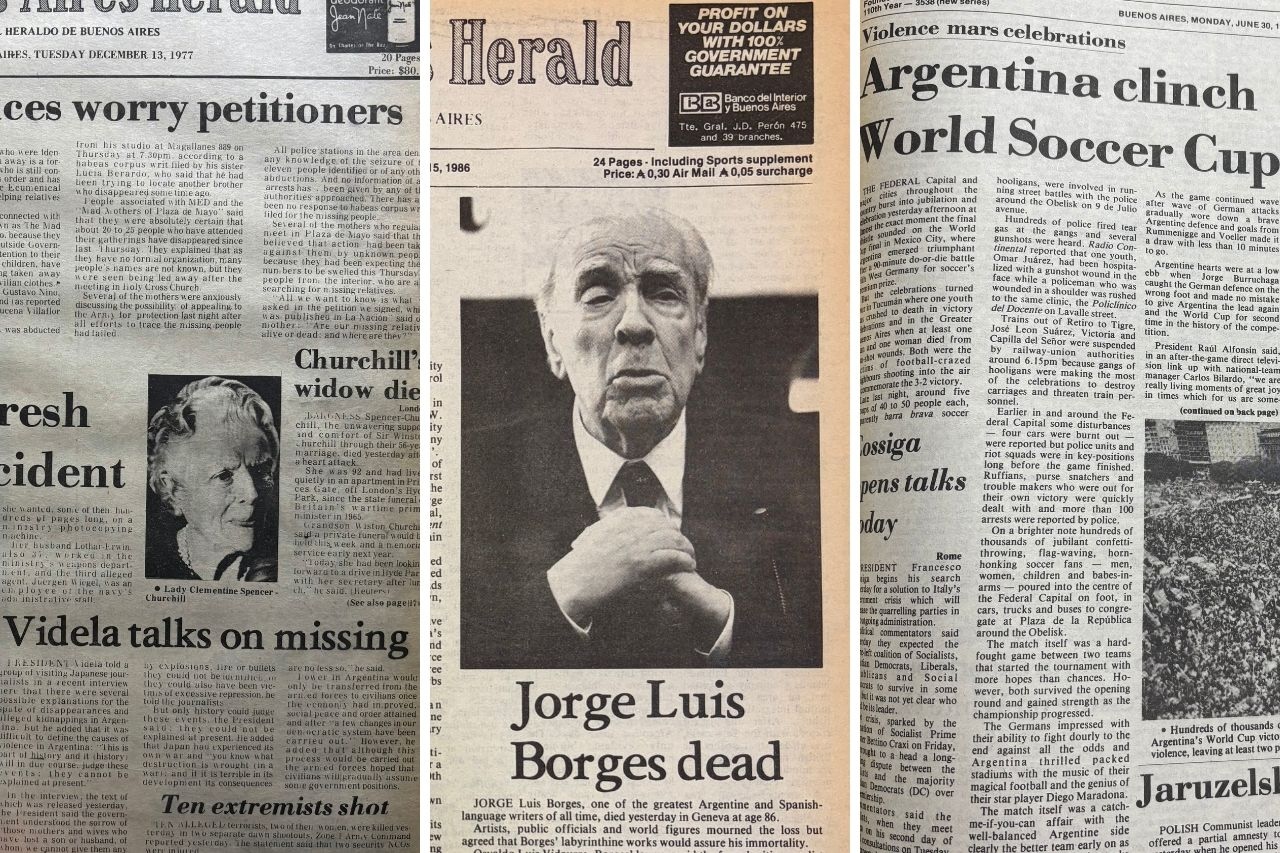
150 years of news in English: 6 front pages from the Herald’s archive
 Buenos Aires HeraldUpdated 1 hour Ago8 Mins read

It was September 15, 1876, when Scottsman William Cathcart published the first edition of a new martime and trade news bulletin. It had only two pages, with commercial ads from British companies on the front page and news on the second. Initially called “The Herald,” at the turn of the century it adopted the name it would eventually build its singular legacy on: The Buenos Aires Herald.
150 years later, it’s still going strong.
Across a century and a half, many things have changed. Some things, dramatically so. Empires and brutal wars have come and gone, decimating and reconfiguring the landscape of entire continents in the process. From its newsroom in Buenos Aires, the Herald sought to bring information to its readers and place it in the appropriate context, trying to make sense of the world and Argentina’s place in it.
The Herald’s initial mission quickly expanded from just maritime news to the broad set of topics that make up contemporary news reporting, from international events to economic trends, sports, and culture.
Covering local politics and developments has long been a key part of the Herald’s mission, making its archive arguably the most comprehensive record of Argentine history in English. To mark the anniversary, we delved into those archives to showcase six front pages devoted to some of the most significant local events covered by the paper.
A quick disclaimer: the majority of covers seen belong to the past 50 years, a decision partially based on the fact that this was when the Herald turned its attention more sharply to what was happening in Argentina.
This is also the period for which we have the most print editions available, as much of the Herald’s archive from the first 100 years of its history (1876–1976) is preserved primarily on microfilm. We are currently working to restore those records and make them available to our readers.
The end of an era Juan Domingo Perón died on July 1, 1974. The founder of the Peronist movement was the only Argentine president elected to three terms and is considered the most important — and controversial — Argentine politician of the 20th century, whose influence continues to this day.
He passed away just ten months after becoming president for a third time, in October 1973, following 18 years in exile, mainly in Spain. He was 78. The Herald reported that the government announced two days of mourning and covered the first speech by his successor, María Estela “Isabel” Martínez de Perón, his wife, whom he had named vice president.
Perón’s body was first transported by hearse to the Metropolitan Cathedral of Buenos Aires for a funeral Mass. Afterwards, it was taken to the National Congress, where it lay in state for the next 46 hours, during which more than 130,000 people filed past his coffin. Finally, the funeral procession traveled 16 km to his residence in Olivos and was followed by one million people.
The coup that unleashed Argentina’s darkest hour The most critical time in Herald‘s history began on March 24, 1976, when the Argentine military overthrew President Isabel Perón, unleashing the most deadly dictatorship the country had ever experienced.
The paper’s front-page article covers reactions from Congress and unions, as well as details on the ousted government’s last moves and how military forces were moving across the country. It also included descriptions, like the following paragraphs, of how the population went about their day, evidencing that the coup was perceived as a matter of “when it would happen” and not “if.”
“The armed forces virtually gave the government advance notice of their plans. But the tanks began rolling, and the troops were moved into position while the population of the country carried on as if nothing was happening. Millions saw River Plate beat Union Portuguesa 2-1 in the Libertadores Cup of the Americas on television — which blithely ignored the setting in motion of the coup, although frantic efforts throughout the day to ward it off through political negotiations and declarations from organized labor and the Justicialist Party were reported,” the Herald reported.
The dictatorship’s crimes take center stage The military regime’s seven-year reign of terror (1976-1983) left 30,000 disappeared, in addition to countless others in exile and economic devastation. While the coverage of the crimes committed during those years etched the Herald‘s legacy in stone, it also came at great personal cost for the staff: Editor-in-Chief Robert Cox and Editor Andrew Graham-Yooll were among those forced to flee into exile.
The headline “Disappearances worry petitioners,” published on December 13, 1977, is related to a petition signed by over 1,000 people that had appeared in the La Nación newspaper a few days before asking for “information of missing relatives.”
Included in the article are references to a kidnapping carried out by the military that the Herald had reported on and is now considered to be one of the most infamous dictatorship abductions: the kidnapping of the “12 of Holy Church” (known in Spanish as “Los 12 de la Santa Cruz”).
The rebirth of hope Argentina celebrated the return of democracy on December 10, 1983, when Raúl Alfonsín was sworn in as president and addressed ecstatic crowds from the balcony of the historic Cabildo building.
The Herald reported his speech and the presence of thousands of people who filled the streets with euphoria to celebrate not only an electoral victory but also the restoration of civil rights and constitutional order after seven years of military dictatorship.
Six weeks earlier, more than 85% of eligible voters had gone to the polls for the first time in a decade. The Alfonsín–Martínez ticket of the Radical Civic Union (UCR) won with 52% of the vote, against 40% for the Luder–Bittel ticket of the Justicialist Party (Peronism).
Farewell to a literary giant The death of Jorge Luis Borges in Switzerland on June 14, 1986, was top news for the Herald. Back then, the newspaper’s front page was usually reserved for international news and only a few local stories made it to the cover. But the passing of Argentina’s greatest writer was featured on the front page, with a large picture of the writer and a wire story about his death.
The relevance of the “Ficciones” author in Argentine culture — one of the three personalities the Herald interviewed for a special supplement on Argentina’s return to democracy on December 10 — also merited a thoughtful obit in the pages inside.
Signed by United States-born curator and artist Edward Shaw — a founding member of Buenos Aires’ Borges Cultural Center, who died in 2022 — the obit was a tender and lucid portrayal of the man behind the genius that now lives in the Herald’s archives.
“The flesh of a man-made myth long ago has gone back to dust. The myth remains intact and will probably grow,” he wrote. “And more important, the opus of literature he wrought word by word, combining syllables in intricate ways that man never dared before, weaving his labyrinths and mazes, mirroring the magic of the real, and capturing the ephemeral of the unreal, will survive to haunt the juries of future Nobel Prizes.”
A football-loving nation rejoices Of Argentina’s three FIFA World Cup victories (1978, 1986, and 2022), it’s easy to argue that the trophy lifted in 1986 is the most emblematic.
The crowning achievement of Diego Maradona’s career was a moment of nationwide healing after the bloody regime that followed the 1976 coup, the tragedy of the Malvinas War, and the growing pains of the newly restored democracy.
The moment was also one of vindication for Maradona himself and for Carlos Salvador Bilardo, the head coach. Bilardo was in hot water for a long time after joining the Albiceleste in 1983, amid a crisis following the departure of former coach César Luis Menotti.
The Herald’s coverage dove headfirst into this. Ahead of the tournament, coverage put a spotlight on the fans’ heavy criticism of the team’s performances in the World Cup qualifiers and how it only narrowly made it to Mexico 1986.
When the tournament began, however, Argentina hit the ground running, advancing undefeated in the group stage. In the quarterfinals, they faced England in perhaps the most memorable World Cup match in history, when Maradona scored his two most famous goals: the Hand of God and the Goal of the Century.
The Herald made history as one of the first English-written outlets to publish Maradona’s own description of the first goal, saying that he didn’t score with his hand but with the “hand of God” (“la mano de Dios” were his words in Spanish).
The victory galvanized the team, and despite some drama in the final, Argentina defeated Germany 3–2, sealing Maradona’s place not only in football’s pantheon but also in Argentina’s collective memory.
Editorial disclaimers: while the Herald used to call the sport “soccer,” our current style guide calls it “football.”
Although the UK refers to the Malvinas territory as the “Falklands Islands,” Argentina strongly contests this name. The Buenos Aires Herald refers to the islands as the Malvinas Islands.
Bonus track: The Herald’s current iteration A large part of the Buenos Aires Herald‘s 150 years of news coverage is reflected in its rich archive. But as a media outlet in the 21st century, history is not the realm where we operate. Working with the stated goal of covering current events in Argentina and placing them within a context global audiences can understand, the Herald relaunched in an online-only format in late 2021.
Here are three key developments of the past three years that the Herald has covered.
An unlikely political win On November 19, 2023, Javier Milei, the far-right economist who vowed to abolish the Central Bank and spoke about liberalizing gun ownership, won Argentina’s presidential election.
The Herald reported that, with 87% of the ballots counted, Milei, from La Libertad Avanza (LLA), had garnered 56% of the vote, while Economy Minister Sergio Massa had 44%, a difference of 12 percentage points.
“An outsider candidate with no experience in public office until he was elected as a deputy in 2021, Milei rose to fame as an eccentric right-wing TV pundit prone to outbursts of rage. He believes taxation is theft and famously raffled off his deputy’s salary because he considered it illegitimate income,” the article read.
“After four years under President Alberto Fernández’s center-left government, Milei shifted Argentina’s window of political discourse dramatically to the right. Fernández took office in December 2019, three months before the COVID-19 pandemic hit, and implemented a lengthy lockdown. The country also struggled to repay a record US$44 billion loan agreement with the International Monetary Fund (IMF) taken out by his predecessor, Mauricio Macri.”
A call to never forget March 24, 2026, marked the 50th anniversary of the start of the darkest period in Argentine history: the last military dictatorship, which left a toll of 30,000 people murdered or disappeared under state terrorism.
Like each year, human rights organizations, political parties, unions, and regular citizens took to the streets to commemorate the victims and renew their constant demand for memory, truth, and justice.
The landmark demonstration came amid President Milei’s measures that have challenged the memory policies pursued in previous decades, including defunding institutions and shutting down government offices dedicated to raising awareness of crimes committed during the dictatorship. People attending the march carried banners sharply critical of his government.
As the Herald reported, the human rights organizations leading the event read a document saying the Milei administration “not only is denialist, but also vindicates state terrorism and genocide.”
A pending matter is resolved Lionel Messi had gone through a myriad of iconic moments wearing the Albiceleste shirt, but he was perhaps missing one of the most important: a win vs. England, Argentina’s greatest footballing rival.
The Herald covered the historical significance of this match extensively, diving into the storied rivalry and the different instances that it had gone through, explaining why it went far beyond 22 players and a football.
As Messi led Argentina’s comeback to a 2-1 win that echoed around the world, the Herald covered it live, updating in the moment as the Argentine star picked up the ball in the 92nd minute of added time to put in a cross for striker Lautaro Martínez to head in inside the six-yard box and seal the win.
The win proved a highly emotional affair for Messi and his teammates, who celebrated with a “The Malvinas are Argentine” flag.
But it also proved controversial, with the Herald later covering how United Kingdom officials pushed for sanctions from world football governing body FIFA, which eventually resulted in a landmark USD321,000 fine for the Argentine Football Association (AFA) for a series of incidents in the semis and final.
Argentina went on to lose the 2026 World Cup final 1-0 to Spain in extra time, but the tournament’s most important photo — and the final chapter of Messi’s legacy, as he announced his retirement a few weeks later — had already been secured.