Latin America’s presidential map looks almost monochrome today: palace after palace occupied by a charismatic right that invokes God and order, from Argentina to Honduras.
Around a dozen countries in the region are now governed by some variant of this new right, and these days added a fresh chapter: Abelardo de la Espriella won in Colombia. His tough-on-crime platform, which saw him compared to El Salvador’s Nayib Bukele, channelled citizens’ discontent.
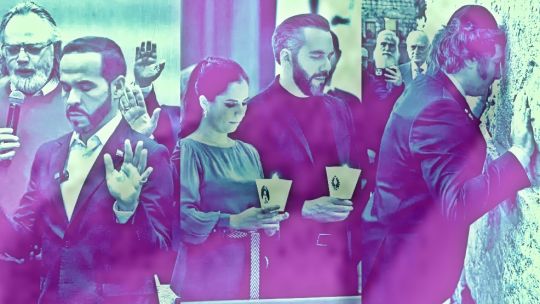
De la Espriella likened himself to Cyrus the Great, the Persian monarch who allowed Israel’s return from captivity, promising protection: “I want to be Colombia’s Cyrus,” he declared. The nod drew evangelical congregations and former military personnel to the polls in droves, in pursuit of what he calls a “miracle homeland” and, in his own words, “putting God back in the classroom, in our children’s schools.”
“El Tigre,” as he likes to be called, is no anomaly but confirmation of a trend. De la Espriella belongs to the most disruptive strand of this new right – the same one embodied by Argentina’s President Javier Milei, who styles himself a “lion” and invokes holy scripture to justify his economic programme, and Bukele, who was re-elected by pushing the limits of the Constitution. Beyond the zoology of power, what unites them is their politics of bullying, their submission to US President Donald Trump and their willingness to hand the region over to a Washington that claims it as its own.
Colombia and Peru now join Argentina, Bolivia, Paraguay, Ecuador and Chile in this South American shift. In Peru, Keiko Fujimori, daughter of former dictator Alberto Fujimori, secured an irreversible lead in the vote count this week and will become the country’s next president. Widen the map and El Salvador, the Dominican Republic, Panama, Costa Rica and Honduras complete a wave that is redrawing Latin America with a force that is hard to ignore. Brazil will be the next key battleground: on October 4, Luiz Inacio Lula da Silva will seek re-election against a Bolsonarista challenge backed by Trump. Although ex-president Jair Bolsonaro was sentenced to 27 years for an attempted coup, his influence endures through his son Flávio, who is emerging as President Lula’s chief rival.
Insecurity, institutional decay and an economy that never recovered from the pandemic paved the way for this shift. Add to that a rising misogyny that has turned feminism into the perfect enemy: influencers and politicians who have made anti-feminism an identity have discovered that resentment is extraordinary electoral fuel. Among their base is a significant share of young men drawn to a simple narrative: entrepreneurship as virility, financial success as superiority, emotions as weakness, and the woman who refuses to submit as a threat.
Trump is the central piece that cannot be ignored. His return to the White House reopened debate over an updated version of the Monroe Doctrine (the historic US foreign policy that asserted American hegemony over the continent), which some have dubbed the “Donroe Doctrine.” Within that framework, the region is living through one of its most turbulent periods in decades: US military intervention in Venezuela has exposed its deepest fractures, even as an agenda of cuts to health, education and science advances, alongside a restoration of gender hierarchies that had seemed consigned to the past.
This new right sets itself apart from the one that held ground a decade ago. Former presidents Mauricio Macri (Argentina) and Sebastián Piñera (Chile), for instance, represented a conventional right that at least respected the system’s boundaries. Bolsonaro was the hinge: his 2019 rise gave this current new oxygen, and it organised itself internationally with Trump as its reference point. The 2020 Madrid Forum, driven by a foundation linked to Vox, the Spanish party that has made xenophobia its banner, was the starting point for weaving the transnational network that defines today’s global new right.
The new right emerging today dehumanises the opposition, courts institutional chaos and makes no secret of its discomfort with the boundaries of liberal democracy. It uses economic debate as an occasional façade, but its real battles are fought on the terrain of order and culture, deploying an inquisitorial politics that brands as heresy and moral decay everything that does not fit its mould.
It has its nuances in each country, but shares common narratives, an offensive against minority rights, and an obsession with anchoring its proposals in religious doctrine — or at least instrumentalising it. All of it seasoned with an old trick they have learned to recycle: invoking the spectre of a long-dead communism and branding as “public spendthrifts” all those they would happily send to the stake. This new right also contests symbols and memory: it minimises or erases the crimes of last century’s dictatorships (Johannes Kaiser’s Partido Nacional Libertario in Chile, for instance, promotes a “Museum of Truth” to vindicate Pinochet’s rule) and rewrites colonisation as a mission of salvation rather than a brutal conquest.
Beneath these movements lies a nostalgia for authoritarian order, intertwined with a punitive populism that turns punishment into spectacle. In this dark moment, in which hatred is being normalised and hard-won rights dismantled, the words left to us by Chilean poet Gabriela Mistral feel apt: she asked for the perseverance of the sea’s waves, which turn every retreat into a fresh point of departure.
The challenge is immense. But history is built from acts of resistance that once seemed impossible. The waves do not give up. They do retreat, yes – but they come back. And each time they return, they advance a little further.
*Writer and political scientist. Originally published by Perfil. Translated by the Buenos Aires Times.
related news
by Antonella Marty, via Perfil