Lower House passes government bills on private property and disability
 Buenos Aires HeraldUpdated 57 minutes Ago2 Mins read
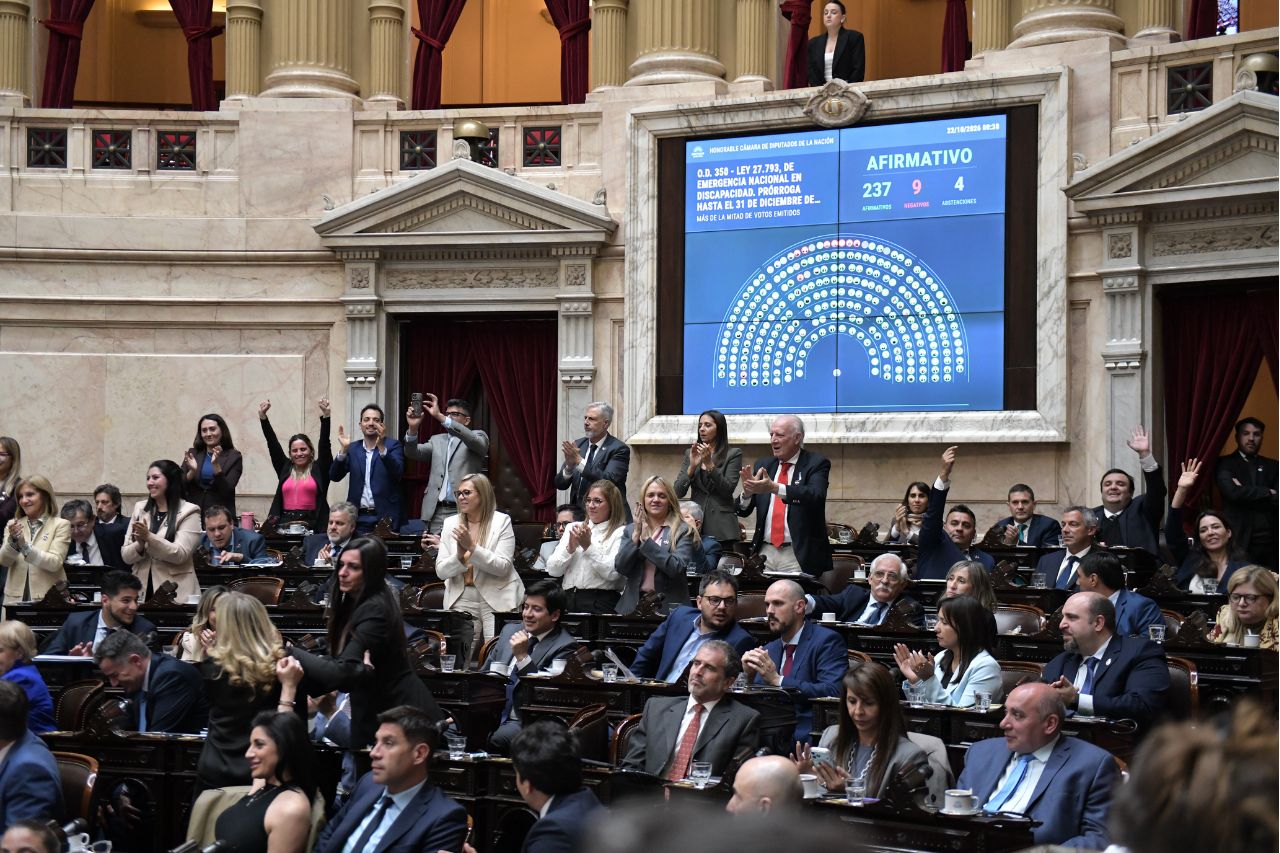

The government scored two legislative wins in a Lower House session that ended in the early hours of Thursday. Deputies approved a bill proposed by ruling party La Libertad Avanza (LLA) to provide additional funding for disability services, as well as a controversial measure aimed at protecting private property.
A package of proposals to address the growing problem of household debt was ultimately sent back to committee without a vote on the chamber floor.
The opposition sought to pass a bill that would allow families to refinance their debt. LLA had introduced its own version, which offered no immediate solutions but instead focused on making credit information more accessible and transparent.
Private property reform The Private Property Inviolability Law was approved with 124 votes in favor, 119 against, and six abstentions. Filed by the Milei administration and already passed by the Senate in August, it had drawn heavy criticism because its original version proposed eliminating the Land Law, which sets restrictions on how much land foreigners can buy in Argentina.
The Senate-approved version omitted the proposal because it failed to garner sufficient support.
However, the controversy did not end there. In December 2023, President Javier Milei had overturned the 2011 Land Law through a sweeping decree, seeking to eliminate the cap on foreign property ownership, but the judiciary blocked that decision shortly afterward, so restrictions remained.
But in late September, those restrictions were temporarily lifted for nine days after the Supreme Court overturned the ruling that had blocked their removal.
This prompted opposition lawmakers in the Chamber of Deputies to propose repealing Mileis 2023 decree, which had already been rejected by the Senate.
Although the Supreme Court reinstated the restrictions in a second ruling, LLA decided to reverse course, incorporating the limits on foreign land purchases into its Private Property bill to secure its passage.
The bill will now return to the Senate, which must approve the changes made by deputies for it to become law. If that happens, the section of the 2023 decree that sought to eliminate the Land Law will no longer be in effect.
The new version of the Private Property law also tightens restrictions on state expropriations, including stricter legal standards for demonstrating that an expropriation serves the public interest.
It also introduces “express evictions” for tenants who fail to pay rent. Tenants would have 10 days to settle overdue rent after missing a payment, after which landlords could seek their eviction through an expedited judicial process.
Under the current system, court-ordered evictions can take months or even years.
Disability funding A provision introduced by LLA to provide additional funding for disability services won support from both the ruling party’s allies and the opposition. The proposal, which still needs Senate approval to become law, would establish a permanent framework for disability funding.
If approved, the law would replace the emergency regime currently in place through December 31 which grants extra funding for disability services. Last week, the opposition attempted to extend the emergency law, but the session ultimately failed to reach a quorum.
The disability emergency law was passed in September 2025. Milei vetoed it, but Congress overrode his veto and reinstated the legislation. Although he ultimately enacted the law, Milei initially refused to comply with it until a court ordered him to do so.
The bill approved in the early hours of Thursday, with 237 votes in favor, nine against and four abstentions, closely resembles the emergency law but makes the funding permanent.
The opposition ultimately backed LLA’s bill because there was insufficient support for extending the emergency law for another year, and lawmakers feared Milei would veto such a measure again.
Deputy Marcela Pagano, a former LLA member, said she “doesn’t trust” the bill approved Thursday, noting that Milei had previously vetoed the emergency law. She argued that the real goal was to “win the pope’s favor,” referring to Pope Leo XIV’s planned visit to Argentina in November.






Charly García turns 75: Argentines celebrate the soundtrack of their lives
Argentine rock icon Charly García will turn 75 on Friday, and celebrations...
Buenos Aires Herald3 Mins read