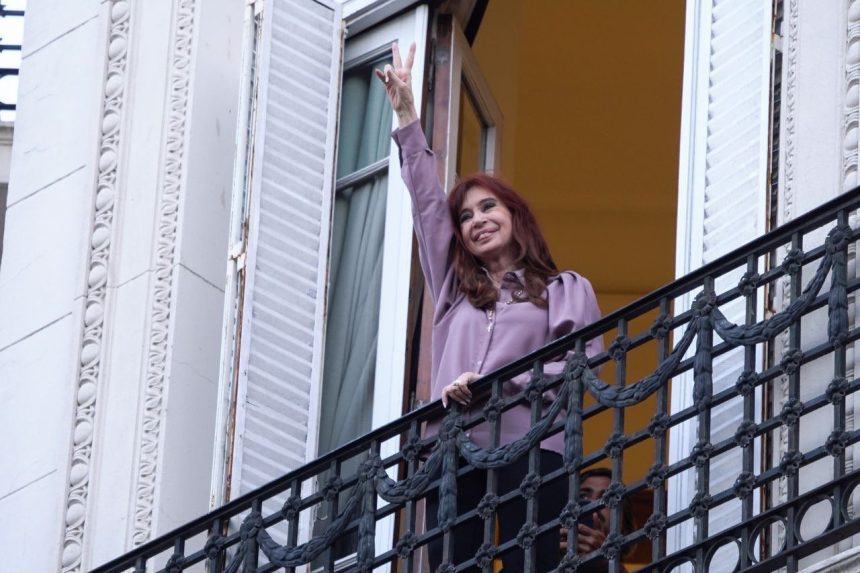
A federal court has ordered the preventive seizure of the apartment where former President Cristina Fernández de Kirchner is serving her house arrest sentence in connection with the “Vialidad” corruption case over public works contracts.
The seizure and other precautionary measures ordered by the court cover more than 100 properties, including 21 belonging to Kirchner and her children, national deputy Máximo Kirchner and Florencia Kirchner.
The move does not imply the former president needs to move out, although the future of the property is unclear.
Most of the remaining properties belong to construction businessman Lázaro Báez, a former associate of the ex-president who is serving a 15-year prison sentence under a unified conviction covering the Vialidad case and a separate money laundering case.
Last year, Kirchner was convicted of directing 51 federally funded public works contracts in Santa Cruz province to companies owned by Báez in what the Argentine judiciary determined was a fraudulent scheme.
The apartment
In May, a federal cassation court upheld an earlier ruling ordering the seizure of 111 assets belonging to Kirchner, Báez and others convicted in the Vialidad case.
The assets are equivalent in value to the amount the judiciary says was obtained through fraudulent operations.
The amount to be recovered totals $685 billion (US$450 million at the official exchange rate).
The apartment at 1111 San José Street, in the working-class Constitución neighborhood of Buenos Aires City, has now been added to the pool of assets being targeted by the courts to ensure compliance with the forfeiture order established in the judgment.
The property belongs to Los Sauces S.A., the Kirchner family’s real estate company.
For now, the decision does not mean the apartment will be auctioned, nor does it imply an immediate change in ownership. Kirchner therefore does not necessarily need to move out.
However, it remains unclear what would happen if the property’s forfeiture were finalized.
According to the ruling, the preventive seizures are intended to ensure the legal unavailability of the assets while proceedings continue to determine which ones will ultimately be subject to forfeiture.
The affected assets
Among the seized properties are six apartments — including the one in Constitución and others in Puerto Madero (Buenos Aires City), and Santa Cruz — as well as seven garage spaces; a storage unit; a hotel in El Chaltén, Santa Cruz, called La Aldea; and other properties in Santa Cruz.
The new measures also cover US$5 million that Florencia Kirchner placed in a safe-deposit box at Banco Galicia.
Most of the seized assets linked to Cristina Kirchner belong to her children, either as part of the inheritance they received after the death of their father, former President Néstor Kirchner, or as assets their mother transferred to them a decade ago.
However, the judges said that, although Máximo and Florencia Kirchner were not convicted in the case, they benefited directly from the fraudulent economic relationship between Báez and the ex-president because they are shareholders in Hotesur SA and Los Sauces SA, the companies under which the properties are registered.