“I came here to pray for all those who don’t have a job. The situation is very complicated.”
José, a pensioner, traveled all the way from northern Santa Fe province to Buenos Aires with a group of friends to visit the Sanctuary of San Cayetano on Friday, August 7, the day the Catholic community celebrates the patron saint of workers and the unemployed.
Just like hundreds of others, José — who also turned 65 on Friday — gathered outside the church, joining a queue of several blocks on a freezing winter morning.
The tradition has been observed for almost a century in the working-class neighborhood of Liniers, in Buenos Aires City.
Known globally as St. Cajetan of Thiene, San Cayetano died in Naples in 1547, centuries before Argentina existed. Amid the unemployment crisis that followed the 1929 stock market crash, Argentine priest Domingo Falgioni began distributing images of the saint holding a stalk of wheat to workers who had little else to hold onto, helping to establish a tradition of pilgrimage and devotion in Argentina that continues to this day.
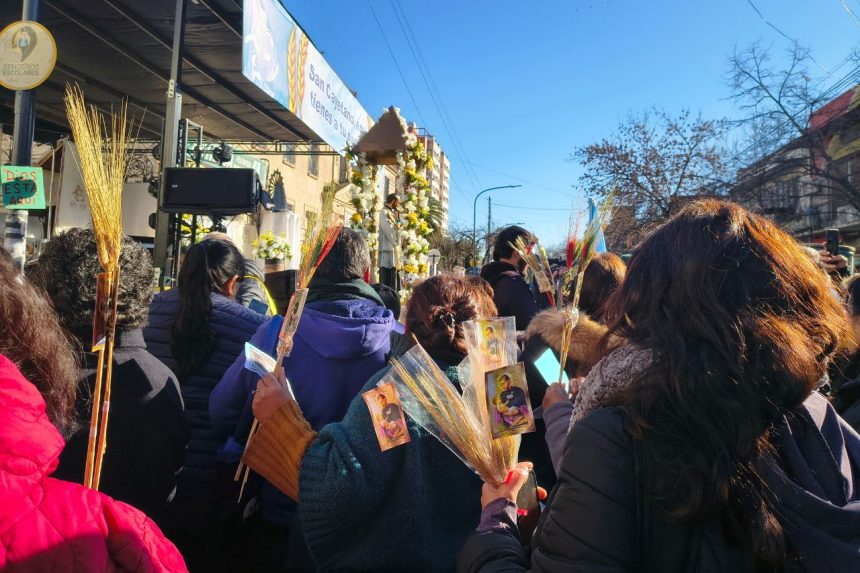
On Friday, many pilgrims entered the sanctuary holding a wheat stalk sold by vendors outside the church, just like almost 100 years ago. Others held on to their thermoses and poured themselves mate to brave the cold, some quietly on their own, and others with family, friends and coworkers.

Children from Catholic schools handed out bread and hot beverages, as priests blessed believers and sang religious songs to pass the time while people waited.
While many visit the saint to thank him for granted favors and for having jobs, the tradition takes on added significance this year as unemployment rises and living conditions worsen even for those with jobs under the government of President Javier Milei, something several pilgrims mentioned while waiting to enter the sanctuary.
Karina, a woman waiting in the queue, told the Herald that she visits the church every year to thank the saint for her job. This year, she said, she also wanted to pray for people who are looking for work, especially among the youth.
“It’s all very difficult. Everything changed so much after the new government came into power because of the economic situation we are going through,” Karina said. “I feel lucky because I have a job, but it’s always good to come here and give thanks and pray for those who are more in need.”

Salaries in freefall
Berenice Iañez, a Peronist Buenos Aires City lawmaker, told the Herald she has been going to the sanctuary every year since she was a child, first with her father and now on her own or with her family. Today, her father is a retired pensioner, but she still needs to help him economically.
“I came here to give thanks for my own situation and to pray to San Cayetano for the many Argentines and people living in this country who need jobs that allow them to live with dignity,” she said as she walked among the pilgrims, visibly moved.
“A lot of people are having a hard time. Some work long hours and still can’t afford to cover their basic needs,” she said.
While unemployment rates are far from their peak of 21% during the economic crisis of 2001, the quality of jobs seems to be dropping, while purchasing power is seeing a steady decline that reached its lowest level since the 1990s.
Since Milei became president, the minimum wage has seen a cumulative drop of more than 40% in purchasing power, according to the Center for Studies on Education in the Argentine Republic (CIFRA).
In addition, most incomes in Argentina’s formal economy are still behind the levels seen before the Milei era. Private sector wages have fallen nearly 4%, and public sector employees have been hit even harder, as their salaries’ purchasing power has dropped 36% since November 2023.

Buenos Aires Archbishop Jorge García Cuerva gave a religious service for those waiting outside the church and said that Argentines were “tired of broken promises and leaders who talk about the worst problems, but are not close to them and live the good life.”
García Cuerva later told the Herald’s sister publication Ámbito that there were many more faithful gathered outside the sanctuary than in previous years, which he felt expressed “people’s need to come here and pray.”
Higher unemployment
Since the start of the Milei administration in December 2023, the unemployment rate has risen from 5.7% to 7.8% in the first quarter of 2026, according to Argentina’s statistics agency, INDEC.
Data from the Labor Secretariat shows that more than 235,000 registered jobs have been lost under the Milei government, a figure similar to the losses recorded during the most critical period of former President Mauricio Macri’s administration between 2018 and 2019.
While the libertarian president has argued that the total number of jobs has increased during his tenure, experts point out that employment has grown more slowly than the working-age population. They also note that the entire increase has been driven by growth in informal employment.
The informality rate rose from 35.7% to 44.2% between the last quarter of 2023 and the first quarter of 2026, according to INDEC.

Although Argentina has seen some improvement in economic activity this year, the first half of 2026 was marked by stagnation across most sectors, particularly those tied to domestic consumption.
The only sectors to post increases in activity were those linked to the primary economy — energy, mining and agriculture — which are experiencing record exports but have limited capacity to create new jobs.
Meanwhile, inflation continues to outpace income growth. Prices in Buenos Aires City rose 33.2% between July 2025 and July 2026, while Argentina’s minimum wage increased by just over 17% over the same period.
A family of four needed AR$1.5 million (around US$1,000) in June to cover its basic needs and remain above the poverty line, and AR$689,853 (US$450) to avoid falling into extreme poverty.
The legal minimum wage was AR$367,800 (US$240) that month, while the average salary measured by the state’s RIPTE index was AR$1.8 million (US$1,220).

A march for bread and work
This year also marks the 10th anniversary of an annual march organized by labor federations and social movements on August 7, to mark San Cayetano day.
The demonstration set off just a few blocks from the sanctuary in Liniers under the banner “Peace, bread, land, shelter and work,” and headed toward the presidential palace, the Casa Rosada.
Donato Lannutti, a member of the Pensioners Union who took part in the march, told the Herald that the protest’s slogan “represents the bare minimum people need, but are missing” under the Milei government.
Lannutti said he also marches with fellow pensioners every Wednesday outside Congress because “this system has become impossible.”
“We can’t allow them to do this, and the only way to stop them is by taking to the streets,” he said, referring to the country’s deteriorating economic situation.

Luis María Alman Bornes, a Mennonite pastor and co-president of the Ecumenical Movement for Human Rights, said that “especially in the times Argentines are living through today,” the demand for peace, bread, land, shelter and work “is more necessary than ever for the sectors that have been hit the hardest by the current government.”
“More and more families are falling into debt; the most vulnerable sectors aren’t even able, in some cases, to meet their basic needs,” Alman Bornes said.
The pastor emphasized that “faith accompanies people in their struggles” and that, in these times, “above all else, it is necessary to hold onto hope, to support and stand in solidarity with those who are struggling.”
“These gestures and moments give us strength and lay the groundwork for a future that’s much more dignified than the one we’re navigating today,” he said.
Photos: Martina Jaureguy