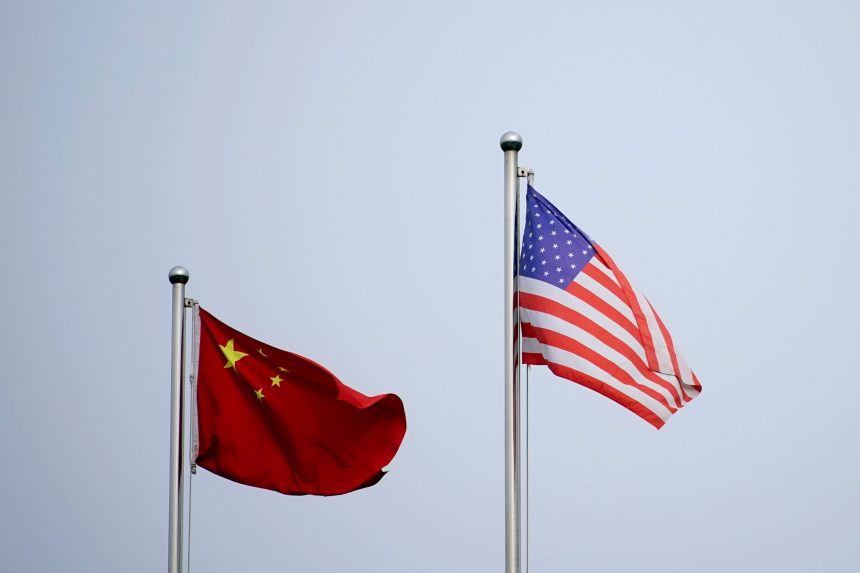
The Chinese Embassy in Argentina said United States Ambassador in Buenos Aires Peter Lamelas made a “baseless accusation” after he stated that Chinese technology companies shared data with the Communist Party and posed “national security” issues.
In a statement released on Thursday, the spokesperson for the Chinese Embassy in Argentina said Lamelas’ comments were “slander without any foundation” and that he has been “overgeneralizing the concept of national security and sowing fear in the market.”
Lamelas’ remarks during the U.S. Chamber of Commerce in Argentina’s Energy Forum 2026 focused mainly on Chinese tech company Huawei, which is in advanced negotiations with Neuquén province’s Provincial Cooperative for Public and Community Services (CALF, in Spanish) to supply it with equipment.
The Chinese Embassy responded that Huawei is one of the companies with the best track record in cybersecurity and data security.
“Huawei is the first telecommunications company to openly commit to signing a no-backdoor agreement and to undergoing third-party audits and verification,” the statement said.
Lamelas’ comments and the Chinese response
On Thursday, Lamelas said that “China requires its companies to give its government access to any data that passes through its technology and artificial intelligence networks” and that all data going through them is “controlled by the Chinese Communist Party.”
“This is not acceptable. And it won’t help attract foreign investors to Vaca Muerta,” Lamelas said.
The Chinese Embassy stated that Xi Jinping’s government “gives great importance to data privacy and security and protects them in accordance with the law” and “never asks — nor will it ever ask — companies to provide, collect, or store data for the Chinese government in violation of local laws.”
“What the U.S. side has been doing is, in essence, motivated by a Cold War mentality. Building a small yard and a high wall does not align with the prevailing trends of this world,” the embassy said.
China also warned that using “exclusionary” measures to disrupt market order goes against Argentina’s policy of economic openness, adding that the country does not need outside guidance on how to attract foreign investment.
“Protectionism cannot make the United States great. We urge relevant U.S. officials to stop exaggerating the Chinese threat and to take more concrete actions to promote stability and development in the region,” the statement added.
Huawei also released a statement responding to Lamelas, saying they are a “100% private” company conducting business “under strict compliance of the laws and regulations of each of the countries it operates in.”
The company added that, since its creation in 1987, they have “built an impeccable record” in terms of cybersecurity and data protection, with their equipment operating “under the highest international standards.”
Growing tensions
Lamelas’ comments and the response from the Chinese Embassy add another chapter to growing tensions.
CALF, the Neuquén company negotiating with Huawei to acquire equipment, recently received a communication stating that the U.S. government is implementing a policy of restricting or revoking visas for executives who expanded Huawei’s operations in Argentina. CALF denounced this publicly.
Last week, China rejected the move, saying that the U.S. “cannot tolerate that a foreign private company can subsist and develop normally in another country” and that it was interfering in its cooperation with an Argentine firm.