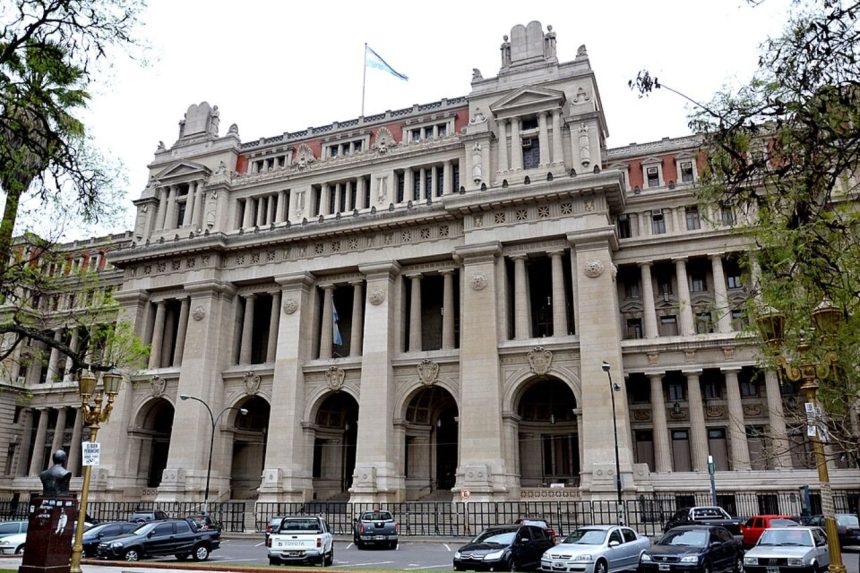
The Argentine Supreme Court of Justice declared an article of a 2019 presidential decree issued by then-President Mauricio Macri unconstitutional, in a decision that limits the president’s use of Necessity and Emergency Decrees (DNU, in Spanish).
The decision was reached unanimously by the three members who currently make up the Supreme Court — Horacio Rosatti, Carlos Rosenkrantz, and Ricardo Lorenzetti — on the grounds that the Executive Branch failed to demonstrate the existence of a situation of necessity and emergency that would justify amending by decree a matter under Congress’s jurisdiction.
Macri’s decree amended the Fair Trade regime, previously regulated by Law 22.802, to require intervention by the National Court of Appeals for Federal Civil and Commercial Matters.
However, after retail company Cencosud challenged a fine for mispricing, the court declared the requirement unconstitutional. The case was then referred to the Federal Administrative Court, which also declined to hear it, ultimately sending the dispute to the Supreme Court.
In the Court’s view, regulation of the jurisdiction of federal courts is a matter that the National Constitution assigns “exclusively” to Congress.
“Exceptional circumstances”
According to the judges, the Executive Branch may exercise legislative authority through a decree “only under strictly exceptional circumstances and subject to formal requirements that constitute a limitation on — rather than an expansion of — its use.”
This occurs when one of two exceptional situations arises: either it is impossible to follow the ordinary legislative process because Congress cannot convene due to circumstances beyond its control, or there is such urgency that the matter must be resolved immediately, making it incompatible with the normal timeframe for enacting a law.
The judges found that neither situation could be demonstrated in this case.
“A reading of the grounds for the decree in question reveals not a single line dedicated to justifying the reasons or exceptional circumstances that led to the changes in the allocation of authority set forth therein,” the Court stated.
Although the decision did not overturn Macri’s emergency decree in its entirety — the declaration of unconstitutionality applied specifically to a single article — it sets a precedent that could affect current and future presidents by limiting their use of DNUs.
The ruling strengthens the authority of judges and lower courts to block or declare entire sections of emergency decrees unconstitutional, potentially affecting the government of Javier Milei, which has issued more than 80 such measures since taking office in December 2023.
With information from Ámbito