Argentina to remain a ‘trade’ unless it can lower volatility, BlackRock exec says
 Estefania PozzoUpdated 2 hours Ago3 Mins read

Argentina’s problem is not a lack of growth potential but a lack of stability, BlackRock executive Pablo Goldberg told business leaders at the IDEA Colloquium in Mar del Plata on Thursday.
Speaking to IDEA treasurer and Grupo Cohen managing partner Ana Cohen, Goldberg summarized the sentiment in one phrase.
“Until Argentina manages to lower its volatility, it will remain a ‘trade,’” he said, referencing the term given to investments that are considered high risk and high reward.
Goldberg, who is currently head of the Emerging Market Debt Research department at BlackRock, the world’s largest asset manager, has followed Argentina’s economy from abroad for 25 years.
Asked whether Argentina is a short-term bet or a long-term destination, he pointed to its track record. Until that changes, he said, international capital will treat the country as an opportunity to enter and exit, not as a place to stay.
The weight of the past During his presentation, Goldberg illustrated Argentina’s case by using the Sharpe ratio, an equity tool measuring return per unit of risk. Applied to countries, this instrument takes growth and divides it by the nation’s volatility.
Goldberg first presented the exercise in 2011, with then-President Cristina Fernández de Kirchner in the front row. At that time, Argentina stood alone with the worst risk-return ratio among 60 countries.
His updated version in 2026 shows that the country’s position has “only deteriorated.” After successive defaults, Argentina ranks among the worst long-term performers in emerging market bond indexes.
“That history stays in the memory,” he said.
Goldberg then used Moody’s breakdown of Argentina’s rating and compared it with countries that share the same grade: Nigeria, El Salvador, and Ecuador. Based on current economic, institutional, and fiscal strength alone, Argentina would qualify for investment grade. Its track record, however, is holding it back.
“The past condemns you in some way,” Goldberg added.
High domestic political risk also adds to this cocktail, as well as the lack of a strong local capital market. This forces the state to borrow abroad and pay in U.S. dollars while collecting taxes in pesos.
What investors look for Goldber was also asked how many political cycles investors need before trusting Argentina, to which he offered a criterion rather than a number.
“If locals don’t trust it, why should I?” he asked.
In cycle after cycle, he went on to say, Argentines seek refuge in U.S. dollars ahead of elections. If locals look for shelter, foreigners will do the same.
Credibility, in his view, depends on both the rules on paper and the actions that show they are respected over time — including reliable official statistics.
He cited the lawsuit over Argentina’s GDP-linked warrants, a case tied precisely to how growth was measured. The BlackRock executive did highlight a cultural shift: a growing consensus that large fiscal deficits cannot be financed by printing money.
The first thing companies look at is “the postal code,” Goldberg told Cohen. Country risk acts as a ceiling on how credit-worthy it is. Investors then look for hard-currency revenue, or at least access to dollars to pay coupons, and a stable framework.
“The best thing that can happen to us is to buy a bond and forget about it,” he said.
The competition for that capital is fierce. With global rates rising amid tech giants absorbing enormous financing resources to build their AI infrastructure, Goldberg said, Argentina is currently competing against Meta, Google, and Amazon.
The investment-grade prize Reaching investment grade would be “highly important,” Goldberg said. Investment-grade countries pay less than 200 basis points over U.S. Treasury bonds, compared with around 600 for Argentina.
Because the curve linking ratings and country risk is steep at the lower end, small improvements sharply reduce financing costs for the state and companies. By his own partial estimate, Argentina’s weight in bond indexes would also nearly double.
Improvements in the current account, driven by energy, mining, and agriculture, help. But he insisted on rebuilding a strong domestic capital market. Turning around the Tequila crisis-era line that Argentina was not Mexico, he said he would now like it to be more like Mexico, with its investment grade and market depth.
The models he pointed to are Peru, which has weathered successive political crises without losing macroeconomic stability, and Uruguay, where governments change but certain rules are not up for debate.
“Reduce the volatility of output and not recklessly encourage growth,” was his advice.
Asked by Cohen whether he sees more interest in Argentina among his peers, Goldberg answered yes. With the world looking for energy, low geopolitical risk, and stability, Argentina is in a position to offer some of those things.
“I do think it has to work on the last one,” he said.
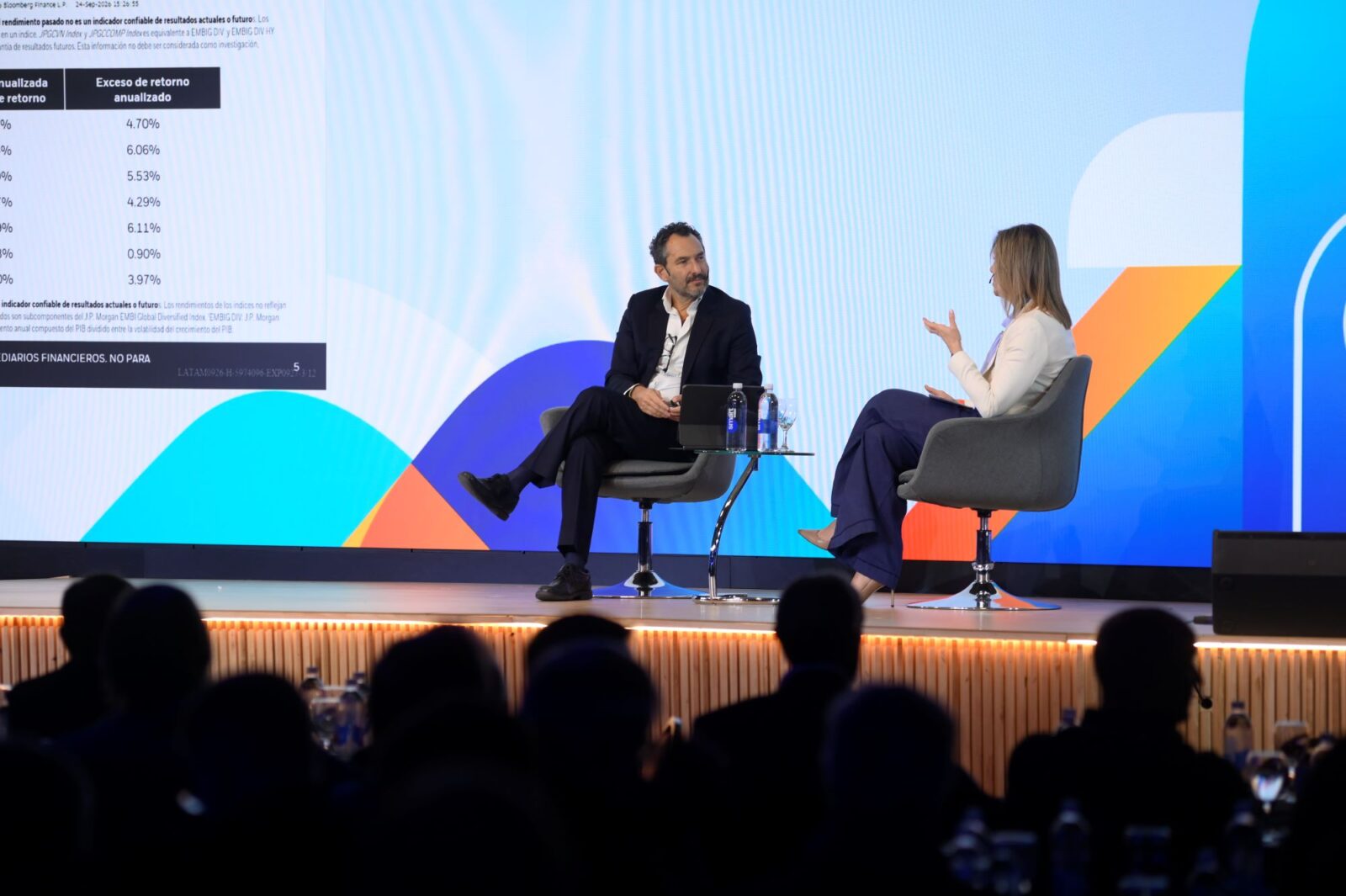
Cover image: BlackRock executive Pablo Goldberg (left) and IDEA treasures Ana Cohen (right). Credit: courtesy of IDEA