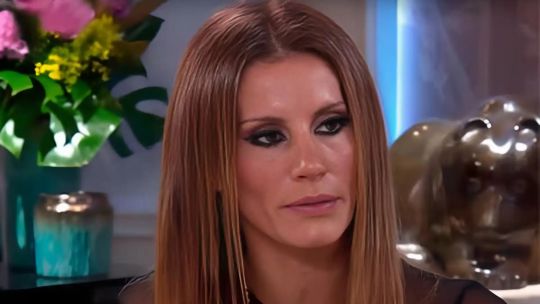
More than seven years after the death of model and socialite Natacha Jaitt in mysterious circumstances, her brother is asking for the investigation into the circumstances surrounding her expiration to be reopened.
Lawyers representing Ulises Jaitt have filed a motion challenging various aspects of the case file that, they claim, were not sufficiently examined before the investigation was shelved.
The filing by lawyers Ignacio Barrios and Yamil Castro Bianchi with the San Isidro Attorney General’s Office seeks to review a decision taken on March 21, 2024, when prosecutors recommended that the case be shelved.
According to the filing, evidence-gathering measures are still pending and there are “inconsistencies” that should be re-examed before definitively ruling out the involvement of third parties.
The complaint does not rely on a single piece of fresh evidence capable of establishing that Natacha was the victim of a homicide, but rather on a series of elements which, in the view of the lawyers, were left without a sufficient technical explanation.
“The case has gone unpunished for years,” Ulises Jaitt told the Perfil newspaper.
Businessman Gonzalo Rigoni, the owner of the Xanadú lounge where the actor and TV presenter died, “was never formally investigated,” alleges Natacha’s brother. Police officers “took his statement as if he were a neighbour who happened to walk past the door,” he added.
More than two years ago, prosecutors Martín Otero and Lida Osores Soler concluded that no crime had been committed in connection with the death of the vedette. Her brother has always maintained a different theory. According to him, Rigoni was responsible for her death.
“She was found dead in her room [at the lounge], with the door closed. And while that was happening, Rigoni threw drugs into the sink, removed three glasses and the champagne bottle from the room and cleaned everything before the police arrived,” Ulises alleged in reference to the events of February 23, 2019, at the entertainment complex in Villa La Ñata, Tigre, north of Buenos Aires.
“That alone is serious and irregular – he altered the crime scene. And from there on, there are thousands of irregularities,” the brother argues. He claimed the businessman had “never really been investigated.”
The request to reopen the case comes after Ulises Jaitt previously sought to have the investigation transferred to federal jurisdiction.
“When they shelved the case, I wanted to take it to the federal courts. They rejected us, and in 2025 I sought to change the jurisdiction, but the prosecutor general refused,” he said.
One of the main arguments in the filing is that elements of the case file have not been resolved. Barrios told Perfil that the request was not based on a single piece of evidence, but on various inconsistencies that should be investigated.
“The scene was altered before the police arrived: surfaces were cleaned, objects were removed and Natacha’s phone was moved. The chronology of the calls for help does not match between the phones, the 911 system, the police notification and the ambulance dispatch,” the lawyer said.
The filing also questions witness statements made by Rigoni, and other witnesses Gustavo Bartolini and Raúl Velaztiqui Duarte, who were also at Xanadú that night.
“The original 911 audio recordings, the dispatch form, the police radio log and the SET/Nextel records do not appear to have been incorporated or individually identified. The digital analysis was incomplete. There are forensic acquisitions from [Natacha’s] iPad and other devices, but no comprehensive, reproducible report has been individually identified showing what was examined, what was recovered and what may have been deleted,” he added.
According to Barrios, Natacha’s phone records show three missed calls from Velaztiqui with timestamps reading 01:30:43, 01:31:52 and 01:39:08. The subsequent sequence differs between the various records: at approximately 1:47am, police received the 911 radio alert; the first police patrol arrived at around 2am; at 2:20am, the SET emergency medical service received the red-code alert via Nextel; and the ambulance arrived at around 2:26am.
This leaves three intervals: 16 minutes and 17 seconds between the first call to Natacha and the police alert; 33 minutes between the police alert and the medical dispatch; and 49 minutes and 17 seconds between the first call to Natacha and the SET dispatch.
“We are not claiming that the delay caused her death or that Natacha could necessarily have been resuscitated. What we are saying is that a difference of more than half an hour between the various sources could not simply be left without an independent technical reconstruction,” Barrios said.
He also requested the recovery and certification of the original recordings from the emergency number, the dispatch form and police radio records, among other evidence.
In addition, the lawyer asked for the authentication of an echocardiogram performed on Natacha in November 2018 which, according to the filing, “had not detected significant heart disease.”
“This appears to contrast with the autopsy and the medical panel, which described chronic heart disease, coronary abnormalities, hypertrophy and signs of an old injury. The echocardiogram, performed three months before her death, does not by itself prove that the autopsy was incorrect, but precisely for that reason it should have been authenticated and explained by specialists,” he said.
Barrios’ colleague Castro Bianchi said the Prosecutor’s Office had suspended witness statements pending the conclusions of the iPad forensic examination, but the documentation they obtained does not identify that report or show that the statements were subsequently resumed.
In addition to requesting a synchronised reconstruction of the sequence of calls and the actions taken by the emergency services, he challenged the alteration of the scene.
“That does not in itself prove that third parties were involved in her death, but it does raise the question of what evidentiary value can be assigned to a scene that was not left untouched,” the lawyer said.
The lawyer said they were awaiting a specific decision on the request for a review and reopening of the case. The proceedings have not resulted in a final dismissal or acquired the status of res judicata, since the decision to shelve the case established that the investigation could be restarted in the event of new evidence or circumstances.
He also said they expected a decision within three days on who would have jurisdiction to review the case, or for measures to be taken to preserve the evidence until then.
Finally, the filing refers to the case known as ‘Operation Jaitt’, which involved alleged intelligence operations and Natacha’s appearance on Mirtha Legrand’s television programme in 2018. The document does not claim there was a connection between that investigation and the case into her death, but asks for the information it contains to be added to the file for analysis.