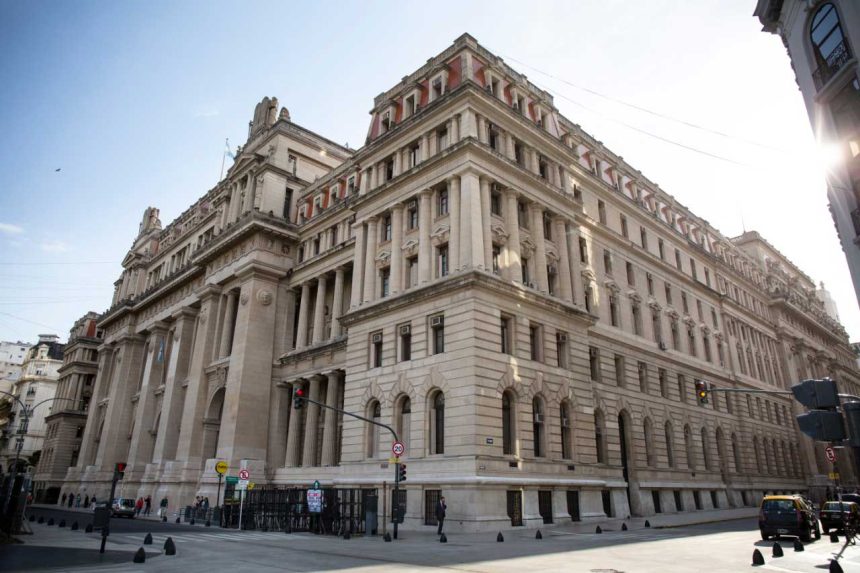
The Argentine Supreme Court overturned the acquittal of two former judges and two judicial workers of the country’s last dictatorship who had been involved in the process of illegal appropriation of Manuel Gonçalves Granada as a baby.
Gonçalves Granada, now 50, was born to dictatorship victims killed during an operation at their home in 1976. He is currently a human rights leader, member of the board of Grandmothers of Plaza de Mayo and head of the National Identity Commission, which is dedicated to finding babies stolen between 1976-1983.
Grandmothers of Plaza de Mayo celebrated the Supreme Court’s decision in a statement on Wednesday, saying the judges accepted the organization’s appeals and revoked the acquittals on Friday.
The move, they added, means there will be a new sentence of the former magistrates and judicial workers “respecting the principles of truth and justice.”
The decision affects former San Nicolás Juvenile Court judge Juan Carlos Marchetti, former Lomas de Zamora civil judge Juan Delfín Castro, and ex-juvenile advisors Juan Carlos Magni and Francisco García Cortina.

The four of them were involved in the several stages of the judicial process that allowed a couple, who were related to Marchetti, to adopt Gonçalves Granada and register him under the name Claudio Luis Novoa. He lived under that fake identity until 1995, when he discovered his true origins.
You may also be interested in: The Operation Condor files: The mystery of the kids abandoned in a square in Chile
A years-long demand
Gonçalves Granada and Grandmothers of Plaza de Mayo have been demanding judicial action be taken against the four ex-judiciary members for the past two decades. The men were acquitted by the Criminal Cassation Court in 2016.
The Supreme Court established that “the judicial paralysis and the premature dismissal of the cases violated the Argentine state’s international obligations to investigate and punish the systematic human rights violations committed during the era of state-sponsored terrorism,” the Grandmothers of Plaza de Mayo said in their statement.
“This court ruling paves the way for a long-awaited investigation into the responsibility and involvement of judges, officials, and judicial personnel in the systematic plan to abduct children during the era of state terrorism,” they added.
Of 140 child appropriation cases that have been resolved, 30 involved the complicity of judicial personnel by illegally granting custody orders and adoptions.
The Abuelas said that the decision brings them “a little closer to achieving justice for Manuel” and that they hope that “this precedent will shed light on other similar cases.”
The case
Manuel Gonçalves Granada is the son of Gastón Gonçalves and Ana María del Carmen Granada. Gastón was kidnapped, tortured and murdered by police in 1976 — he was buried as John Doe in a cemetery in Escobar, and was considered disappeared for 20 years until his remains were identified in 1996.
Following the kidnapping, Ana María escaped under a false identity to San Nicolás, a city in northern Buenos Aires province, alongside another family. When Manuel was born, she registered him under the surname Valdez to protect him.
On November 19, 1976, a military and police operation surrounded the house where they lived. Ana María hid her son inside a closet. Ana María and the other family — a couple and their two children aged 3 and 5 — were killed. Manuel was the only survivor and, affected by the tear gas, was hospitalized.
The baby remained at the hospital for several months, until Marchetti first granted temporary custody to his cousin, and then granted adoption to a relative of his cousin’s wife.
“Inconsistencies and irregularities”
Marchetti was accused of not carrying out the necessary measures to find and contact the family of the surviving boy. In 2016, he was acquitted on the grounds that since Ana María had registered the baby as “Manuel Valdez,” he couldn’t have known where to look.
Magni was also accused of not issuing mandatory notices about the child in order to find his family. Castro and Cortina then formalized the adoption at the Lomas de Zamora court.
“Even though, from 1978 onwards, several human rights organizations visited the court looking for children of dictatorship victims, Marchetti never informed having had the boy’s custody under his purview,” Grandmothers of Plaza de Mayo said.
“The custody files present numerous inconsistencies and irregularities that allow to infer that the judge had knowledge of Manuel’s true identity,” they added.
Grandmothers of Plaza de Mayo denounced that the case against Marchetti was “strongly opposed” by the San Nicolás judiciary and that he was acquitted on several instances “without even being summoned to testify,” and that, later on, the Criminal Cassation Court dropped the charges for the four defendants “prematurely and arbitrarily.”
Marchetti is currently free and working as a lawyer. Recent cases he has been involved in include defending a man convicted of sexual abuse against a minor, and five men accused of causing damages due to the use of chemical pesticides.