Market alert: Argentine assets slide as country risk tops 800 points
 Juan Marcos PollioUpdated 21 hours Ago2 Mins read
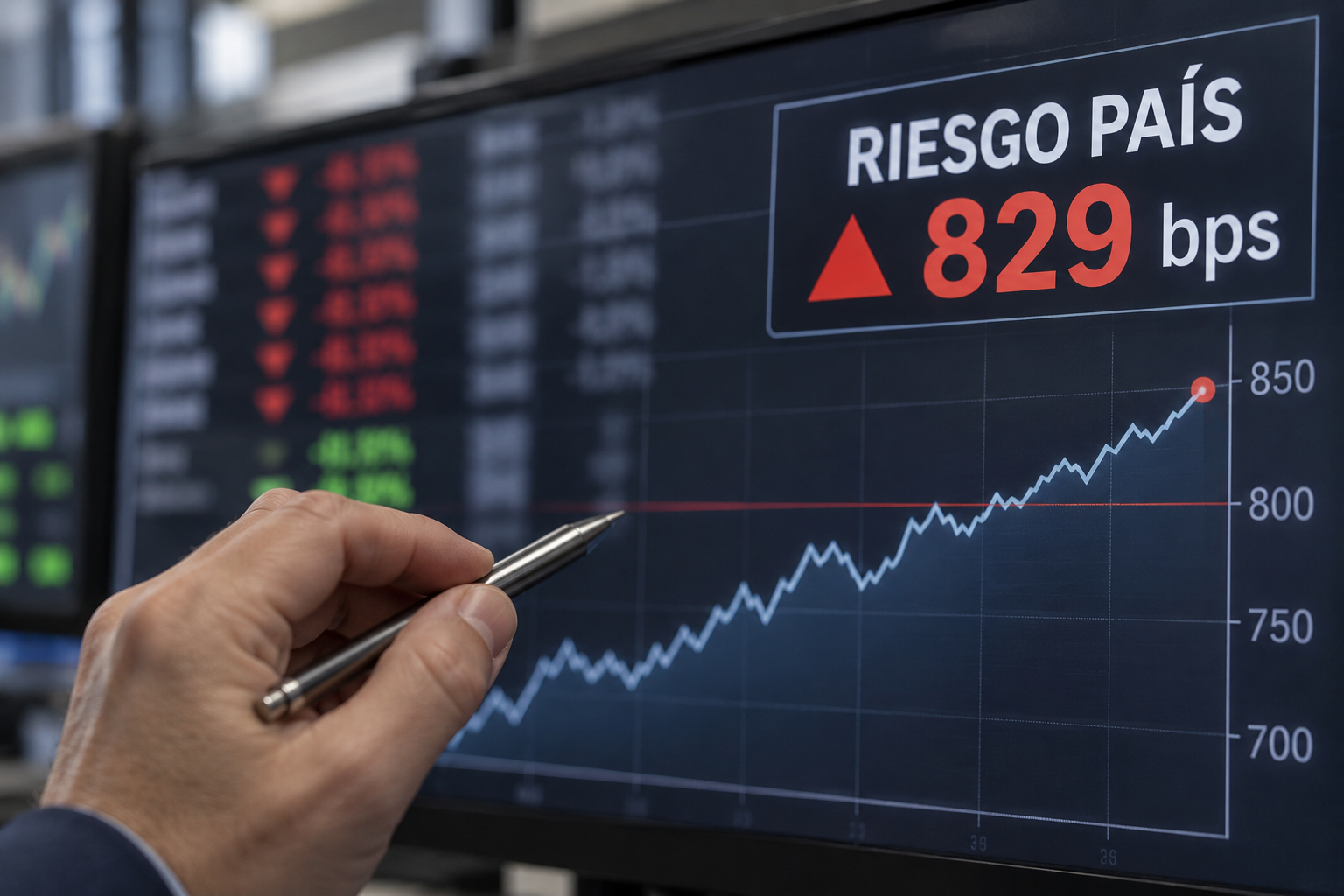

The electoral climate weighed on Argentina’s stock market at the start of November, along with sovereign bonds and shares of Argentine companies traded on Wall Street.
However, according to analysts, the sell-off was not driven by uncertainty surrounding the U.S. midterm elections, but rather by growing concerns over Argentina’s upcoming presidential election.
The concern is that the election that will determine whether President Javier Milei secures a second term is still just under a year away, leaving Argentine assets facing a long period of uncertainty — and potencially significant volatility.
A rocky start to November Argentine sovereign bonds traded in New York closed the session with further losses, pushing the country’s risk premium firmly above 800 basis points.
The country risk index closed at 829 points on Tuesday, its highest level since late October 2025, when Milei’s government secured a sweeping victory in the midterm elections, easing market jitters.
This effectively puts the administration’s hopes of returning to international debt markets in the short term at single-digit interest rates on hold.
Meanwhile, shares of Argentine companies listed on US stock exchanges also fell, despite gains across Wall Street’s major indexes.
Technology company Globant led the day’s losses, dropping 5.4%, followed by construction company IRSA (-3.3%) and electricity provider Edenor (-3%).
The Merval, Argentina’s benchmark stock index, was the only major local market indicator to trade higher during the session, gaining 1.7%. However, it remains down 1.7% so far this week.
The impact of the US elections In its latest report to clients, local brokerage firm Portfolio Personal Inversiones (PPI) noted that market attention is focused on the US midterm elections, “which will determine Trump’s room for maneuver in pursuing his agenda over the next two years.”
Analysts explained that a Democratic victory in both chambers of Congress would limit Trump’s ability to push forward new legislative initiatives and could also complicate fiscal negotiations.
“The first challenge will come on December 11, when government funding expires and the risk of another shutdown resurfaces — a partial or full halt in federal government operations when Congress fails to approve a budget or funding bill. In 2027, the debate over the debt ceiling will also come into play,” they explained.
Nevertheless, the PPI report noted that investors have already priced in a Democratic victory, meaning particular attention will be paid to the final composition of the Senate and how far the outcome deviates from market expectations.
They cautioned that determining control of both chambers “could take several days” as vote counting and verification continue, and that an unexpected result “could add volatility to US Treasuries and, in turn, to emerging-market debt,” including Argentina’s.
A market focused on politics rather than the economy Taking a more domestic-focused view, analysts at Max Capital argued that Argentine bonds “have been overly punished” in recent days, suggesting the presence of an idiosyncratic factor.
However, they pointed out that recent domestic developments have not been particularly negative either: “Polls have not deteriorated, and economic activity indicators point to a rebound in September.”
They considered that “it is reasonable to say that electoral risks are gradually becoming more tangible, but the elections are still almost a year away.”
Consequently, they argued that “the sell-off appears to have been excessive, both for USD-denominated bonds and equities.”
Along similar lines, market economist Gustavo Ber said that “session after session, it becomes increasingly clear that electoral uncertainty is weighing too heavily on domestic assets.”
As a result, political factors “have become paramount,” while external conditions have taken a back seat for now.
“The lack of market drivers continues to leave valuations at the mercy of capital flows which are currently dominated by sellers. As a result, macroeconomic data, even when positive, fall on deaf ears and fail to generate any enthusiasm,” he concluded.