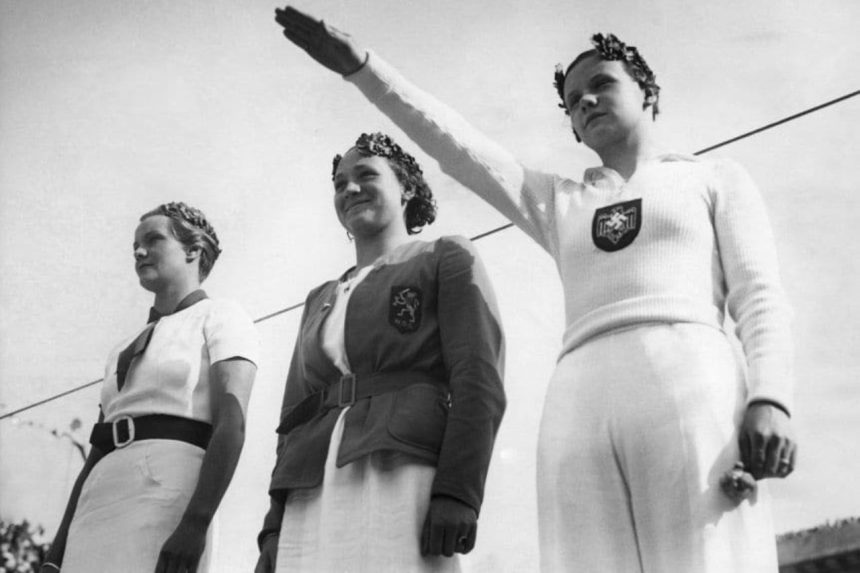
Argentine sport is full of trailblazing stories, from Emanuel Manu Ginóbili conquering the NBA to Gabriela Sabatini winning the US Open in 1990. Few, however, did it by breaking gender and historic barriers like Jeanette Campbell did at the 1936 Olympics, under the eye of Nazi Germany’s leaders.
On August 9, 1936, when she crossed the line in second place in the 100m freestyle swimming final, she became not only the first Argentine woman in history to represent Argentina at an Olympic Games, but also the first to claim a medal.
According to Alicia Morea, vice president of the Argentine Olympic Committee (COA) and chair of the committee’s Women in Sports Commission, it was “one of the most important milestones in the history of the Argentine Olympic movement.”
“It wasn’t just the first Olympic medal won by an Argentine woman; it was proof that talent, determination, and athletic excellence know no gender,” said Morea.
Today, 90 years later, Campbell’s legacy remains one of incredible talent, overcoming difficulties, and pioneering for women’s sports in the country.
Humble beginnings
Jeanette Campbell was born on March 8, 1916, in San Juan de Luz, in southern France, to a Scottish father and an Argentine mother. They emigrated to Argentina in 1918, at the end of WWI, and settled in Buenos Aires.
Having begun swimming at 6, Campbell’s talents were quickly apparent.
In 1934, at 18, she won her first Argentine 100-meter championship with a time of 1:18.6, a South American record. The win made her a star in Argentina, and she appeared on the cover of the prestigious sports magazine El Gráfico.
A year later, she repeated at the Argentine championship and qualified for the South American Championships in Rio de Janeiro, the first time women were included in the championship.
“We traveled by boat for four days and had a great time, because everything was so new for us,” Campbell told Herald editor Marcelo Fernández Bitar when he interviewed her in June 1980. “I was lucky enough to win, and that was my ticket to Berlin.”
She was a little more than “lucky.”
Campbell broke records in the 100 meters (1:08.0) and the 400 meters (5:47.8), and won the 4 x 100 relay with the Argentine team alongside Celia Milberg, Alicia Laviaguerre, and Úrsula Frick.
That year, she officially took on Argentine citizenship, aiming to represent the country in the 1936 Berlin Olympics, where she’d compete in the 100m freestyle.
Trailblazer
Campbell traveled to Berlin as the sole female Argentine representative among a group of 50 male athletes, the first woman to represent Argentina at the Olympic Games.

“Back then, the trip to Hamburg took three weeks, so I trained in a small pool in the boat, or at the ports of call,” she recalled.
However, the journey also proved a big advantage. Used to splitting her time between her day job and her practice in Buenos Aires, Campbell arrived a month before the games and got to work.
“I trained like I’d never done before, swimming twice a day,” she said, adding the responsibility felt “almost scary.”
“Arriving in Germany was wonderful. We arrived and took an ‘express’ train to Berlin — the fastest in the world at the time. We reached the city in just four hours,” she said.
Despite it all, Campbell didn’t budge under the pressure. She won her opening heat with a 1:06.8 time and qualified for the semifinals.
There, she won with a time of 1:06.6, beating world record holder Willy den Ouden of the Netherlands.
“At the time, she wasn’t doing very well, and I won the semifinal by the narrowest of margins,” recalled Campbell. “I think her problem was that she had set the record four months earlier and couldn’t maintain it.”
Her semifinal time also broke the Olympic record set by United States swimmer Helene Madison in the 1932 Olympics in Los Angeles.
In the final, Campbell led for most of the race, but Dutch Rie Mastenbroek overtook her in the final few meters, with the Argentine swimmer securing the silver medal, which she claimed was “a big surprise.”
Campbell’s final time of 1:06.4 became a South American record and wouldn’t be beaten for 29 years, until Brazilian swimmer Mary Silva did in 1964.
“I used to swim 1000 meters a day, […], now they’re doing 15 or 20 kilometers a day. Swimming is much more efficient; every detail is accounted for,” she said. “Now it’s a full-time sport; before it used to be more of a hobby.”
Campbell’s impact at the Olympics wasn’t limited to her time in the pool. She was also crowned Miss Olympia in Berlin and reportedly received offers to work in Hollywood.
An Olympic legacy
WWII denied Campbell a shot at conquering gold at the canceled 1940 and 1944 games, but she went on to become South American champion two more times in the 100 and 400-meter freestyle events in 1938 and 1939.

“Opportunities for women to pursue a career in sports were very limited,” said Morea. “That is why Campbell’s achievement went beyond the sporting result. She became a symbol of possibility, of overcoming adversity, and of openness for future generations.”
To this day, Campbell remains one of only four Argentine women to earn a medal in an individual sport, alongside Noemí Simonetto (silver at London 1948 in long jump), Gabriela Sabatini (silver at Seoul 1988 in tennis), and Paula Pareto (bronze at Beijing 2008 and gold at Rio 2016 in judo).
However, that is a gap the Olympics have gone a long way toward shrinking.
“At Berlin 1936, opportunities for women were constrained by significant cultural and social barriers,” said Morea. “Today, the Olympic Movement is experiencing a historic moment.”
Although she admits significant challenges remain, Morea credited a sustained commitment by the International Olympic Committee (IOC) and national committees and federations in achieving “near parity between men and women.”
In that, achievements like Campbell’s proved a landmark.
“Today, we see Argentine women reaching Olympic finals, winning medals, holding leadership positions, and more,” Morea said. “Jeanette Campbell was, without a doubt, one of the first to show that this path was possible.”
Campbell’s connection with the Olympics didn’t end in 1936. She was chosen to lead the Argentine team during the opening ceremony of the 1964 Tokyo Olympics.
“It was a great honor,” said Campbell, who saw her daughter, also a swimmer, represent Argentina in those games. “Between those two things, I can’t really ask for anything more.”
In 1991, she was inducted into the International Swimming Hall of Fame, the first and, so far, only Argentine woman to get the distinction.
Campbell passed away on January 15, 2003, at 86, in Buenos Aires, Argentina.
Additional reporting by Marcelo Fernández Bitar
Cover image: Jeanette Campbell seen on the left, with gold medal winner Rie Mastenbroek from the Netherlands (center) and German bronze medal winner Gisela Arendt (right). Credit: Wikimedia Commons.