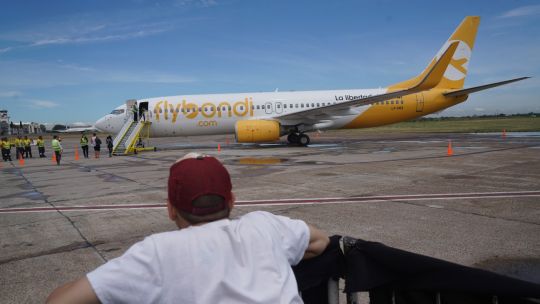
A low-cost Argentine airline is on the brink of collapse, eight months after an ally of President Javier Milei promised to invest US$1.7 billion in an attempted turnaround of the decade-old carrier.
Leonardo Scatturice’s Miami holding company became the principal shareholder of FB Líneas Aéreas SA, known as Flybondi, last year and vowed to spend the money on overhauling its aging fleet.
“We’re taking a historic step for Flybondi,” Scatturice said in a statement in December, laying out plans for at least 25 new Boeing Co. and Airbus SE jets. “Investing is believing, and today we believe more than ever in the future.”
Two CEOs later, Flybondi has yet to place firm orders with either planemaker, according to industry databases and people familiar with the matter.
In July, local website Failbondi tallied cancellations of about 75 percent of scheduled flights, while FlightRadar24 data show that the airline operated only 153 flights, down from 2,105 in the same month a year ago. Last week, Brazil’s civil aviation agency ordered it to stop selling tickets in the country – a key tourist destination for Argentines.
Milei has stayed mum on Scatturice, whose other companies have either received contracts during his administration or have ties to his US ally, Donald Trump. The silence marks a departure for the libertarian president, who is often quick to criticise executives he views as incompetent.
Scatturice’s COC Global Enterprise and Airbus both declined to comment, while Boeing referred questions to Flybondi. Milei’s press office didn’t respond to requests for comment.
The airline is badly in need of the overhaul Scatturice envisioned. Its youngest jet is over 15 years old and it’s operated only five of 11 aircraft in the past 60 days, according to data from aviation analytics firm Cirium. A search on FlightRadar24 for recent Flybondi flights, meanwhile, showed only two aircraft currently active.
The phantom investment is just the tip of an iceberg melting fast in Argentina. Flybondi’s troubles boiled over in July when it publicly accused its former executives of building “a strategy plagued by irregularities of a fraudulent nature that affected shareholders and had consequences for workers and passengers.”
The airline “reserves the right to take legal action for the damage done,” Flybondi said in a July 15 statement. In a separate announcement on the same day, COC Global Enterprise said it’s invested US$70 million in the company so far, adding that it was “in a terminal situation, three days from bankruptcy” when COC became its principal shareholder.
On Wednesday, Argentina’s aviation regulator approved Flybondi’s plan of action to restore service and permitted it to continue selling tickets despite the rebuke by its Brazilian counterpart.
Pandemic and politics
To be sure, Flybondi’s problems started well before Scatturice arrived.
Established in 2016 during former president Mauricio Macri’s market-friendly administration, the carrier pitched itself as a private-sector alternative to state-run Aerolíneas Argentinas SA. After a flashy debut, the Covid-19 pandemic, political missteps and Argentina’s economic crisis almost brought Flybondi’s operations to a halt before the fresh investment.
Despite Scatturice’s efforts, Flybondi is flailing. It didn’t fly a single plane for a roughly two-week stretch last month, as Argentine media reported it didn’t have money to pay for jet fuel. While it’s resumed operations, it’s still canceling most routes.
An employee exodus – from pilots to ground crew to corporate staff – is now underway. The union representing Flybondi workers alleges that suspended staff haven’t been paid as per a government-approved agreement; fired employees claim on social media they haven’t received severance; and unsatisfied customers say they can’t get refunds the airline offers for canceled trips.
One hotel in Buenos Aires alleges Flybondi has unpaid bills totalling 660 million pesos (US$443,000) for rooms going back to December. The airline’s last Instagram post was nearly two months ago. The Failbondi website chronicling the demise asks bluntly, “Game Over?”
Such material would usually be ripe for Milei to seize on in ripping apart an inept business executive. He’s bashed billionaire Paolo Rocca for submitting an overpriced bid on a government tender, and branded the owner of a now-shuttered tire factory a “delinquent” for protectionist practices. On the campaign trail, he often lashed out at “crony businessmen” who preserved the status quo.
So far, Milei’s government is staying silent. Argentina’s transport secretary referred questions to the aviation regulator, which wouldn’t comment on the record. An official at the agency who asked not to be named said it has increased inspections, fines and sanctions.
A former Argentine intelligence agent and Trump supporter, Scatturice has an alphabet soup of companies in the United States and multiple ties to political figures in both Buenos Aires and Washington. He’s widely reported to be close to Milei’s senior adviser, Santiago Caputo.
One of Scatturice’s firms, OCP Tech, has won several contracts with Milei’s administration, appearing in nearly 20 announcements of government tenders since 2023. Another, Tactic Global, employs senior staffers from Trump’s campaigns in 2016 and 2020, as well as the head of the Conservative Political Action Conference’s Argentina branch. Scatturice himself was photographed with Trump in June 2025.
Aviation observers note the irony that the state-run carrier, Aerolíneas Argentinas, is actually thriving amid Milei’s deregulation push, while a private airline led by an ally nears its end.
“Deregulation didn’t kill it,” said Enzo Aldo Stobbione, a travel industry veteran and head of Brazil-based market intelligence firm Business Matching Global. “Governance did – numbers that were not true, a schedule that was not backed, oversight that arrived after the tickets were sold.”
by Patrick Gillespie & Siddharth Philip, Bloomberg