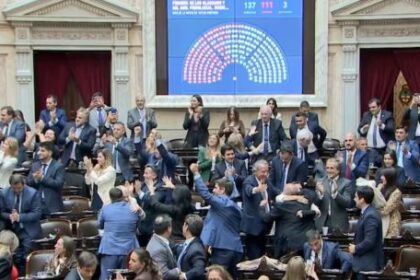
In the early hours of Friday, after an evening of heavy clashes outside the Congress building, the Senate approved a reduced version of the government’s controversial Private Property Rights reform bill, which will now be decided by the Chamber of Deputies.
The changes focus primarily on speeding up evictions and tightening the rules governing state expropriations.
However, the approval of the bill amounted to a Pyrrhic victory for the government. To secure enough votes, it was forced to let go of two initiatives that had been central to its original proposal.
The first was a reform of the Land Law that would have opened the door for foreigners to purchase up to 25% of Argentina’s territory. The other changed the Fire Management Law and would have allowed land burned by wildfires to be sold and used for other purposes.
The Land Law proposal was withdrawn before Thursday’s debate after the government lost support among several of its allies. The measure faced intense political and social opposition, particularly over concerns about foreign ownership of strategic land and natural resources.
The Fire Management reform survived until the final hours of the Senate session. It was ultimately removed after provincial senators, including representatives from Patagonia, made clear they would not support it.
The reform would have eased restrictions on the use of land after wildfires. The existing law prevents certain burned areas from being sold or repurposed for decades, with the aim of curbing a practice that had become dangerously widespread: deliberately setting fire to forests and wetlands to clear land for agriculture, livestock farming, or real estate development.
With both provisions gone, the government was left defending a considerably narrower bill.
Protests
The political scuffle inside the Senate was accompanied by a much more volatile scene outside Congress.
A large demonstration against the bill ended in clashes after a small group of protesters threw stones at police and set fire to trash cans and containers, prompting a strong response from security forces after most demonstrators had already dispersed.
Infantry units from the Federal Police, Gendarmerie and Naval Prefecture used water cannons, tear gas, rubber bullets and motorized units to disperse and pursue the violent protesters, with clashes extending beyond Congress to 9 de Julio Avenue, four blocks away.
Security forces also targeted the majority of protesters who were not involved in the disturbances, including bystanders and passersby, according to witnesses and reports from the scene.
A journalist and a photographer were among those injured. The Police reported that five officers were also wounded, while 12 people were arrested during the clashes.
The violence provided a tense backdrop to a debate that exposed the government’s growing reliance on provincial blocs to secure the votes it needs to pass legislation.
What was approved?
If endorsed by the Chamber of Deputies, the Senate-approved legislation would speed up judicial procedures for evictions, including cases involving illegal occupation and unpaid rent.
In residential rental cases, landlords would have to formally notify tenants and give them only 10 days to settle outstanding payments before initiating eviction proceedings through an expedited judicial process. Under the current system, court-ordered evictions can take months or even years.
The bill also creates a faster procedure for recovering property from squatters and precarious occupants.
The new rules regarding evictions have caused concern amongst many, amid a growth in unemployment and a steep drop in purchasing power since Javier Milei took office at the end of 2023.
The measure would also impose tighter conditions on government expropriations. Public-interest declarations would have to meet stricter tests of necessity and proportionality, while compensation would be tied primarily to the objective market value of the property and directly resulting damages.
Government senators portrayed the bill as an attempt to restore legal certainty and strengthen private property rights.
Critics, however, argued that the accelerated eviction procedures could disproportionately affect tenants and that the changes to expropriation would restrict the state’s ability to act in the public interest.
Cover photo: Mariano Fuchila (Ámbito)