The Chinese Embassy in Argentina released a statement accusing the United States of interfering in commercial ties between Argentine companies and Chinese telecommunications giant Huawei.
The communiqué, published late on Wednesday, followed reports that the U.S. Embassy in Argentina had warned directors of a private cooperative in Neuquén province that they could face visa restrictions if they went ahead with a planned deal with Huawei, a company Washington considers a national security risk.
The Chinese Embassy said its U.S. counterpart had “deliberately stoked the ‘China threat theory,’ expanded the concept of national security and, by revoking visas, blatantly prevented an Argentine company from engaging in normal cooperation with the Chinese company Huawei.”
It added that the move “fully reflects the arrogance and prejudice of the United States” and amounted to “a serious disregard for the sovereignty of other countries and a grave undermining of free-market principles,” a position China said it “firmly opposes.”
The embassy also challenged Washington’s longstanding rhetoric on democracy and individual freedoms.
“The United States has always boasted about its values of democracy and freedom, but it does not tolerate a foreign private company operating and developing normally in a third country, which fully exposes its hypocritical nature,” the statement said.
The Argentine company involved
The CALF Cooperative (Neuquén Provincial Cooperative for Public and Community Services, Limited) distributes electricity in the Patagonian city of Neuquén and surrounding areas in the south of Argentina.
On Wednesday, the U.S. Embassy warned CALF’s board members that they could face the revocation of their U.S. visas if the cooperative moved forward with its agreement with Huawei.
On its site, the company announced in April that it formed a “strategic alliance” with the Chinese giant in order to “enhance the electrical and connectivity infrastructure in the Neuquén region.”
U.S. Ambassador Peter Lamelas told Argentine newspaper Clarín that the issue was not one of interference in “Argentine sovereignty” but rather of U.S. national security.
CALF released a public statement on Wednesday saying it began receiving messages via an instant messaging service in early July about “a U.S. government policy that would restrict or revoke visas for executives involved in the expansion of Huawei’s operations in Argentina.”
According to the cooperative, the messages also asked whether it could cancel the project or whether CALF had “crossed the line.”
The cooperative said that if there were “a well-founded technical objection” to its network, it should be “submitted in writing through institutional channels.” It added that, while it is “willing to make its projects available to the relevant Argentine technical agencies for evaluation,” it will “continue to evaluate bids from all suppliers worldwide — whether American, European, or Asian.”
CALF also sent a formal letter to the U.S. Embassy, with a copy to Argentina’s Foreign Ministry, seeking clarification on the scope of Washington’s warning.
According to Clarín, the measure could affect 16 members of the cooperative’s board of directors and two trustees.
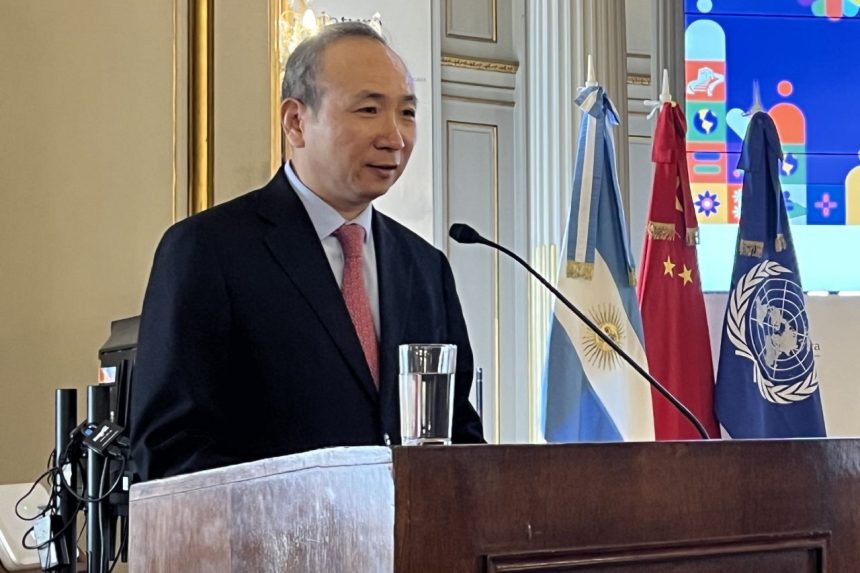
Cover image: Chinese Embassy