Argentina-US trade deal can unlock opportunities, but Congress must approve it
 Juan Marcos PollioUpdated 2 hours Ago3 Mins read

Bilateral relations between Argentina and the United States are at an unprecedented point in their history, driven by close geopolitical alignment between Javier Milei’s government and Donald Trump’s administration.
That alignment could deepen on the trade front through the Agreement on Reciprocal Trade and Investment (ARTI), signed by the two countries earlier this year.
The agreement could open up new business opportunities for American companies looking to invest in Argentina, as well as for Argentine firms seeking to expand into the U.S. market.
One way capitalize these opportunities is through friendshoring—the practice of shifting or developing key parts of a country’s supply chains in countries that are its geopolitical allies.
This approach has gained particular prominence since Donald Trump’s second term began and his administration escalated its tariff war with China.
For this to become a reality, however, one crucial step remains: approval by the Argentine Congress, the final hurdle before the agreement can take effect.
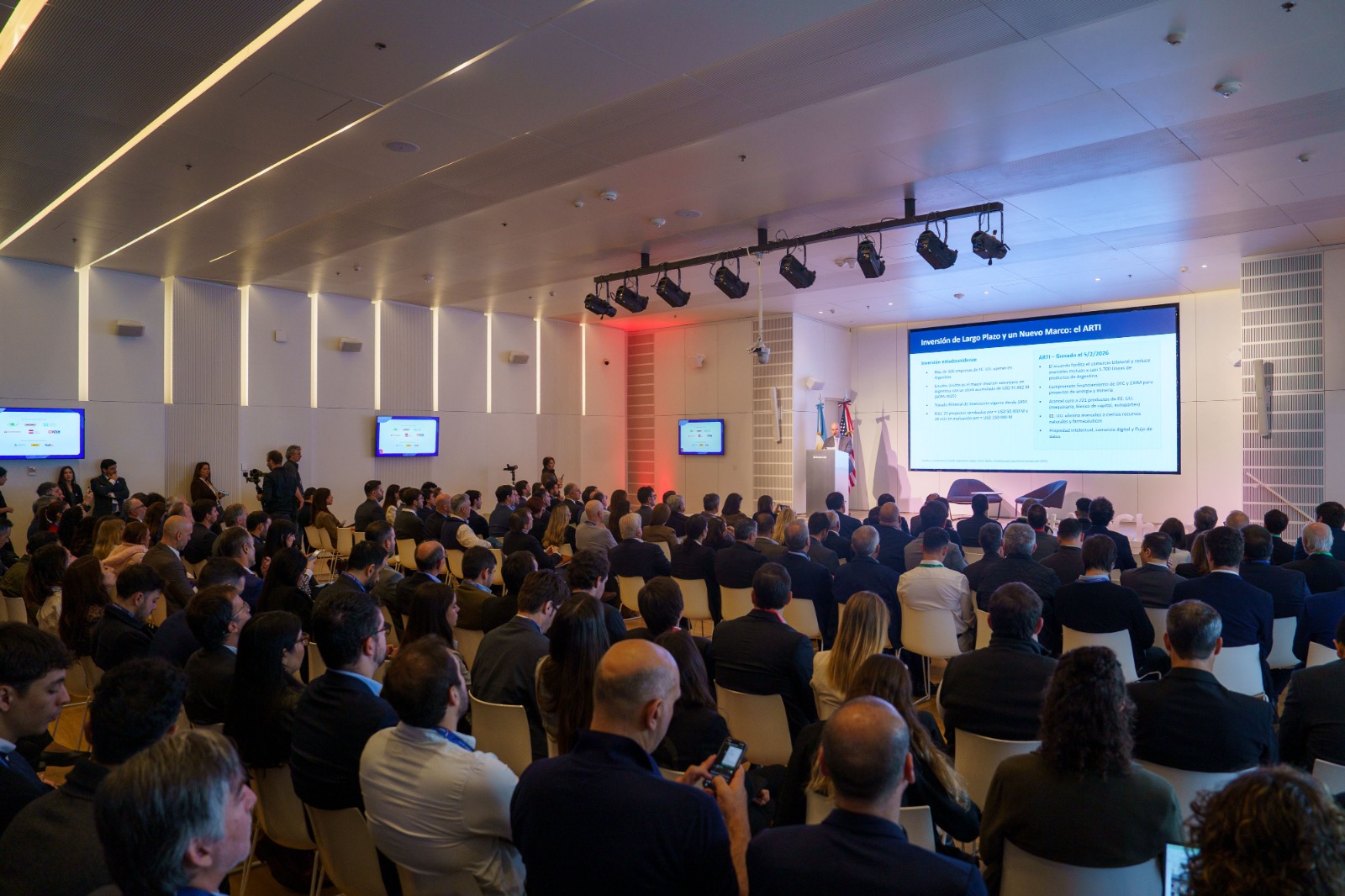
That was the main conclusion drawn by several speakers at the AmCham’s (the American Chamber of Commerce) Trade & Conference on Wednesday, which the Herald attended at the Santander Auditorium.
A unique moment in US-Argentina relations
AmCham Argentina CEO Alejandro Díaz highlighted the “unique” moment in diplomatic relations between the two countries as he addressed more than 300 attendees, including representatives of European and Brazilian companies operating in Argentina.
He argued that the two presidents have not only “found a personal ideological dynamic through which to interact,” but that both governments are also “predisposed to establishing a strategic relationship on a scale that puts geopolitics clearly clearly ahead of trade.”
He said trade flows from a geopolitical alignment that places Argentina in a central role within the Southern Cone.
Díaz also emphasized the opportunity for friendshoring with the United States, saying the two countries could use their political ties to boost bilateral trade and investment.
For Argentine companies seeking to enter the U.S. market, he explained, the first step is to improve competitiveness, which depends on the conditions Argentina offers businesses seeking access to that market.
“What we need here is not so much productivity, which is clearly a factor companies can manage themselves, but rather competitiveness, which depends on other factors,” he said.
These factors include the tax burden, logistics costs, infrastructure constraints and the ability to make the economics work for products, particularly manufactured goods, to enter the United States.
Interest in securing approval of the agreement with the US
Joel Reynoso, Commercial Counselor at the U.S. Embassy, said Argentina “has a great deal to offer” in terms of natural resources, “particularly in energy, minerals, and agriculture.”
He also highlighted the country’s “highly skilled workforce and dynamic technology sector.”
He said the embassy was “very interested” in seeing the Senate approve the Patent Cooperation Treaty (PCT), included in the agreement, this week.
The international framework facilitates patent protection in 159 countries, an issue that has created tensions between local pharmaceutical companies and their American counterparts.
“I’m being told it will take a little longer, but we are very eager to get the PCT across the finish line. Hopefully, it will be approved tomorrow,” Reynoso added. When asked about the matter by the Herald, he declined to comment further.
Reynoso also said the embassy was seeking to “expand investment and financing opportunities” for Argentine companies. He noted that the Export-Import Bank of the United States (EXIM) had reinstated coverage for Argentina in February 2026.
“That is important because it can facilitate financing for projects that use American equipment, technology, and services,” he stressed.
He said an “energy mission” organized by the embassy and the Business Council for International Understanding was scheduled to visit Argentina in December.
Meanwhile, the embassy is organizing a security and defense event for February 2027 “to showcase innovative technologies from the United States and facilitate contact between American companies and Argentine authorities.”
Dissenting voices
Despite the optimism aming the other speakers, not everyone agreed with the overall approach.
Daniel Novoa, president of the Hispanic Retail Chamber of Commerce (HRCOC) and one of the event’s speakers, told the Herald that “all anyone has talked about is extraction [of natural resources].”
“No one has talked about supporting the domestic market, including through financing. No one is talking about supporting small and micro businesses, which are the ones that create jobs and drive growth,” he said.
He also argued that the boom in mining, energy, and agricultural exports benefits a “very small number of businesspeople,” but not the rest of the country.
“The problems Argentina is facing today, with low profitability and weak consumption, are also affecting the United States.”
Novoa said an HRCOC survey of member businesses in Florida and California had found that profitability was down 15% to 30% from a year earlier.
He attributed the decline to Trump’s tariffs.
“When we were consulted as a chamber of commerce, I drew on my experience in Argentina and said this does not work. It is a terrible idea to do this because, ultimately, the cost will be passed on to the end consumer.”