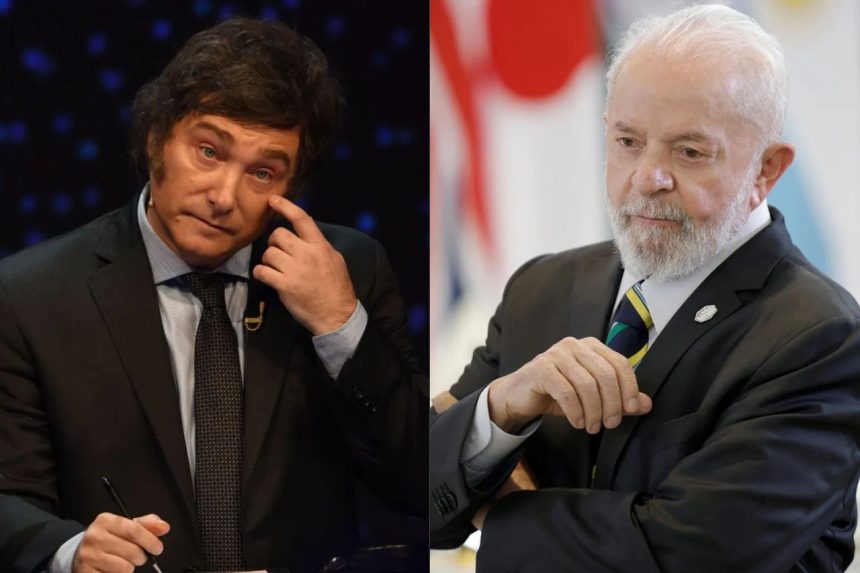
Javier Milei arrived in São Paulo as president of Argentina and spoke as though he were still on the campaign trail.
At the launch of Flávio Bolsonaro’s presidential bid, on July 25, Milei called Brazil’s government a collection of “thieving socialists,” described President Luiz Inácio Lula da Silva as a thief and a convict, and attacked Supreme Court Justice Alexandre de Moraes.
Brazil recalled its ambassador to Argentina for consultations and summoned the Argentine ambassador in Brasília.
The next day, Milei accused the governments of Brazil and Mexico, along with the United States Democratic Party, of financing an online campaign against Argentina during the World Cup. Brazil, he said, had supplied 25 percent of the resources. He offered no evidence.
The episode followed a familiar script. Milei provokes, the target responds, and that reaction is folded back into the original accusation. Objection becomes persecution. A dispute created by the president returns to Argentina as proof that the country is under attack.
The permanent campaign
The method has been electorally powerful because the insults are not just insults. They offer a mouthpiece to people who believe conventional politicians have ignored or humiliated them. Milei gives their anger a vocabulary and performs it at full volume, echoing Donald Trump’s instinct that louder objections only prove the point.
Breaching decorum is part of the appeal: the rules of public speech get cast as one more privilege enjoyed by a failed elite.
A Brazilian minister will not change a trade rule because an Argentine video clip went viral. Lula will not make concessions because Milei’s supporters enjoyed hearing him insulted. The reward is immediate at home but detrimental abroad.
Milei’s São Paulo speech reads less like a negotiating tactic and more like another episode in his domestic political story, staged on foreign soil. And it is the same instinct, treating a complicated reality as a story with a villain, that also shapes how he talks about economics.
Countries as ideological props
Milei’s worldview is well suited to the rally stage because it reduces countries to examples. Venezuela and Cuba show where the left leads. Switzerland shows what economic freedom can produce. Each case arrives stripped of the history and institutions that would complicate the lesson, the same simplification that turns a foreign judge or a foreign president into a stock villain, just applied to economics instead of politics.
Switzerland is an especially convenient prop in Argentine political debate. It is prosperous, stable and friendly to business. It also has compulsory health insurance, strong cantonal governments, extensive public infrastructure and a state capable of enforcing rules. Its success cannot be reduced to low taxes or reverence for markets.
The problem appears in reverse with Peru, which followed market-oriented policies and maintained macroeconomic discipline for decades, yet informality remains pervasive and the state remains weak in large parts of the country. Liberal reforms did not cause every Peruvian failure, but neither did they manufacture Swiss institutions.
The countries near the top of the United Nations Human Development Index make the simplification even harder to sustain. Norway, Denmark, Sweden and the Netherlands are capitalist economies with extensive public services and large welfare states, neither socialist command economies nor experiments in abolishing the state.
Milei’s map works by treating nations as campaign slides: one image, one label, one conclusion. Foreign governments have their own voters, interests and capacity to respond.
An Argentine president can criticize Lula. He can challenge Brazil over trade, regional policy or the conduct of its institutions. But criticism from a head of state should be attached to an Argentine purpose, not merely to a foreign candidate the president would like to see elected.
Nothing in the São Paulo speech suggested a negotiation under way or a concession Argentina hoped to obtain. Milei intervened in Brazil’s presidential campaign on behalf of an ideological ally. The applause stayed in the room. The diplomatic cost crossed the border.
Speaking for Argentina
Argentina’s Constitution is not ambiguous about the president’s role. Article 99, Section 11 assigns the president responsibility for concluding and signing treaties and for negotiations required to maintain good relations with foreign nations and international organizations.
That responsibility does not disappear because Milei has a domestic mandate to defend. When he speaks abroad, he is not simply Javier Milei expressing a personal opinion. His words carry the authority of the Argentine state, whether or not he intends them to.
An election gives a president the right to govern. It does not transform every personal alliance into a national interest, or turn the enemies of his political friends into foes of Argentina.
Brazil is where this distinction has the highest price tag: Argentina’s largest bilateral trading partner, with a combined trade of roughly US$2.59 billion in June alone. Auto parts, grains and energy move across that border by the truckload, carried by companies and provincial economies that have spent decades building a relationship dense enough to survive periodic political conflict.
Part of that relationship runs through the regional bloc Mercosur, where Brazil has been examining Argentina’s separate trade agreement with the United States over concerns that it breaches the bloc’s rules, exactly the kind of dispute that needs a functioning channel between Buenos Aires and Brasília to resolve.
One speech will not unwind that. Its resilience comes from institutions and economic ties Milei did not build, and, on the evidence of this trip, does not feel obliged to protect.
What did Argentina gain?
Milei’s defenders will say bluntness beats hypocrisy, that previous presidents smiled for photos with regional counterparts while quietly resenting them, and that at least Milei says what he thinks. There’s a legitimate argument to be made: diplomatic niceties can curdle into a kind of dishonesty, and voters are entitled to a president who doesn’t feign friendships he doesn’t feel.
But that argument confuses candour with strategy. Milei wasn’t blunt in service of an Argentine position on trade or the Mercosur dispute working its way through both governments; he was blunt in service of Flávio Bolsonaro’s campaign.
Saying what you think is not the same as using what you say to get something for your country, and diplomacy is judged on the second, not the first.
Confrontation continues to pay domestically, which is exactly why Milei sees little reason to leave campaign mode. A protest from Brazil becomes proof that the international left fears him. A recalled ambassador becomes another prop in the story of a president besieged by a hostile establishment.
Judged by that story, the trip was a success. Judged by what Argentina actually obtained — a concession, new leverage, an opening in the Mercosur dispute — there is only a fresh quarrel with the country Argentina depends on more than any other in the region.
The applause was Milei’s. The consequences belong to Argentina.