Argentina draws German interest. Elections, economic turbulence hold it back
 Juan Marcos PollioUpdated 2 hours Ago3 Mins read

German companies have had a presence in Argentina since the mid-19th century, when Siemens installed a telegraph network along the railway.
Over the years, their presence has only grown, especially in automotive manufacturing (Volkswagen, BMW, and Audi), as well as chemicals and pharmaceuticals (Bayer and BASF).
Recent global developments could increase it even more.
Geopolitical changes such as Russia’s invasion of Ukraine, Donald Trump’s return to the U.S. presidency, and the war in the Middle East have increased the number of German companies interested in expanding their businesses in the country. The European Union and Mercosur deal is an additional appealing factor.
Their main interest is in sectors considered strategic, such as minerals, energy, and agribusiness.
There are, however, obstacles in the way of concrete investments: political uncertainty ahead of the 2027 presidential elections and Argentina’s rising country risk.
Strategic areas for cooperation “Argentina has opened up to the world, and I believe good partnerships can emerge from that. It will be one of the central focuses of my work here,” German ambassador Catalina Cullas said at an event at the German embassy attended by the Herald this week.
German companies, she added, are showing “interest,” particularly in sectors related to mining, energy, and agriculture. Cullas expressed optimism that these key sectors could “give a boost” to the rest of the economy.
“There is a lot to be done in industrial production, which is where German companies have a lot to offer,” she said, adding that three factors are working in favor of trade relations between the two countries.
The first is “the opening of the Argentine market and the improvement in macroeconomic indicators” since President Milei took office. The second is interest in Europe — and Germany specifically — in diversifying investments due to the “geopolitical situation.”
The third factor is the EU-Mercosur deal, with its trade-only segment finally approved by both blocs earlier this year after more than two decades of negotiations.
Cullas, however, also acknowledged the challenges ahead.
“Companies need, of course, predictability; they need to be able to plan. Country risk in Argentina remains high.”
Risks and opportunities For Julieta Barra, foreign trade manager at the German-Argentine Chamber of Industry and Commerce (AHK Argentina) and one of the speakers at the event, the desire for economic stability is shared by business communities, “regardless of the country.”
German companies operating in Argentina have a “very long-term” perspective, as many of them have been in the country for more than a century.
“Those that have been here for many years have already experienced many of these ups and downs, and they have teams in the country that are accustomed to finding solutions to these challenges,” she told the Herald.
Barra nevertheless acknowledged that operating in a market that has “prospects and clear rules” is a “priority” for German companies.
Asked about competition between German subsidiaries and Chinese imports, she played down the issue, arguing that “it is part of an international trend.”
Regarding the EU-Mercosur deal, she said it remains to be seen whether the deal will open doors for products or service segments in which the two countries have so far had limited commercial experience.
“Germany brings considerable expertise in environmentally important technologies, as well as in energy efficiency, innovation, automation, and digitalization,” she said.
This could help Argentine industry “make the productive leap it now needs after the market has opened up.”
In search of new partners Hans-Dieter Holtzmann, Southern Cone project director at the Friedrich Naumann Foundation, said that Germany needs “new friends around the world” because of geopolitical volatility and “the economic challenges” it creates.
He said the past model, where the U.S. provided Germany’s security, China bought its cars, and Russia supplied it low-cost gas, is over.
“We have become too dependent on the unpredictable shifts in the United States,” he said, adding that the German economy is vulnerable to “blackmail” by China while also depending on Chinese inputs.
“This is especially true when it comes to the supply of raw materials and rare earths,” the economist said.
This increases the need to “find new allies around the world” and helps explain the growing interest in Argentina. Regarding energy supplies, Holtzmann said Germany “depends too heavily” on Russia.
“Companies and citizens are paying the price through extremely high energy costs, which affect Germany’s competitiveness and households.”
The conflict in the Middle East, along with what he described as “serious and misguided decisions,” has compounded Germany’s energy-security challenges.
He described as “a good sign” an agreement signed by Germany and Argentina for the supply of 2 million tons of liquefied natural gas (LNG) over eight years, with deliveries expected to begin by the end of 2027.
“It is good for Germany in terms of diversification, but it also gives Argentina the opportunity to become a kind of gateway and build trust, precisely when it comes to its ability to supply [energy],” he said, adding that Argentina’s raw materials and Germany’s technology represent a “highly complementary” model for mutually beneficial trade relations.
“It is not just about exporting raw materials [but also] generating added value here and creating local jobs.”
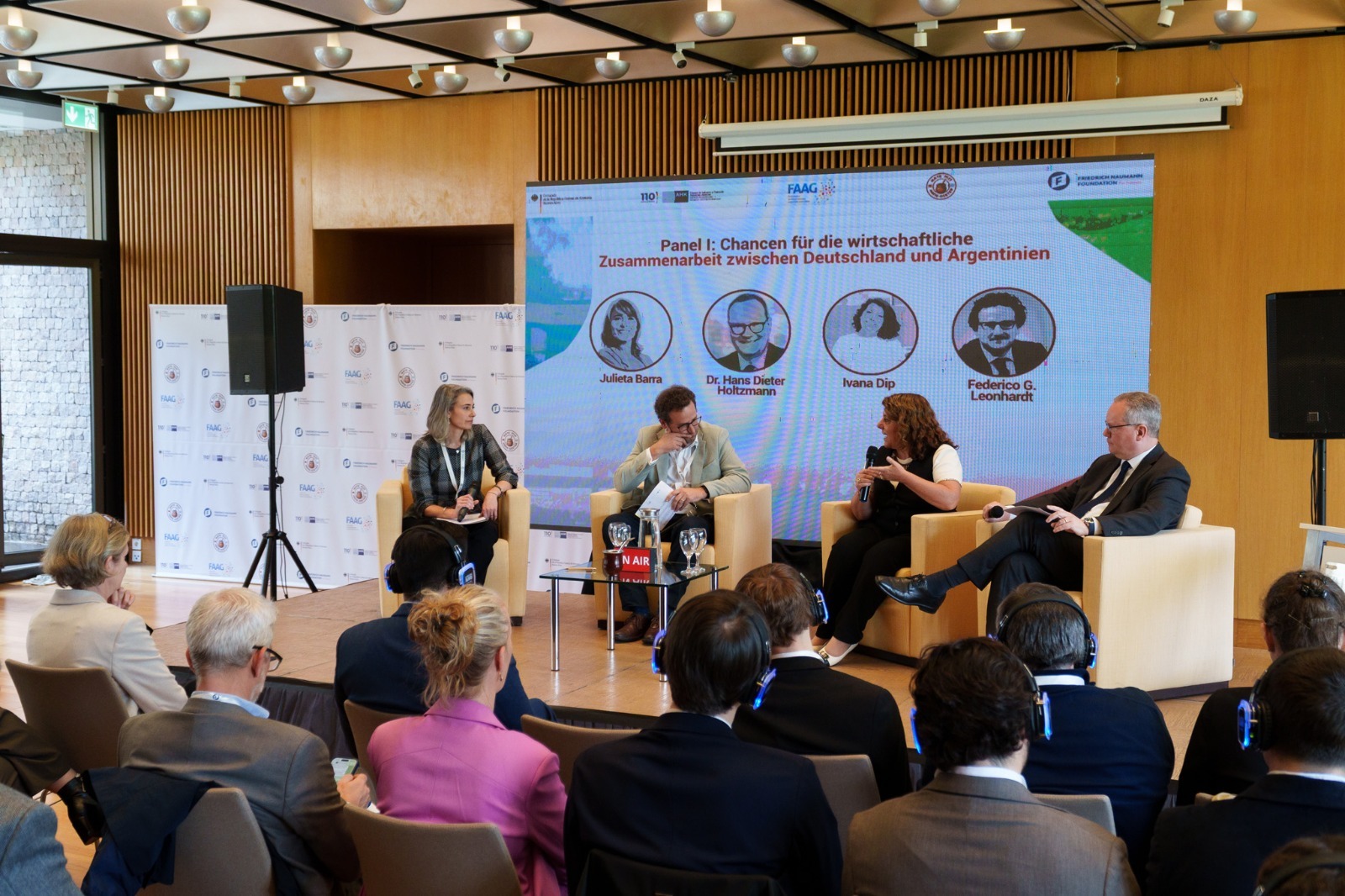
Photo of panel at the German Embassy. From left to right: Julia Barra (foreign trade manager at the German-Argentine Chamber of Industry and Commerce; Federico Leonhardt (attorney); Ivana Dip (president of BMW Argentina); and Hans-Dieter Holtzmann (Southern Cone project director at the Friedrich Naumann Foundation). Image courtesy Friedrich Naumann Foundation.