Argentine biotech developing first treatment of haemolytic uraemic syndrome
 Veronica SminkUpdated 3 hours Ago6 Mins read

Look around the streets of Buenos Aires City and you’ll notice a new food trend: an explosion of restaurants offering all kinds of hamburgers, from smash burgers and sliders, to gourmet blends and even an infamous raw burger.
While many Argentines are embracing this newfound love of ground beef, for parents of young children the fad is a bit of a nightmare. And not only because they’re worried about junk food and obesity.
The main reason for concern is that hamburger meat is considered the main culprit of a potentially life-threatening disease called haemolytic uraemic syndrome (HUS) that is particularly dangerous for children under five.
The disease is caused by bacteria found in cattle and is carried in contaminated food, especially undercooked ground beef.
This bacteria, called Escherichia coli, is commonly found in the intestinal tract of cattle and produces a toxin, called Shiga, which causes diarrhea, often bloody, abdominal pain and fever, and can lead to irreversible damage to the kidneys.
Argentina has the highest incidence of HUS in the world, with around 300 children developing the disease each year, according to biologist Vanesa Zylberman, research and development manager and technical director at Argentine biotechnology company Inmunova.
“There is no specific treatment for HUS today,” Zylberman tells the Herald. “All that can be done is supportive care.”
The unusually high incidence of HUS in Argentina is one of the reasons Inmunova decided to focus on what could become the world’s first specific treatment for the disease.
Its investigational drug, INM004, is now in Phase 3 clinical trials, the final stage of testing before the company can seek regulatory approval.
The international trial involves 220 children between nine months and 18 years old and is being conducted at more than 40 health centers in Argentina and Europe.
Why is HUS so prevalent in Argentina? Contamination with Shiga toxin–producing Escherichia coli (or STEC) can occur not only through meat, but also through other food or water contaminated with fecal matter, including vegetables and fruit.
However, minced beef is particularly problematic because bacteria that is on the surface of a cut of meat can become mixed throughout it when the meat is ground.
“That’s why in many parts of the world it is known as hamburger disease,” Zylberman explains.
Argentina’s high incidence cannot be attributed to a single cause, she says. It is the result of multiple factors, including eating habits, the country’s large cattle population, bacterial strains and environmental conditions.
“We eat a lot of meat, there are a lot of cattle, and sometimes there’s a lack of control over certain types of consumption.”
Photo: Antonio Groß/Unsplash Cases also tend to increase during the summer, when many Argentines are traveling and eating in places where food-handling standards may vary.
Importantly, the roughly 300 annual cases of HUS represent only a fraction of STEC infections. Zylberman estimates that around 90% of people who contract the bacteria do not develop the disease, often recovering spontaneously.
Some infections are also never diagnosed because they cause mild or no noticeable symptoms.
However, when it does hit, HUS can be very dangerous, especially for children.
Zylberman highlights that the disease is the leading cause of kidney transplants in adolescence.
Symptoms to look out for The initial manifestations of a STEC infection start in the gut, typically appearing 3 to 4 days after swallowing the bacteria.
At first there is severe stomach pain, with intense abdominal cramps that can feel like sharp, twisting knots. This is followed by diarrhea, which usually starts out watery but turns bloody within 24 hours.
Many people experience frequent vomiting and nausea, which makes it difficult to keep fluids down. This tends to be accompanied by either no fever or just a very low-grade, mild fever.
The major red flag, according to doctors, is lack of pee, especially if it occurs as the diarrhea seems to be improving.
It’s a sign that the infection is turning into HUS and the kidneys are shutting down.
Why is it more dangerous for small children? HUS primarily affects small children because their immune system is still in development, Zylberman says.
There’s also a more complex explanation: children’s kidneys have a higher amount of receptors that attract the Shiga toxin, the poison that causes the internal destruction. This is why the damage tends to be more severe.
In addition, their bodies dehydrate faster from the severe diarrhea caused by the disease. When a small body runs out of fluids, less blood flows to the kidneys, making it even harder for the organs to recover.
This devastation is why HUS is considered a critical public health crisis, despite the fact that it affects a relatively small share of the population.
Currently, all doctors can do when a child becomes ill with the disease is offer supportive care, says the expert.
Around 40% to 50% of patients require dialysis during the acute phase, while long-term complications can include chronic kidney disease, hypertension and neurological damage.
Inmunova estimates the disease can be fatal in approximately 3% of cases.
How the Argentine treatment works One of the reasons HUS has proved so difficult to treat is that doctors can’t use antibiotics to kill the bacteria, the usual solution.
This is because when it comes to STECs, far from killing the bacteria, the drug stresses them, causing them to release even more toxin.
That led the researchers at Inmunova toward a different strategy: an antitoxin.
INM004 is a biological drug made from polyclonal antibodies directed against the Shiga toxin. The antibodies are intended to bind to the toxin before it can attach to receptors on kidney cells, interrupting the chain of events that produces severe disease.
The concept has been under investigation for years. Zylberman herself has worked on antitoxins since her doctoral research.
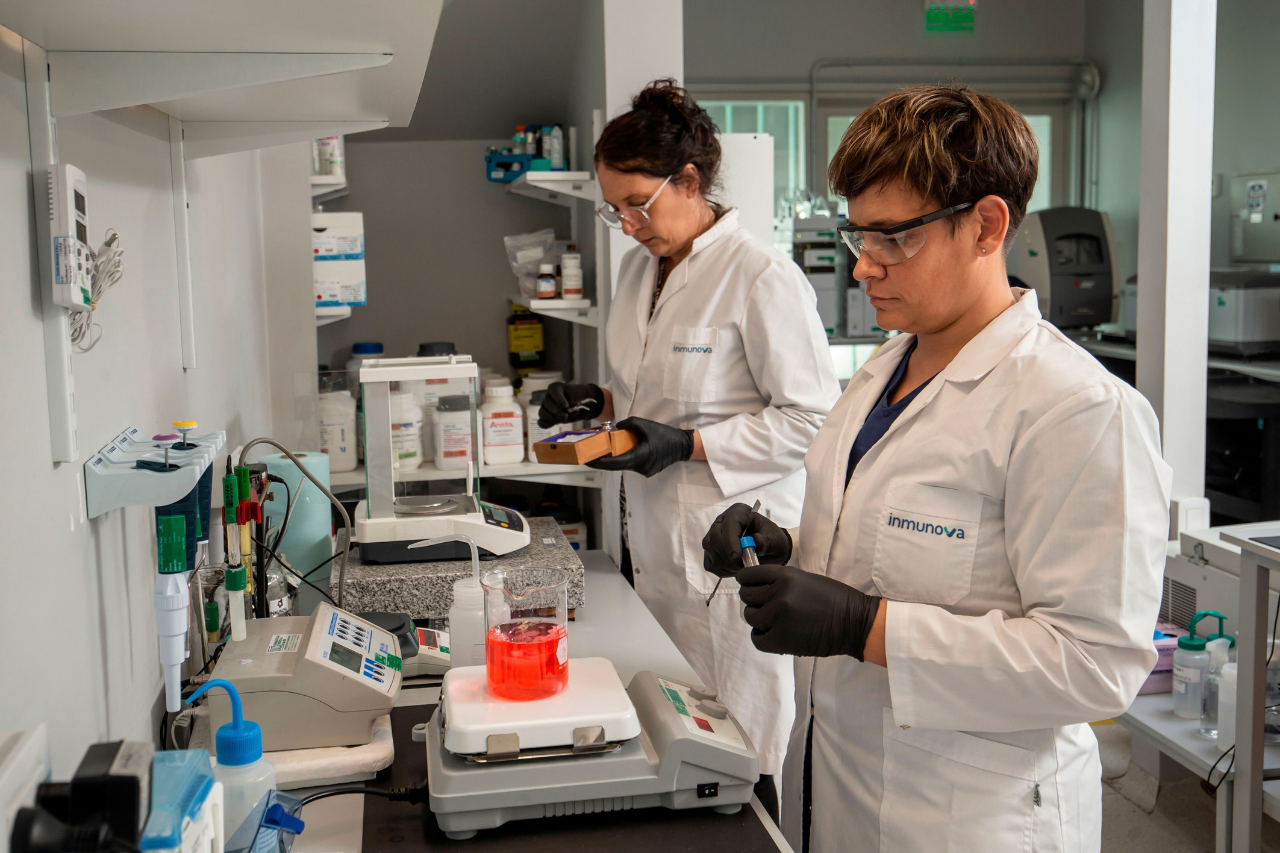
Photo. Inmunova The breakthrough came through protein engineering: researchers designed a special molecule that combines a portion of the Shiga toxin with another molecule that stabilizes it.
This engineered molecule is then injected into horses, where it stimulates their immune system to produce antibodies against the Shiga toxin, turning them into a sort of “biological antibody factory, ” Zylberman says.
The scientist emphasizes that the animals — chosen because they produce a high proportion of antibodies — “do not suffer and don’t develop the disease or symptoms.”
“It is as if they were receiving another vaccine as part of their vaccination schedule,” she explains.
The resulting antibodies are then extracted and processed through a biotechnology process to produce the medication.
Inmunova developed the engineered molecule in its own laboratory and holds two patents related to the technology.
The company works with the Argentine Biological Institute S.A.I.C. (BIOL, in Spanish), a private laboratory that produces antivenoms and other antibody-based products, to immunize the horses and process the antibodies.
Phase 3 The treatment first had to pass through preclinical testing, including animal models, before human trials could begin.
Phase 1 tested safety in healthy adult volunteers. Phase 2 was conducted in children diagnosed with HUS and continued to assess safety while beginning to collect evidence related to efficacy.
The early clinical studies have provided encouraging signals that INM004 can help limit the kidney damage caused by Shiga toxin, although its efficacy has not yet been definitively demonstrated.
The results of the early clinical studies were published in the British Journal of Clinical Pharmacology and Pediatric Nephrology.
Now comes the decisive test.
The Phase 3 study is randomized and double-blind. All participants receive the standard supportive treatment they need, while approximately half are also randomly assigned to receive INM004.
Photo: Inmunova While Inmunova will only be able to determine the efficacy of the treatment at the end of Phase 3 —- which is expected to last another year — they have cause for optimism: an independent evaluation carried out around the middle of the trial determined that the study should continue.
“One thing that has to be highlighted is that this is a development that began in a 100% Argentine company, from the creation of the molecule to its intellectual property,” Zylberman says. “Reaching Phase 3 today is very significant.”
When could it become available? If the final phase goes well, there will still be regulatory hurdles to clear before the treatment can be made available.
The project has received authorization from Argentina’s National Administration of Medicines, Food and Medical Technology (ANMAT, in Spanish), as well as the European Medicines Agency (EMA) and the United Kingdom’s Medicines and Healthcare products Regulatory Agency (MHRA).
The EMA and the United States’ Food and Drug Administration (FDA) have also granted INM004 orphan-drug designation, a regulatory status given to a medicine being developed for a rare disease or condition.
But these agencies will have to review the evidence on safety and efficacy once Phase 3 is over before deciding whether to approve the treatment.
There is therefore no confirmed date for commercial availability.
Zylberman details that, if and when that occurs, the treatment will be sold to hospitals and not to private patients, as it will have to be administered intravenously by doctors as part of a larger medical treatment.
For now, Argentina remains both the country with the world’s highest burden of HUS and the place where an experimental treatment has advanced furthest toward addressing it.
And while parents should continue to take precautions — particularly by avoiding undercooked ground meat for young children — the prospect of a specific treatment represents a significant change for a disease that, since first being identified in 1955, has had to be managed only through supportive care.