Architecture buff? Here are 6 modernist gems you can’t miss in Buenos Aires
 Buenos Aires HeraldUpdated 2 hours Ago4 Mins read

It’s spring in the Southern Hemisphere, and benefits are on display for everyone to see. Warmer weather and an inviting public life mean troves of people with an extra pep in their step, eager to explore and enjoy the multiple activities Buenos Aires has to offer.
One crowd favorite is the city’s outstanding architecture.
You’ve probably heard the highlights. Teatro Colón, Casa Rosada, and Palacio Barolo are all up there. And although Buenos Aires has much more to offer, there is one catch: most buildings are in use and thus limited for visitors to see.
But if you happen to be in the city, you’re in luck, as the 2026 Open House Buenos Aires will be taking place.
Part of a worldwide network present in over 50 cities, Open House is an initiative that once a year allows free entrance to multiple buildings that have restricted public access, as well as walking and biking tours to explore the city.
This year’s list includes more than 150 buildings that can be visited over the weekend in two different shifts, from 10 a.m. to 2 p.m. and from 3 p.m. to 7 p.m. And while some of the more famous venues require a sign-up to enter (allowed slots have already filled up), there are plenty of fabulous places beyond tourist maps and guidebooks where you can just show up, go inside, and smooze around for free.
Just remember to take some form of ID and be sure to check the time (some buildings might not open at the scheduled time pointed above).
This year’s Herald‘s selection is centered around modernist and late modernist architecture built in Argentina between 1930 and 1960.
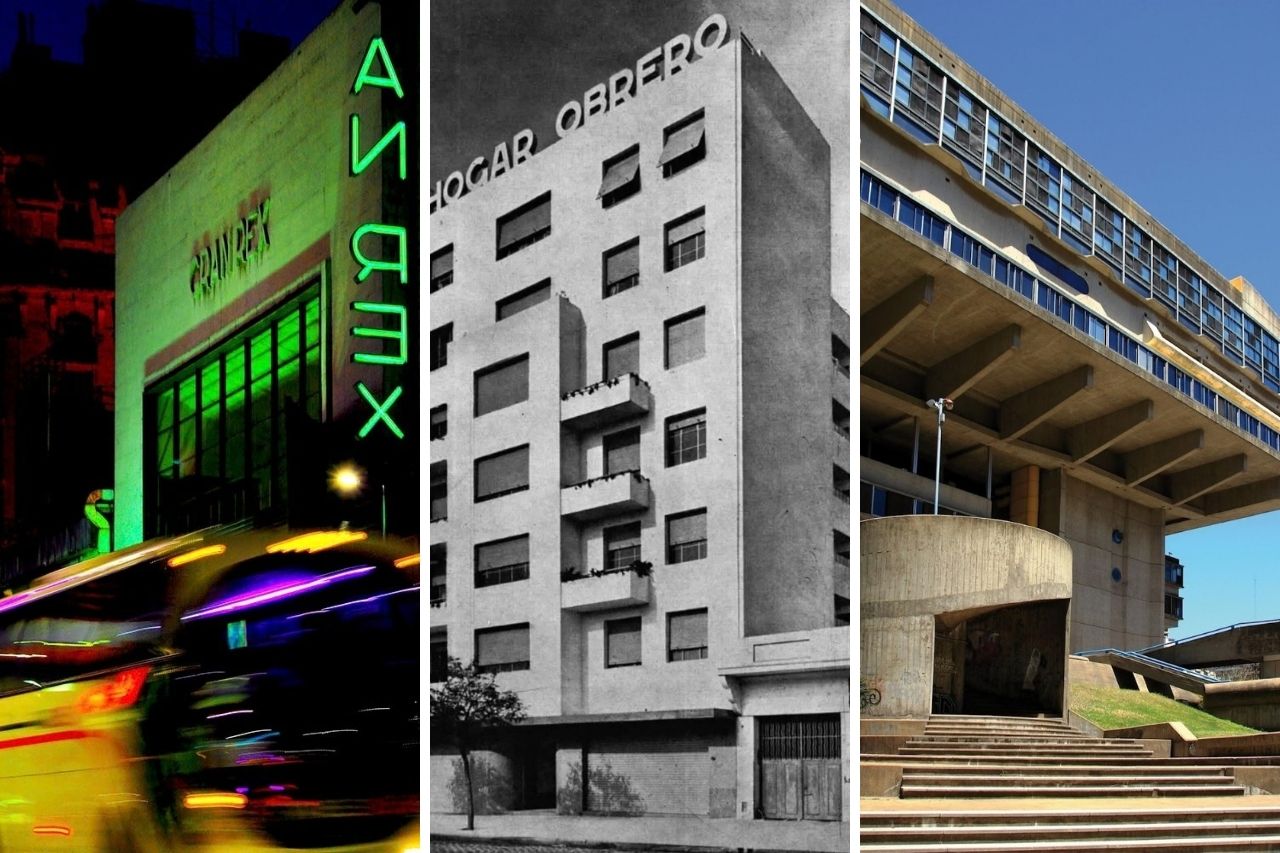
Cine Teatro Gran Rex – Av. Corrientes 857 Designed in 1936 by Alberto Prebisch, the Cine Gran Rex is a symbol of a new Buenos Aires making its way as the city grows.
Prebisch, a pioneer of modern architecture in Argentina, built the largest-capacity performance hall in Latin America in seven months, the first of its kind and the most refined ‘modern’ space of the period.
The austerity of its facade contrasts with the monumental triple-height hall, where subtle curves of the mezzanines are tensioned against the dominant lines of the staircases and the expressive force of the exposed structure. Transparencies are placed at the service of a space, while the public and the street are parts of the interior-exterior ‘show’ latent in the project’s design.
Fun fact: Prebisch also designed the Obelisk, just a couple blocks away from the Gran Rex.
Inside of Cine Teatro Gran Rex. Credit: Pablo Corral Biblioteca Nacional – Av. Gral. Las Heras 2555 Renowned Argentine architect Clorindo Testa won the public contest to design the Biblioteca Nacional (National Library) in 1962, together with architects Francisco Bullrich and Alicia Cazzaniga. Both buildings heavily feature concrete, displaying the specific material characteristics of brutalism. But they also show signs of Testa’s unique artistic sensitivity, the capability to infuse an air of lightness that stands in contrast with the heaviness associated with concrete.
According to architecture critic Miguel Jurado, Testa conceived architecture as an “artistic venture” and always had a metaphor on hand. During excavation of the building’s foundation, for instance, they found the remains of a glyptodon, a prehistoric species of giant armadillo.
“Testa would play off that idea and say that he had decided to reassemble the creature, as if the building were some kind of four-legged animal,” Jurado said in a story on Testa’s work published in the Herald.
Biblioteca Nacional. Credit: Daniela Mac Adden Edificio Los Eucaliptus – Virrey del Pino 2446 Designed by famed Argentine architects Jorge Ferrari Hardoy and Juan Kurchan in 1941, this 10-story housing building in Belgrano is tucked behind a grove of eucalyptus trees. The building bears the influence of Swiss master Le Corbusier, one of the central figures of modernist architecture for whom Ferrari Hardoy and Kurchan worked.
This building aims for a change in the way of living, both inside the building and in relation to its surroundings. The service areas and circulation core are oriented toward the rear, while the living areas and bedrooms face the front, with all units having their own balcony or terrace.
Edificio Los Eucaliptos. Credit: Albano García Edificio Comega – Avenida Corrientes 222 Designed in the modernist style for the Compañía Mercantil y Ganadera S.A., the building is made up of two side volumes and a central tower rising significantly higher, reaching 21 stories and 88 meters.
This allowed it to adapt to the changes demanded by modern high-rise living, linked to concepts of comfort, efficiency, standardization, and climate control.
Edificio Comega. Credit: Pablo Corral Hogar Obrero – Av. Álvarez Thomas 1326 The Hogar Obrero (Working Man’s Home) was a cooperative created in 1905 with the goal of providing housing for working-class families. Between its creation and its closure due to bankruptcy in 1989, the cooperative built around 5,000 homes and 30 apartment buildings.
One of its most iconic projects is the Hogar Obrero Villa Ortúzar, built in stages between 1932 and 1944. Following the modernist principles of clean surfaces, no decoration, and rational design, the building complex has five different blocs interconnected through internal gardens. The only “decorative” element is the sign reading the complex’s name at the top of the building.
In 2015, it was declared a “Bien de Interés Histórico Nacional” (An Asset with National Historical Interest).
Hogar Obrero. Credit: Rocío Torres Astigueta Bonus track Estudio para Artistas y Locales Comerciales – Suipacha 895 Located on a busy corner in the porteño neighborhood of Retiro, this delightful 1938 building designed by Antonio Bonet and Vera Barros y López Chas is bound to catch your eye. Conceived as a space to showcase modernist architecture, it has curved street-facing retail shops on the ground floor (one of them houses Acuario Bar, also well worth a visit) and double-height studios and mezzanines above, plus rooftop terraces. The design features concrete domed vaults and large windows for natural light.
Estudio para artistas y locales comerciales. Credit: Pablo Corral Cover image: Cine Teatro Gran Rex (Credit: Pablo Corral)/Hogar Obrero (Credit: Rocío Torres Astigueta)/Biblioteca Nacional (Credit: Pablo Corral). Building information obtained from Open House and Moderna Buenos Aires.