Milei at IDEA: a call for patience and a bet on 2027
 Estefania PozzoUpdated 3 hours Ago3 Mins read
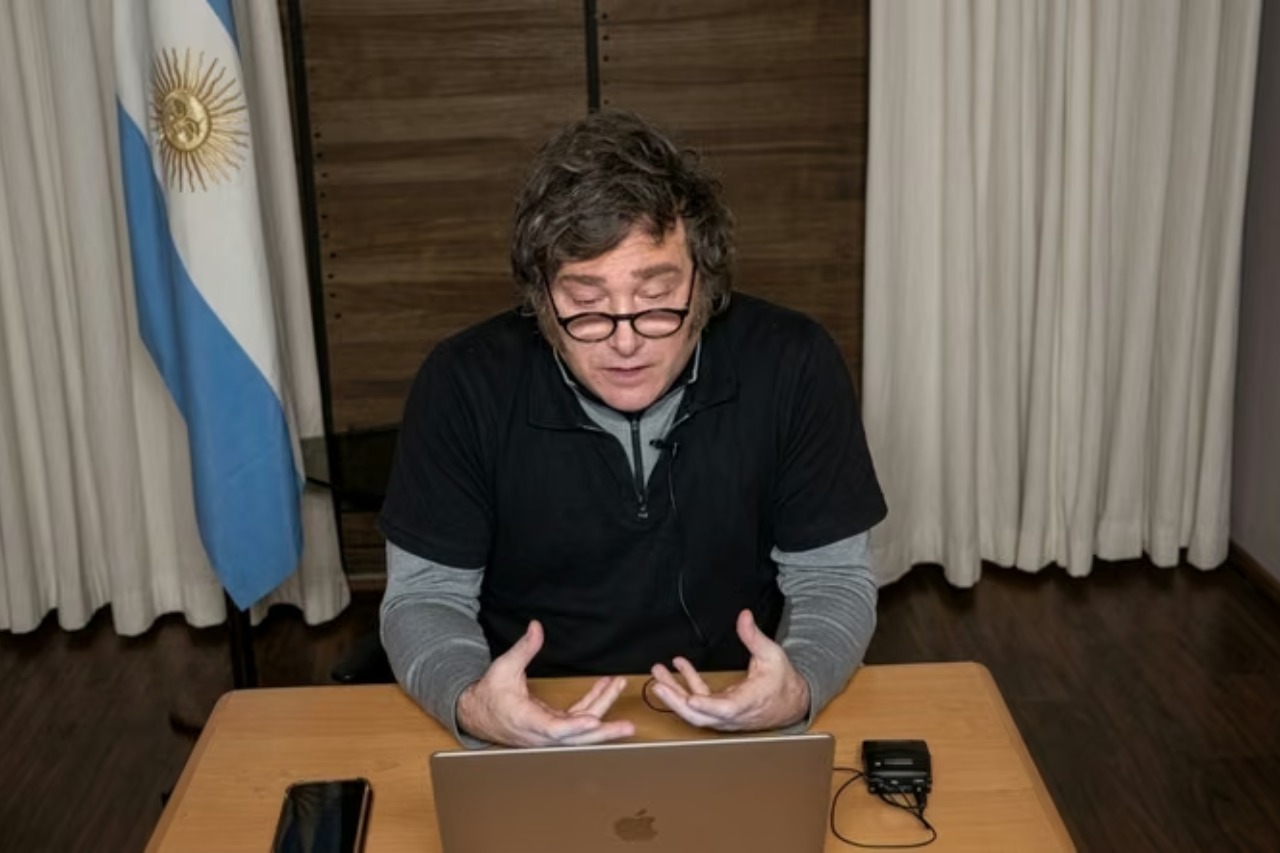

President Javier Milei asked Argentina’s business elite for the one thing that is becoming scarcer by the week: patience.
“The first thing you need is patience. Growth processes are not linear,” he said on Wednesday, at a moment when economic indicators are testing the confidence of even his most enthusiastic supporters.
Milei spoke in an interview via Zoom from Paris, where he is attending Argentina Week, with José del Río, content director at La Nación newspaper. The conversation closed the first day of the IDEA Colloquium in Mar del Plata.
Organized by the Institute for Business Development of Argentina (IDEA), the colloquium is one of the most closely watched events on the country’s business calendar. Every year, it brings together executives from Argentina’s largest companies, politicians and economists in the coastal city.
Top officials usually attend, and their remarks are read as a gauge of the government’s relationship with the private sector.
This year, the mood was shaped by the numbers. Economic activity fell 2.9% month-on-month in July, and J.P. Morgan now expects a contraction in the third quarter.
Unemployment reached 7.9% in the second quarter, and country risk climbed above 600 basis points last week.
The diagnosis Milei’s tone was noticeably softer than in other recent appearances. The message, however, was familiar: the program is working, and the obstacles lie elsewhere.
“Argentina could be growing at 7%, but in the middle there is the machine of obstruction, and there is also the external shock,” he said. The “machine of obstruction” was a veiled reference to Buenos Aires province Governor Axel Kicillof, a potential candidate in next year’s presidential election.
The president said his government was pulling “all the levers” of growth — from deregulation to human capital — but that every one of them faced people “literally willing to destroy everything.”
2027 election: prosperity or decline If 2026 is a year to endure, 2027 is the one Milei is betting on. He framed next year’s election as a choice between “the model of prosperity and the model of decline.”
“If Argentines choose this path, I will double the pace of reforms, and inflation will be pulverized,” he said. “If they want something else, they will pay the consequences of facing decline.”
In a revealing admission, Milei said it was “perfectly reasonable” for investors to hold off until after the vote. “The option of waiting has value,” he said. For a government that needs private investment to turn a rebound into sustained growth, that is no minor concession.
Reforms: growth first On taxes, the president said the goal is to lower export duties and eliminate the tax on bank debits and credits. But the order of factors is clear: “For that we need to grow. We need fiscal balance, because it is the central anchor of this program.”
Pension reform follows the same logic. According to Milei, the structural changes in the economy are being absorbed by the informal sector, where everyone is in “wait and see” mode.
If country risk falls, growth picks up and that labor gap closes, he said, there will be “more resources to carry out pension reform without anyone losing out.”
He also said the government had removed “almost all” of the cepo — the web of currency controls in place since 2019 — and that companies sent nearly US$4 billion in dividends abroad in the second quarter. Full removal, he suggested, will come after the election.
On privatizations, Milei acknowledged the limits of his power. “We aimed for 40 companies and they allowed me 11,” he said, referring to the list of privatizations of state-owned firms approved by Congress. “I have institutional limits, and fortunately they exist.”
In the hallways: ‘Has anyone seen it?’ After the interview, the questions among attendees were less about the election than about the present. “Where is the economic activity? Has anyone seen it?” one mocked.
Another pointed to a contrast with the 2023 campaign: the president now invokes institutional limits because the economy is not doing well, while back then, faced with the same questions, he promised to take on everything.
An economist at the event told the Herald the program is “very dogmatic, especially monetary policy.” Targeting the money supply, he explained, makes interest rates highly volatile.
The fastest way to revive the economy, in his view, would be to give more certainty on rates, with credit for households to boost consumption and for companies to invest.