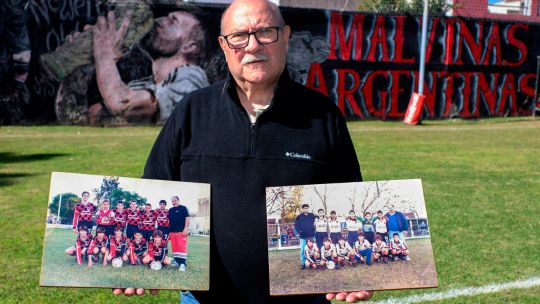
At the age of 12, Lionel Messi brought the career of his first coach Enrique Domínguez to an end. In 1999, the trainer decided to resign from the Malvinas Argentinas boys club in Rosario because “he had already trained the best player in the world.”
If you look up “Estado de Israel 525, Rosario, Argentina” on Google Maps, the answer rings out: “Birthplace of Leo Messi.”
In Argentina, there are tributes everywhere to the star, who at the age of 38 is out to set new records by participating in his sixth World Cups.
Messi’s birthplace is an unpaved street in a working-class neighbourhood located in the south of the Rosario, a port city on the banks of the Paraná River, the huge waterway second only to the Amazon in South America.
The Messi family were living there when on June 24, 1987, the third of four brothers was born. Today, he is Argentina’s standard-bearer, leading the nation as it defends its title at the 2026 World Cup, set to run between June 11 and July 19 in the United States, Canada and Mexico.
Messi’s early home, today an uninhabited dwelling, is a kind of pagan sanctuary. On the metal grill at the entrance hangs a Colombian flag highlighting the cross-national appeal of Argentina’s idol.”Leo, your greatness transcends boundaries, thanks for so much football and magic. Yours truly, a grateful Colombian,” it reads.
A few metres and a couple of houses away is where Leo’s childhood friend Walter Barrera was born. They have known each other from the cradle.
Barrera, 39, says it has always been clear that Messi’s destiny was football.
“Since he was a kid, we knew that he was going to play somewhere, he was an animal. You saw him playing as a kid and you said ‘paráaa‘ (“hold it”),” relates Walter.
‘Mischievous but healthy’
The friend of Leo’s childhood adventures recalls how they tried out different sports in the street: rugby, baseball, football-tennis. And also how, on occasions, they came to infuriate the local military garrison in their eagerness to get to school.
“We cut the barbed wire of Batallón 121 to cross through their grounds as a short cut to school, [and were] chased by some soldier on guard,” recalls Walter between chuckles. “We were pretty mischievous but in a healthy way.”
Andrea Sosa is today a retired teacher but in 1997 she taught mathematics to the fifth and sixth grades in General Las Heras school, a few blocks away from the home of the Messis.
She remembers that Lionel “liked to run out to the breaks to play with whatever ball – an assembled one with paper, socks, soft drink tops.”
“La Pulga,” the flea, as they called him as a child, because of his small physique, always stood out for his speed and skill.
Those who saw him play at the age of eight swear that he was the same as when the world later discovered him at Barcelona.
In the memory of Domínguez, his first coach, “what Leo is doing today in a First Division match or at a World Cup is the same as what he was doing at the age of 12.”
‘He knew it all’
After starting off at the Abanderado Grandoli club, Messi tried his luck at Malvinas Argentinas, the under-12 category linked to local giants Newell’s Old Boys, of whom he is a fan.
“We kicked off in 1999 with Leo … for me he was a gift from Heaven,” recalls the 72-year-old Domínguez.
“I was once asked: ‘What do recognise of what you taught him when you see Leo play?’ Nothing – because I could not teach him anything, he knew it all!”
When he stopped training him that same year, Domínguez says he communicated his resignation to the club co-ordinator: “When I said he was the best player in the world, I came up short; for me he is the best player in history.”
At the end of the last century, the Messi family’s finances were not in the best of shape.
Adrián Coria was Leo’s coach as the player moved up to Newell’s. He would later meet the star again in Barcelona and with the Argentine national squad, working as an assistant to Gerardo ‘Tata’ Martino.
Coria recalls that Jorge Messi, the player’s father, made a great effort to ensure that Leo was always at training.
They had “a Renault 12 [car], which was in pieces” and he sometimes said that he did not know if he would be coming back the next day “because he had no money for the petrol,” Coria recalls.
Jorge had lost his job and his health coverage with it, when a growth problem requiring costly treatment was detected in his son.
“At the time Leo lagged 40 centimetres and 15 kilos behind the rest of his mates. Do you know what that’s like for a player? Terrible,” remembers Coria.
But he already “knew what he wanted in life, he wanted to be a footballer, he wanted to be the best.”
With the promise that they would help him to resolve his growth problems and fund his treatment, Messi left Newell’s and moved to Spain, joining Catalan giants Barcelona in 2000 aged only 13.
The rest is history.
related news
by Luciano Couso, AFP