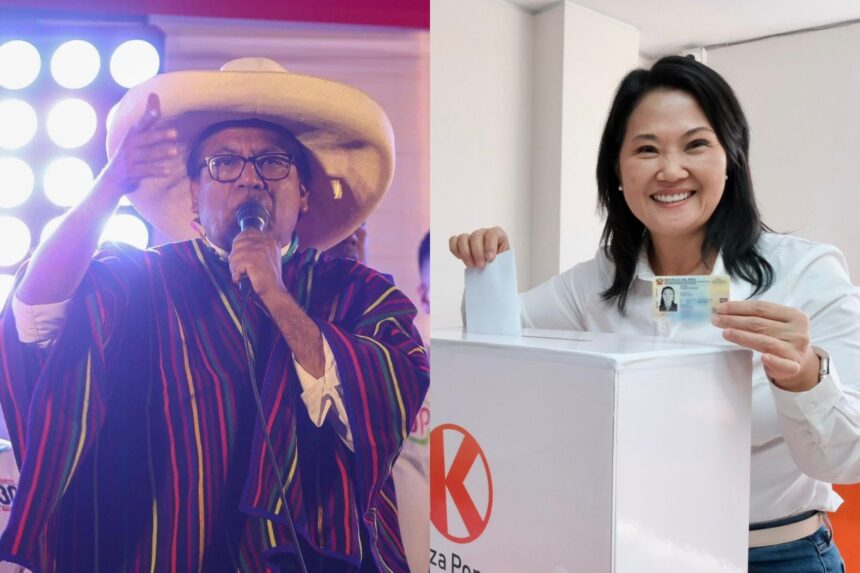
Peru’s presidential race is headed to a runoff between right-wing candidate Keiko Fujimori and left-wing contender Roberto Sánchez Palomino, setting up a polarized contest to determine the country’s next president.
The definition came on Wednesday, one month after the April 12 election, following a slow vote count, fraud accusations, and a dispute between three candidates for second place.
Fujimori gathered 17.17% of the vote, followed by Sánchez Palomino with 12%. This means that they will compete in the June 7 runoff, as none of the contenders reached the required 50% of the vote to win the general election.
Peru’s electoral authorities have yet to formally announce the result, as the slow vote count has not reached 100%. However, by Wednesday, with 99.9% of ballots tallied, the second-place candidate’s lead over the third-place finisher had become mathematically irreversible.
Fujimori had a clear advantage over the other candidates almost from the start, and it seemed at first that she would be neck-and-neck with far-right candidate Rafael López Aliaga.
Sánchez Palomino’s vote count added up until he went from fourth place to become the runner-up.
The difference between Sánchez Palomino and López Aliaga ended being just over 18,000 votes, a reflection of a highly fragmented election in which 35 candidates participated amid a political and institutional crisis.
Who are the candidates?
This is the fourth time Keiko Fujimori has participated in a presidential election. She also earned a spot in the runoff on the previous three occasions.
She is the daughter of late Peruvian President Alberto Fujimori, who between 2007 and 2016 was imprisoned for serious crimes against humanity committed by the state during his rule. He was also convicted on embezzlement and corruption charges.
As a conservative, traditional right candidate, Keiko Fujimori’s proposals include increasing security to lower the homicide rate and allowing the armed forces to take part in operations to control immigration and jails, and to carry out police searches.
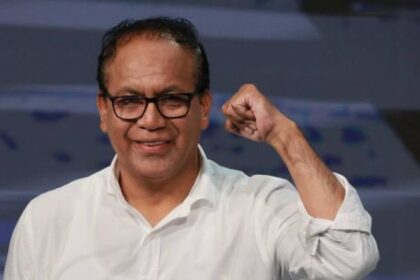
Sánchez Palomino, the unexpected runner-up, was minister of foreign trade and tourism during the administration of ex President Pedro Castillo, who remained in power for only 17 months (2021-2022).
Pedro Castillo was removed from office in 2022 after attempting to dissolve Congress, a move that later led to an 11-year prison sentence. Despite this, Roberto Sánchez embraced his ties to Castillo’s left-wing administration during the campaign, even adopting the broad-brimmed hat associated with Castillo and commonly worn in Peru’s rural Andean regions.
Sánchez Palomino, currently a congressman, aims to carry on Castillo’s legacy with a government based on sovereignty and social justice. He has said that, if he wins, his priority will be fighting poverty and bringing “modernity” to all regions of Peru.
A controversial election
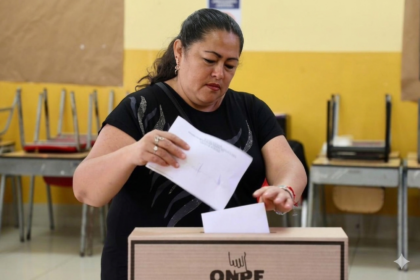
The vote count ended up taking over a month, something unusual for Peru and other countries in the region.
Thousands of tally sheets were challenged and had to be reviewed by electoral authorities before the final result could be determined. The disputed tallies included counting errors, missing required signatures and illegible handwriting.
López Aliaga has alleged electoral fraud affected his campaign and called on electoral authorities to conduct an audit of the vote.
The vote count was “terribly delayed” due to geography and reception of votes in foreign countries, among other issues, although it was not the first time something like this happened, political scientist Eduardo Dargent told the Herald.
Dargent stated that these issues could have been solved if they used an electronic voting system, something Peru does not currently have “since there is so much fear of electoral fraud.”
Piero Corvetto quit as head of the National Office of Voting Processes (ONPE) on April 22 due to “problems encountered in the distribution of electoral materials” in Metropolitan Lima, which, he said in his resignation letter, prevented him from remaining in his position.
He also stated that, given the current context and with the presidential election vote count nearing completion, he considered it necessary to step aside to facilitate the organization of the second round in a scenario that restores public confidence.