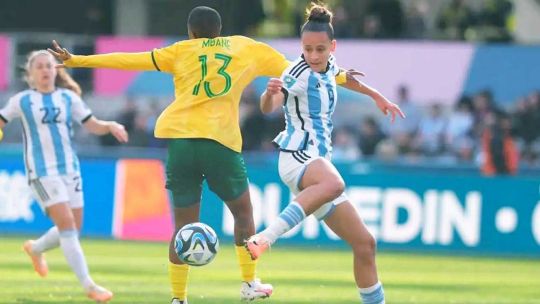
There can be little doubt that football is hugely popular in Argentina. If more proof were needed, here it is: a newly published survey shows that almost three in ten Argentines play football at least once a month, with 14 percent playing weekly. What has been less clear – until now –is that women’s football is also becoming increasingly popular across the country. The survey provides clear evidence of that trend.
The findings come from a recent nationwide opinion study conducted by Voices! Consultancy firm in partnership with the NGO Winn Argentina. While men still play more frequently, the survey found that around 25 percent of women say they have played football at some point in the past year.
This is, of course, a global phenomenon. One only has to look at recent figures, such as the match a few weeks ago between Barcelona’s women’s team and Real Madrid’s female side at Camp Nou, which drew a record crowd of 60,067 spectators.
Closer to home, a 2023 friendly match between the Argentine and Venezuelan women’s national sides at the Estadio Mario Alberto Kempes in Córdoba attracted 31,800 fans.
Despite this, media outlets and sports-related businesses – such as organisers, sponsors, broadcasters and platforms – do not yet appear to fully reflect the growing popularity of the women’s game. According to the Voices! study, 65 percent of respondents agreed with the phrase that “women’s football currently receives less visibility than it deserves in the media and on social networks.”
Another key finding: three in ten Argentines follow news or content about women’s football at least once a monthy. According to the report’s authors, this suggests established consumption habits rather than merely stated interest.
Engagement is particularly strong among those who play football regularly: in this group, 57 percent follow women’s football.
“Across the world, women’s sport – and football in particular –is enjoying growing public support. It is a multi-million-dollar industry in Europe and the United States. The difference is that in Latin America, we are still observing it from the outside,” says Gabriela Oliván, the founder of the WINN Argentina NGO.
“Just look at what has happened with Barcelona Women, who have several players valued in the millions and attract crowds large enough to fill stadiums,” Oliván told Perfil in an interview.
According to Oliván, despite a sizeable Argentine audience interested in women’s sport, club executives and decision-makers still tend to view women’s football as primarily “social” – and often with a somewhat patronising attitude.
“Directors and federations often say: ‘It’s good for girls to play so they can stay off the streets and develop healthy habits.’ They frame it largely as a social initiative and fail to recognise its commercial potential. As a result, women’s football is not properly professionalised because it is not seen as economically viable or attractive,” she argues.
In Oliván’s view, the women’s game is treated as something that is given minimal resources out of obligation, rather than as a serious sporting and commercial endeavour.
“They don’t invest in top coaches or provide the time and resources needed for a professional team. Nor do they attempt to market the league effectively. Instead, it is treated as a social necessity and given only superficial attention,” said the director of the NGO, a non-profit network of women journalists and communicators.
Oliván insists there is both space and a significant target audience for the sport. “Even companies and brands fail to realise that a large proportion of those interested belong to higher socio-economic groups, which are typically the most sought-after consumers in advertising,” she explains.
The campaigner also highlights another key point: acceptance of women’s football is higher across Argentina’s inland provinces than in Greater Buenos Aires and major cities.
The survey shows that both engagement and positive perceptions are stronger outside the capital. For example, 57 percent of respondents from the provinces say that when a brand supports women’s football, their perception of that brand improves, compared with 48 percent in Buenos Aires.
The report ultimately leaves a clear question hanging: it is no longer a matter of whether women’s football has a future – that is already settled. The real question is who will be ready when that future becomes mainstream.
A long female sporting history
The first women’s football club was founded in London in 1894. The earliest recorded women’s football match in Argentina took place in 1923 at Boca Juniors’ old ground, featuring teams named “Argentinas” and “Cosmopolitas.” It drew a crowd of around 6,000 spectators.
In 1971, Argentina’s women’s national team competed for the first time at a World Cup – the second edition, albeit one that was unofficially organised. Seventeen players travelled to Mexico without boots, a doctor, a physio, or a coach, to compete.
In 1986, the Argentine Women’s Football Association (AAFF) was established, organising several tournaments and even competing internationally. In 1991, the Argentine Football Association (AFA) absorbed the AAFF and staged the first official women’s league, featuring eight clubs.
According to a report from the International Football Congress, women’s football was the fastest-growing sport worldwide during the 2010s. The AAFF estimates that around one million women in Argentina now play the game.