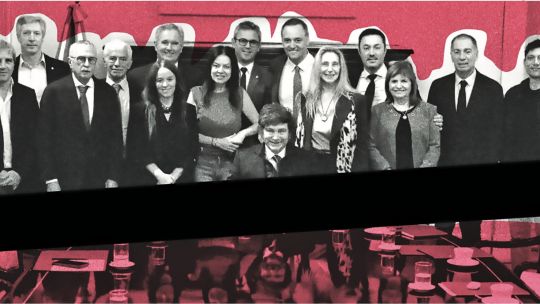
The case of Cabinet Chief Manuel Adorni’s assets and expenses still awaiting explanation is generally seen as an exposure of corruption in a government preaching austerity and so it should. But it also contains a perhaps deeper question: how long can we continue to take this government’s self-identification as libertarian seriously? The defence of the beleaguered official has underlined as never before the military discipline permeating President Javier Milei’s purple party from the way the entire Cabinet was dragooned into cheerleading at a Congress session where the budget of the entire nation and not one man should have been the issue.
Nothing especially new about this modus operandi but it should be highlighted alongside all the minute details about water features and Caribbean trips. Earlier this year Presidential Chief-of-Staff Karina Milei enjoined La Libertad Avanza deputies ahead of February’s extraordinary sessions: “You vote for government bills first and then you read them,” while during last spring’s midterm campaign (when candidates from allied parties were obliged to don purple overalls, looking like Teletubbies) she defined: “Loyalty is not an option, it is a condition.” The latter statement would not be so alarming (who wants traitors in party ranks?) were it not for a dangerous confusion between loyalty and blind obedience with the intolerance of dissent confirmed by this administration’s high turnover of officials.
The Milei administration would probably be making much greater progress towards the transformation of an obsolete economy were it not for a string of unforced errors undermining credibility and these are the direct result of an intense subordination leading to a fear of questioning the leadership (“The boss’s word is not to be discussed,” dixit Karina Milei, who has herself been called “The Boss” by her brother). “I’m not here to guide lambs but to arouse lions,” preached Milei in his 2023 presidential campaign but who could ever see anything leonine in the abject submission of his flock? Not only are government members forced to toe the line when they detect aspects which could be corrected but they are obliged to share the presidential hatred of the press, thus isolating them from an important channel of contact with public opinion and trapping them further within an echo chamber – President Milei and his government urgently need to listen. One would think that a free press and open debate would be axiomatic for a libertarian movement but since this is a subjective comment coming from a media voice, we will not press this point.
This political dogmatism has uncomfortably much in common with the preceding Kirchnerism, something making it easy to hop from one to the other (thus Pilar Ramírez, the libertarian spearhead in this City, was the secretary for years of ultra-Kirchnerite Senator Mariano Recalde when running state carrierAerolíneas Argentinas) – this inheritance could also contribute to the infighting rife in this government. Opportunists have far less qualms about falling in line than orthodox economists with intellectual honesty and this threatens to contaminate the economic purism which is the core of the Javier Milei Presidency.
Yet Peronist infiltration (which may run deeper than generally suspected) is not the only problem for economic policy, which is endangered by the dictatorial and the genuinely libertarian in this government alike. Despite its authoritarian overtones, the Milei administration differs from such entrenched dictatorships as, say, Communist China, in being chaotic and disruptive with these novel traits leading to a certain improvisation in policy at the expense of method. But when the government does lay down the line with a script written in advance, this stifles creative energies and dynamism.
The incapacity to be genuinely libertarian also leads to government policy contradicting its own premises. In his 2023 presidential campaign Milei vowed to dynamite the Central Bank – today that Central Bank maintaining ‘cepo’ currency and capital controls for companies and blocking the repatriation of pre-2025 dividends is undermining the renewed appeal to overseas investors made by Milei in Los Angeles on Wednesday. If overseas investment last year was lower than in the last year of an Alberto Fernández administration perceived as anti-market, this was not only due to political uncertainties and the slow progress of structural reforms but also to abuse of the currency anchor against inflation – the high interest rates to defend it are now coming home to roost in the form of crippled credit, bank arrears and slumping consumer markets.
But the overriding concern must be the threat to the democratic fabric from a government anything but libertarian.